
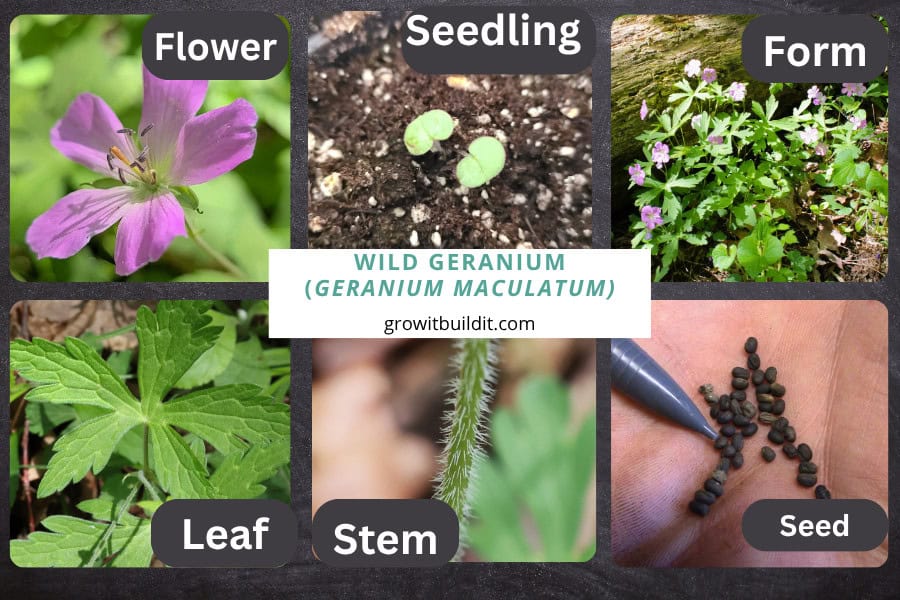
Wild Geranium is a herbaceous wildflower native to Eastern North America. Scientifically known as Geranium maculatum, it can grow 2′ tall in part sun and well-draining soil[1]. Blooming large pink to purple flowers for up to four weeks in Spring, it attracts numerous pollinators and even hosts some caterpillars[2][3].
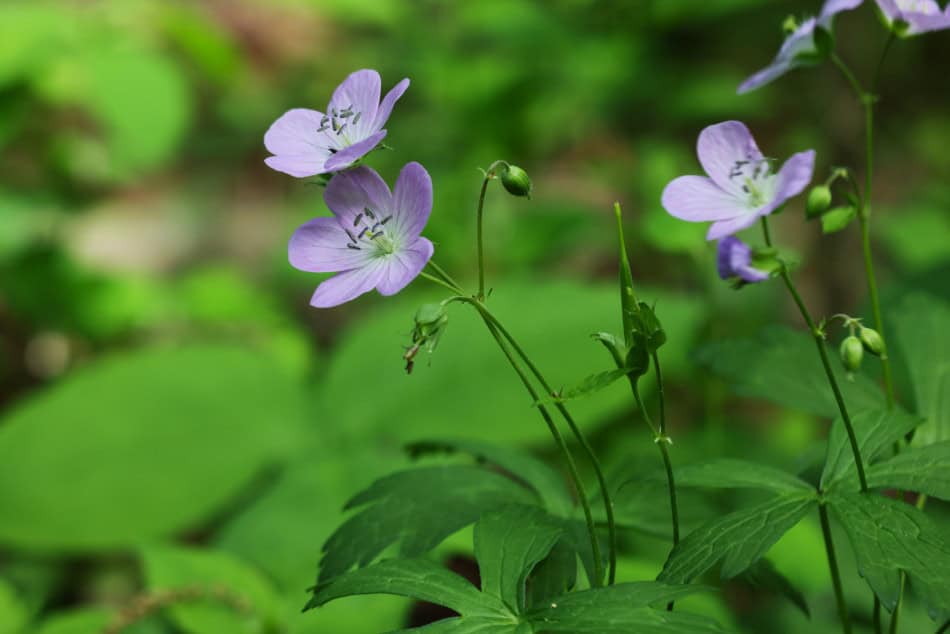
When it comes to woodland wildflowers, Wild Geranium can really stand out. The large (>1″ diameter) five-petaled flowers contrast nicely with the lush greens of Spring. When encountered in the wild you often find multiple plants, which increases the overall showiness. Further adding to the beauty is that the overall plant can grow 2′ tall, making it tower over many other Spring ephemerals. This height also makes it one of the easier-to-establish woodland wildflowers, as it is harder to crowd out by other, later growing herbaceous plants.
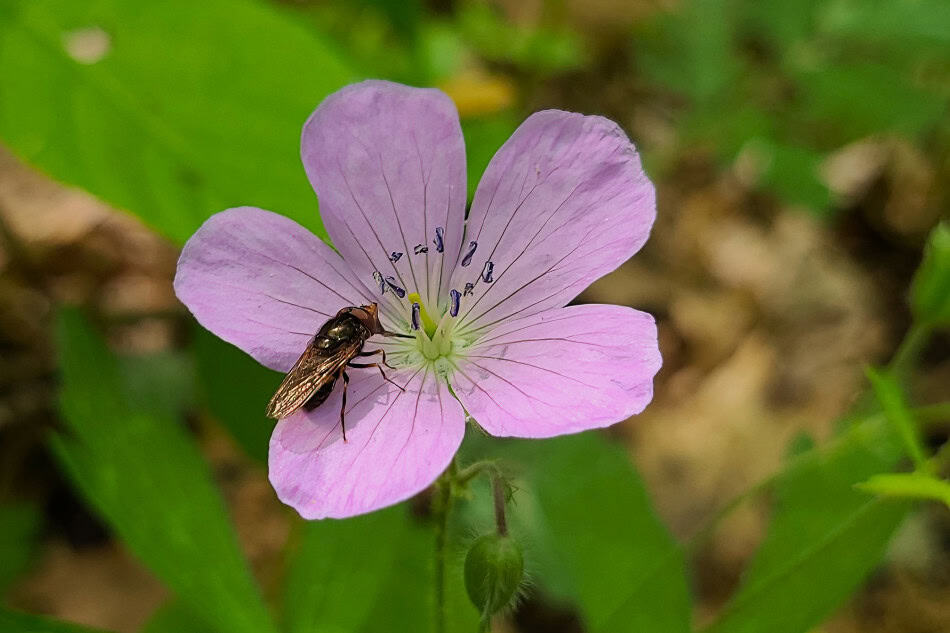
But it’s more than just a pretty face – the flowers of Wild Geranium have been shown to attract over forty species of pollinator. But it doesn’t stop there – it also hosts several species of caterpillar. This proves it’s value within our ecosystem. Let’s face it, many of the woodland wildflowers feed pollinators, but the number of visiting species is often not as high. So, this combined with it being a host plant mean it should be a component in any shade or woodland garden.
Native Range
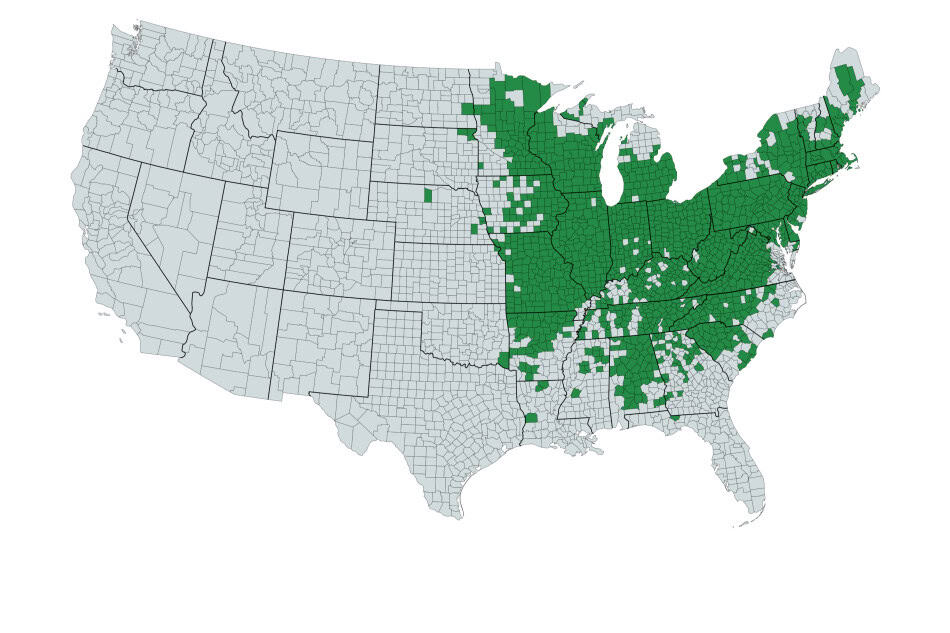
The primary native range for Wild Geranium is from Southwest Arkansas, East to South Carolina. And then North to Manitoba, Canada and Maine.
Click on the images to enlarge the range: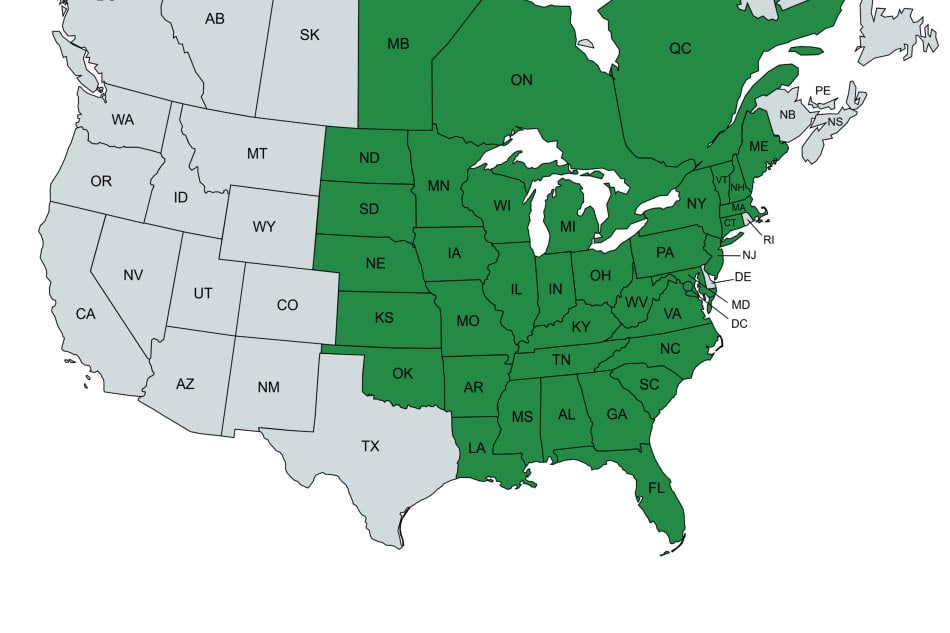
Reference Table
| Scientific Name | Geranium maculatum |
| Common Name(s) | Wild Geranium |
| Native Range, USDA Zone | Eastern North America, USDA hardiness zones 3-8 |
| Bloom Time | April-May |
| Bloom Duration, Color | Four weeks, pink to purple |
| Height | 1-2′ |
| Spacing / Spread | 1-2′ |
| Light Requirements | Full sun to part sun |
| Soil Types | Sandy loam to clay loam, prefers ample organic matter |
| Moisture | Slightly dry to slightly moist, must drain well |
| Fauna Associations / Larval Hosts | Bees, skippers, pollinating flies. Hosts several moths |
Benefits
Beauty
This is one of the more noticeable and beautiful forest flowers. The flowers themselves are often 1″ diameter, making them stand out when combined with their height of up to 2′. You often see small colonies of this plant, as the seeds are flung nearby.
Drought tolerance
This flower grows really well on slopes, and can tolerate drought. They normally go dormant by mid-summer, meaning the won’t be effected by the late, dry droughts that can commonly occur.
Wildlife
There is a large number of bees that are attracted to the flowers, as well as smaller butterflies (skippers). Several moth caterpillars are also hosted on the leaves. Although not a preferred food, deer and rabbits also will feed on the leaves.
Identification and Characteristics
The overall structure of this plant is that of a group of basal leaves and flowering stalks that grow direct from the rootstock. This combination can give it a small bush-like appearance, but the plant is in fact herbaceous. The basal leaves will appear in early Spring, and the flowering stems will appear approximately two weeks after the basal leaves[1].
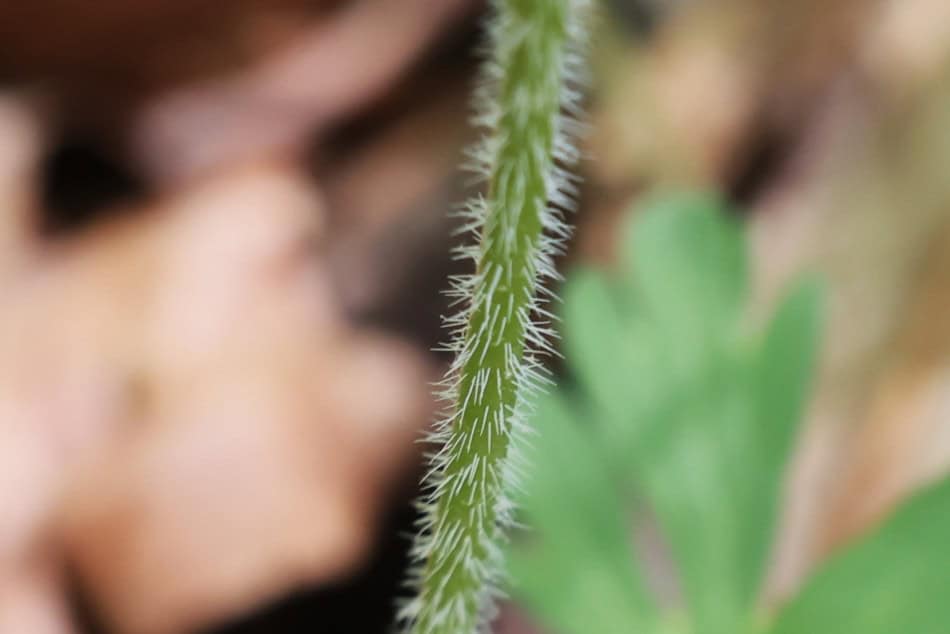
Stalk
Growing upwards of 24″, the flowering stems are round, light green, and has white hairs on it.
Leaf
The distinct leaves of Wild Geranium are one of the best ways to ID the plant. Each flowering stem will have a pair of basal leaves on long petioles. Leaves are up to 5″ long and wide, palmately cleft with deep lobes and veins[1]. The lobes are obovate or linear, but typically wide at the outer edge and taper towards the origin, giving a keystone or wedge shape. Margins are coarsely serrated and may have additional lobes.
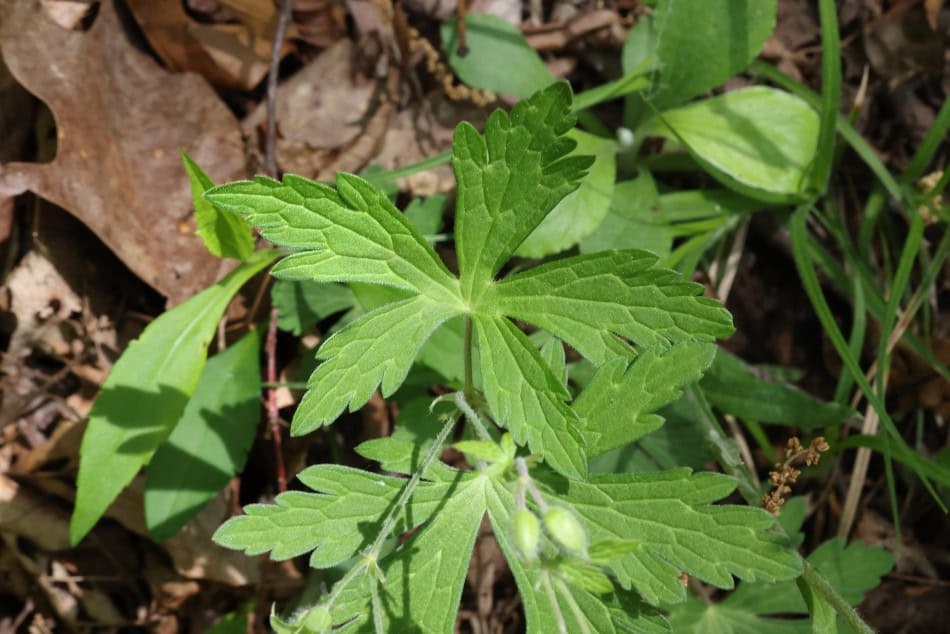
On the flowering stems there are other leaves, but are a bit smaller and 3-lobed rather than 5. They are oppositely arranged. All leaves are medium green with hairs that lie down on the leaf.
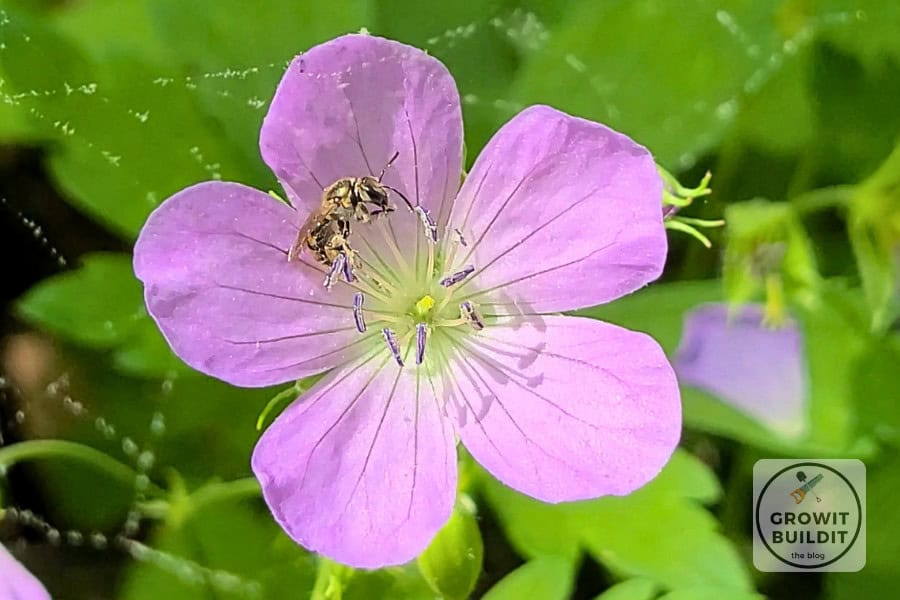
Flower
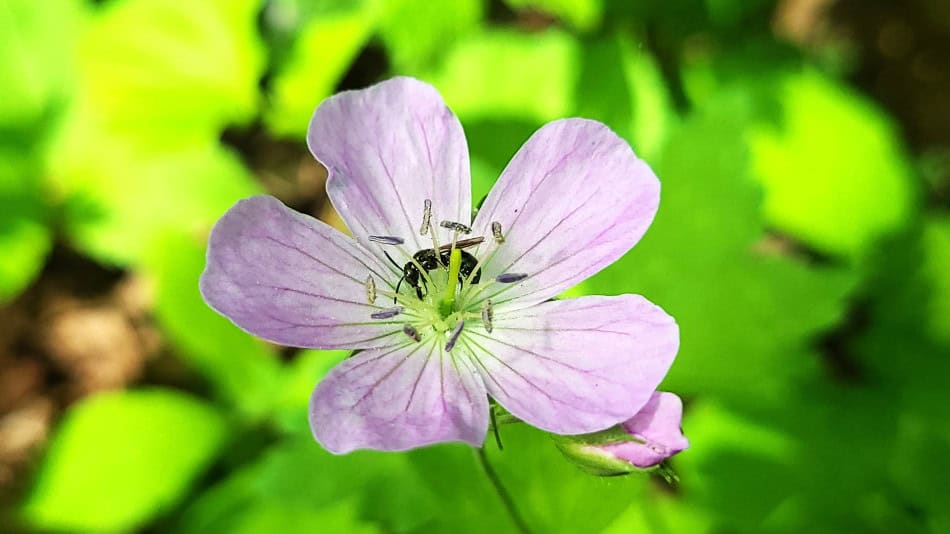
At the end of each flowering stem is a corymb of 1-5 flowers. Each flower is usually around 1″ diameter with five rounded petals that are a pale pink or pale purple color. They have noticeable veins running out from the center to the rounded ends of the petals.
Root
Wild Geranium root system is fibrous but will also produce rhizomes. These rhizome sections are not long-lived, and will die in 1-2 years[1]. It has been observed that the rhizomes vary from 1/4″ to 9/16″ diameter, and can grow anywhere from near the surface (in Oak forests) to up to 3″ deep in prairie or cedar glade ecosystems.
Growing Conditions
Wild Geranium most often grows in part sun to part shade, or dappled sunlight that filters through trees. It is possible to grow in full sun if the soil is moist. For soils, it most often grows soils rich in organic matter or loam, just like where you normally find it in the forest.
How to save seed
Several weeks (approximately 3 weeks) after flowering a pod or fruit will form where the flower once was[1]. As this fruit dries, tension will build within it as it shrinks. Eventually, when the fibers break the seed will be flung several feet away. This is a similar mechanism for seed dispersal as Partridge Pea or Jewelweed.
This seed should be stored in a sealed container in the fridge. Do not let it dry out.
How to Grow Wild Geranium from Seed
Wild Geranium is one of the trickier plants to grow from seed. References and suppliers state that it needs at least 60 days cold stratification to break dormancy. Historic study of Wild Geranium found that dormancy is due to the embryo, but also a hard seed coat[1]. The dormancy can be broken by cold stratifying in the fridge, or by winter sowing. I have tried growing this plant from seed twice, and had various degrees of success by winter sowing.
Based on my past experience with other Spring Ephemerals I strongly suspect that the shelf life of the seed is quite short, and that it should be sown the same year it is harvested. Hopefully this year I can manage to do some experimentation on seed that I collect from the wild, as I think I could manage a high germination rate with a modified protocol. But that will be for a future update, as for now, I will just relay how I successfully germinated some plants over the last couple of years.
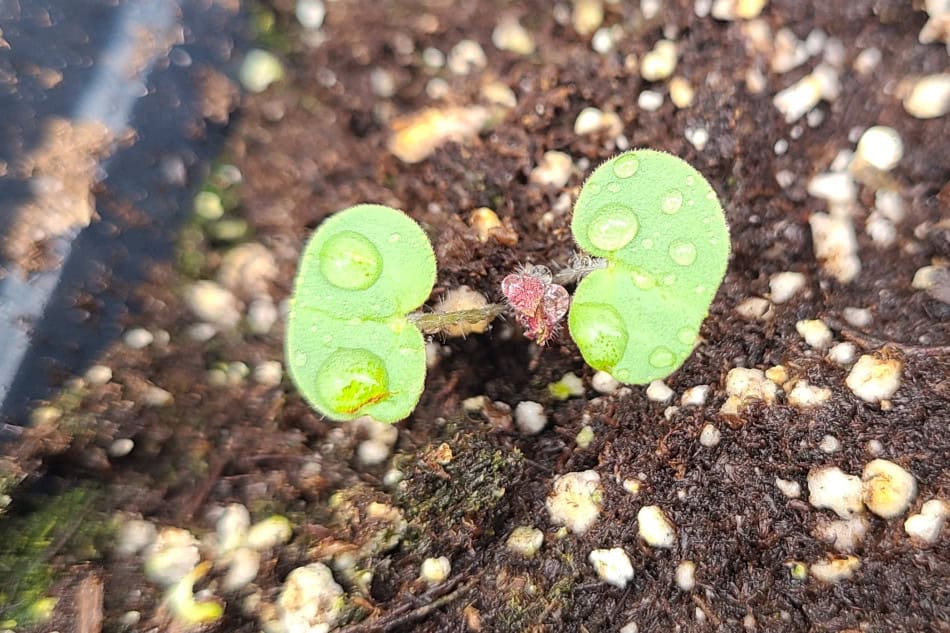
I purchased seed from reputable suppliers (always in December) and winter sowed the seed (by the 1st week of January). I planted it fairly shallow (1/8″ or 3 mm) in pots one year, and then in jugs the next. I was able to get several to germinate.
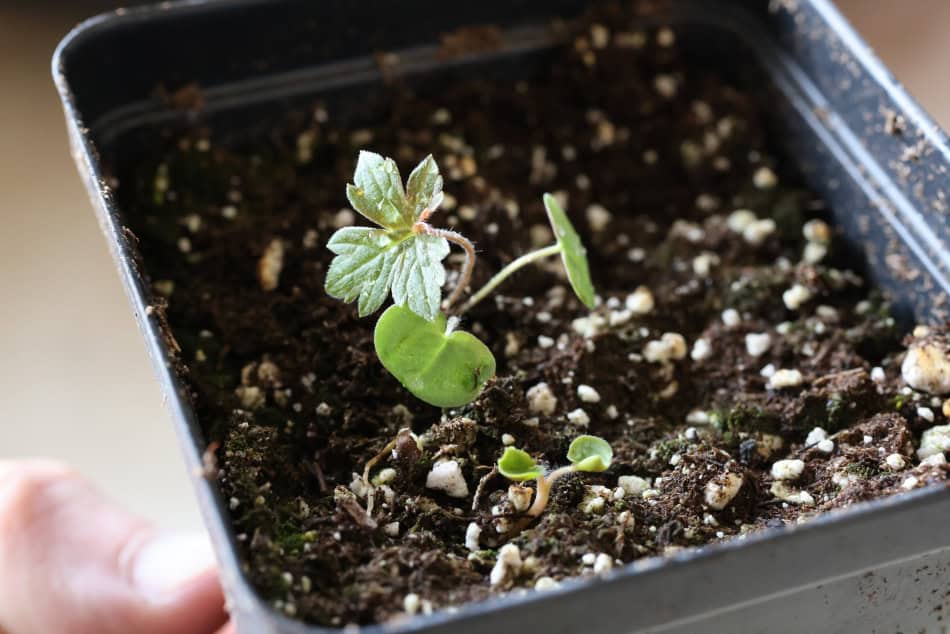
Wildlife, Pests, and Diseases associated with Wild Geranium
Pollinators
An important plant for pollinators, over 44 species of bee, fly, and butterfly have been recorded visiting the plant for pollen or nectar[robinson]. This include a variety of Native Bees; Bombus; Honey Bees; Beetles, Wasps, Flies; Moths and butterflies. It also serves as a host plant for several moth species, specifically Carmenta giliae, Helicoverpa zea, Heliothis virescens, Lacinipolia lorea, Orgyia leucostigma, Parectopa geraniella[2][3].
Deer and Rabbits
Although this plant is listed as deer resistant, resistant doesn’t mean immune. So, deer and rabbits will browse the foliage periodically. As with any plants, protect seedlings with Liquid Fence until they are established.
Disease
Where you can buy Wild Geranium
Wild Geranium is not typically sold in nurseries. But it can sometimes be purchased at specialty nurseries that deal in Native Plants. You can find native plant nurseries near you on our interactive map.
Where to buy seeds
We have ordered a variety of native flower seeds from Everwilde Farms, which you can order right from Amazon through our link on our RECOMMENDED PRODUCTS PAGE. (We may earn a small commission when you purchase through our links, at no cost to you. This helps support our website.)

Uses of Wild Geranium
Landscaping
If you have a woodland border, or have a wooded property, this plant should definitely be in your garden. It looks great, and is fairly easy to establish. It can be used to line walking paths, or as a component in any shaded garden provided that the soil drains. I’m trying to establish it in the woods behind my house, as a way to hopefully fight the evil Japanese Stiltgrass.
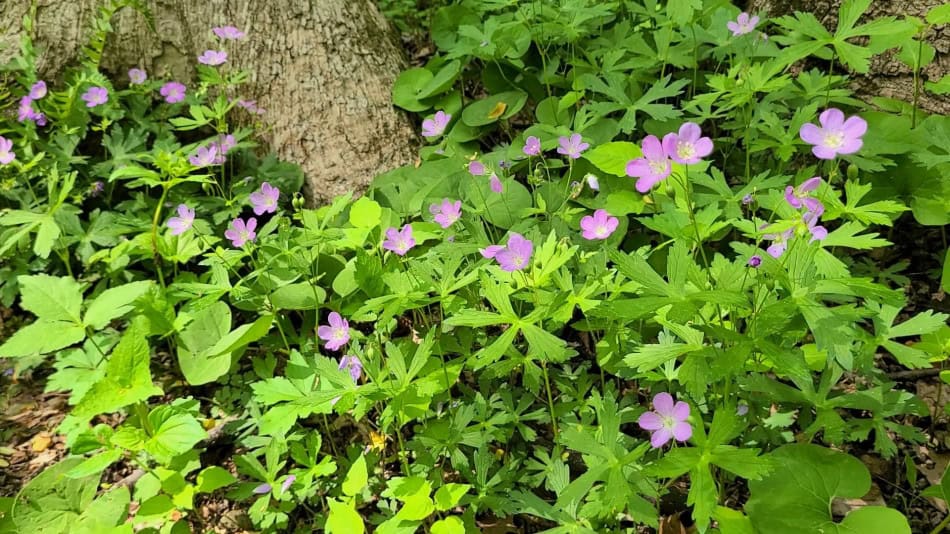
If you had moist, but well draining soil, then you could grow this plant in a more open, full sun area.
Companion Plants
There are a huge number of natives that would pair nicely as a component of a more shaded or woodland garden. Most of these (save the asters) are going to be blooming at some point in Spring.
- Bee Balm (Red or White Bee Balm)
- Black Raspberry (although this could overtake it if not monitored)
- Blue Lobelia
- Columbine
- Dutchman’s Breeches
- Rue Anemone
- Spring Beauty
- Virginia Bluebells
- Violets (Viola sp.)
- White Wood Aster
- Wild Ginger
- Wild Strawberry
There are also a number of grasses that can grow near it, mainly sedges (yes, I know they aren’t technically grasses). But try Pennsylvania Sedge for a nice compliment to Wild Geranium.
Medicinal Uses
While not used in modern medicine, Wild Geranium was used by the Native Americans. 32 different uses by 7 Tribes have been documented. Some of these uses include making a decotion of roots for washing sores, boils, itching. The root would be dried and pulverized for sores in the mouth. An infusion was taking for diarrhea or venereal disease[4]. Additionally it is a potent astringent, and will shrink tissue like gums or wounds.
Final Thoughts
Wild Geranium is one of the more showy woodland wildflowers one could grow. In my observations, it seems to start blooming towards the tail end of Virginia Bluebells blooming period, and can allow you to have that much more color in the forest for longer. While difficult to grow from seed, it is not impossible. The key is to over sow and then transfer seedlings to larger pots and allow them to grow a nice root mass. Then, plant them towards the fall to establish, which will allow them a nice chance to compete in the Spring. But this plant feeds a surprisingly large number of bees, and serves as a host plant for several caterpillars. This attests to it’s value in the North American ecosystem, and as such should be planted where the growing conditions will allow it.
Find more native plants here
References:
[1] – Martin, M. Celine. “An ecological life history of Geranium maculatum.” American midland naturalist (1965): 111-149.
[2] – Federal Highway Division, Ecoregional Revegetation Application (ERA)
[3] – Robertson, Charles. Flowers and insects: lists of visitors of four hundred and fifty-three flowers. s. éd., 1929.
[4] – Geranium maculatum. North American Ethnobotany Database. Accessed 22MAY2026.
[5] – Geranium Maculatum, USDA NRCS.
Recent Posts
October 6th, 2026 Do you ever feel overwhelmed by the amount of chores that come with gardening? Ever miss a planting window because you forgot? Are you a total beginner at gardening and don't...
Wrinkle-leaf Goldenrod is a herbaceous perennial flower native to Eastern North America[1]. Scientifically known as Solidago rugosa, it can grow up to 5' tall by 3' wide in full sun and moist to...