
Look, anyone who spends time outdoors in the fall should be aware of Ticks. Given enough time, you are sure to pick one up while weeding, planting, or just tending to a garden. So, after many years of landscaping and gardening, I thought it might be good to share what I’ve learned to be the most effective means of managing ticks – keeping them off me, and reducing the chances of ever having one latch on. I’m going to be focusing on ticks in North America, but the information will be very relevant for ticks in any part of the world, as there is much crossover.
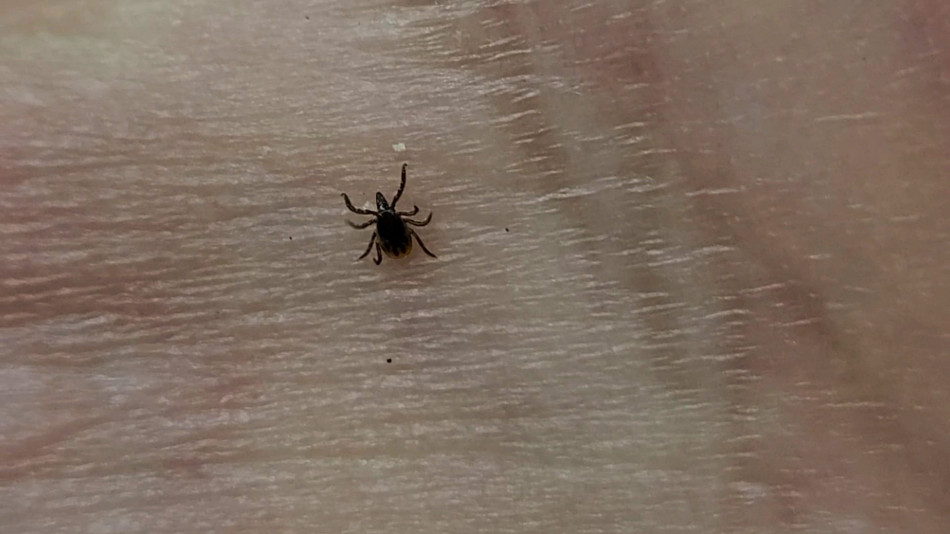
When I was a kid, ticks weren’t really a concern. Nobody really worried about them, and I never had one on me (to my knowledge). My first encounter with ticks wasn’t until I was 12 and we went up to Northern Wisconsin to visit some relatives. On that trip was the first (but not the last) time I had start crawling up my legs. Walking through a sand prairie, everyone in my family probably picked up a dozen ticks. Now, we all picked them right off, but it was eye-opening to me just how prolific these little parasites could be.
But this is a long article, so I’m making a digital table of contents. But by the end of this you will truly understand tick behavior, what keeps them alive, what kills them, and how to manage them and your own personal risk.
- What are ticks
- Diseases ticks carry
- How ticks get on people and pets
- Common disease carrying ticks in North America
- Tick habitat
- Where ticks live in your yard/garden
- Methods to manage ticks
What are ticks?
Ticks are probably the most feared pest in the garden (or should be). And although it might be easy to think of them as insects, they are actually arachnids. Arachnida is the class that includes spiders, scorpions, mites, and well, ticks.
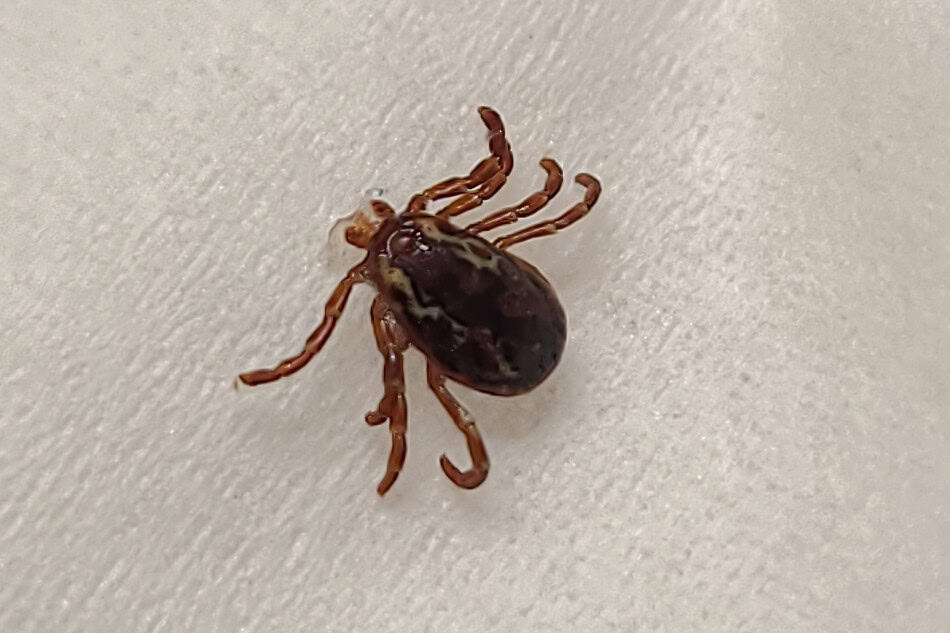
Ticks are parasitic, and feed on the blood of humans, mammals, birds, and even amphibians or reptiles depending on the species. If you google image search ticks on snake, you will be greeted with a nightmare vision of snakes covered in ticks (don’t say I didn’t warn you). The images are almost horrible enough to generate sympathy for the snake from people who hate snakes. But, as we are mammals, we can be bitten by them too.
Why you should be concerned with ticks
When ticks are attached to you feeding, they can transmit diseases directly to your blood. This most often happens when they ‘detach’ at the end of their feeding. But serious disease can be acquired via ticks. I will list some of the more serious ones below:
- Lyme disease
- Lyme disease is a bacterial infection that causes many painful symptoms, and can be fatal. The earliest symptom is usually a rash that is in the shape of a bullseye that expands over time, but not always. This will often progress to fever, severe aches and pains in the form of arthritis, and an irregular heartbeat. I personally know people with this disease (I live in Pennsylvania), and you do not want it.
- Rocky Mountain Spotted Fever
- This is also a bacterial disease. Signs and symptoms may include fever, headache, rash, nausea, stomach or muscle pain. The rash usually starts within a few days, but the form and other symptoms can vary wildly. It can progress to a potentially fatal disease. In other severe cases it can result in permanent damage such as amputation of appendages (from blood vessel damage), hearing loss, or mental disability.
- Alpha-gal Syndrome
- This is a molecule that can be transmitted via the bite of the lone star tick. This molecule is naturally in most mammals, but not humans. When it becomes present, you may develop an allergy. When detected, the immune system can identify alpha-gal as a threat and will attack it. And if you develop the allergy, you may have an allergic reaction to eating red meat!
How do ticks get on you?
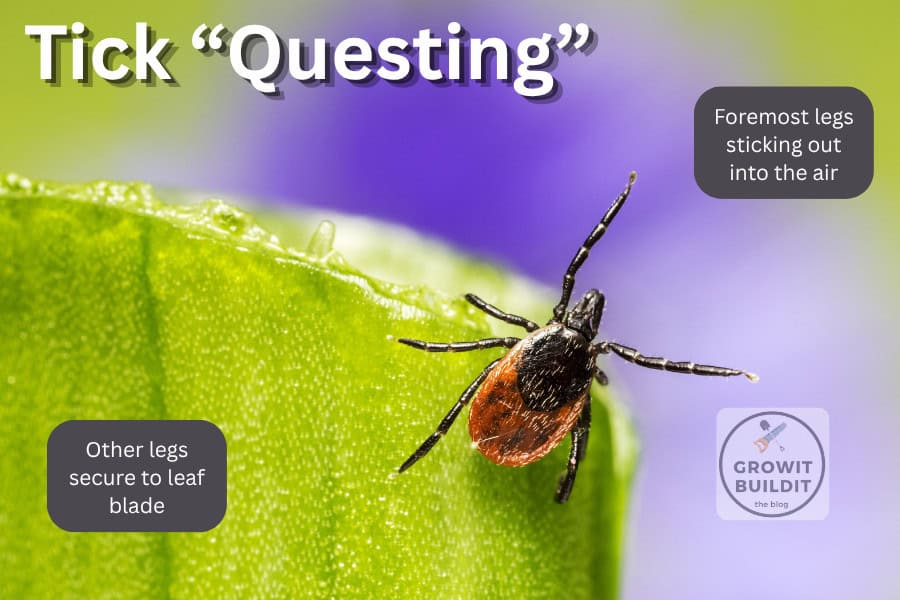
Ticks will grab on to pretty much any passing organism that they can as it passes by them. Their feet are sticky, like a spider. And if your shoe comes in contact with one, they may latch on directly. Ticks spend a lot of time in leaf litter, so just walking through the forest can result in picking up a tick. But they also will crawl up out of the leaf litter or vegetation and hang off leaves or blades of grass and grab on to your shoe or leg as you brush passed, a process known as ‘questing’. From there, the tick will crawl up your leg, searching for a suitable place to feed. So, checking your ears, head, and really everywhere is necessary.
Tick myths
This is probably a good time to dispel some tall tales about ticks. Just about everyone you meet knows something about them, and are willing to pass on that information. However, sometimes this information gets corrupted.
- Ticks do not climb trees.
- Ticks are ground dwelling insects, and were they to climb up high above a couple feet (when not on a host) they would certainly be at risk of dying of dehydration.
- Ticks don’t jump
- Ticks walk stealthily with sticky feet. That is how they get a hold of their hosts. They do not and cannot jump.
- Ticks don’t fall from trees.
- See the previous point. Ticks can drop off of something they are grabbing a hold of, but they are not falling from trees, as they don’t climb them.
Most common ticks that bite humans
Ok, so there are around 20 species of tick that inhabit North America. But the ones you need to be concerned with are shown below. These are the ticks that frequently bite/latch on to humans and can transmit disease. Click on the images and maps to enlarge.
| Common Name | Scientific Name | Diseases/Pathogens Transmitted to Humans | Image | Range (North America) | Typical range |
|---|---|---|---|---|---|
| Blacklegged Tick (Deer Tick) | Ixodes scapularis | Lyme disease (Borrelia burgdorferi), Anaplasmosis, Babesiosis, Borrelia miyamotoi disease, Powassan virus, Ehrlichiosis (rare, E. muris eauclairensis) | 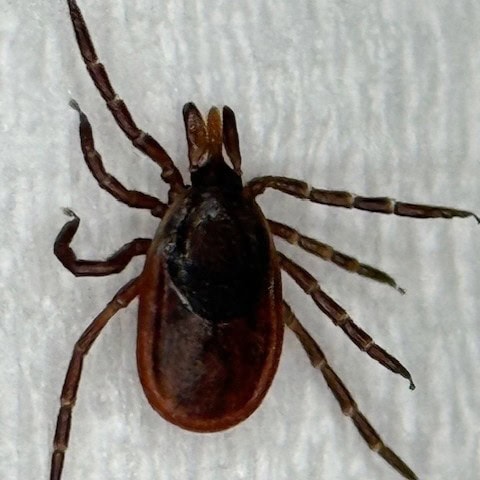 | Eastern and upper Midwestern US; expanding northward | 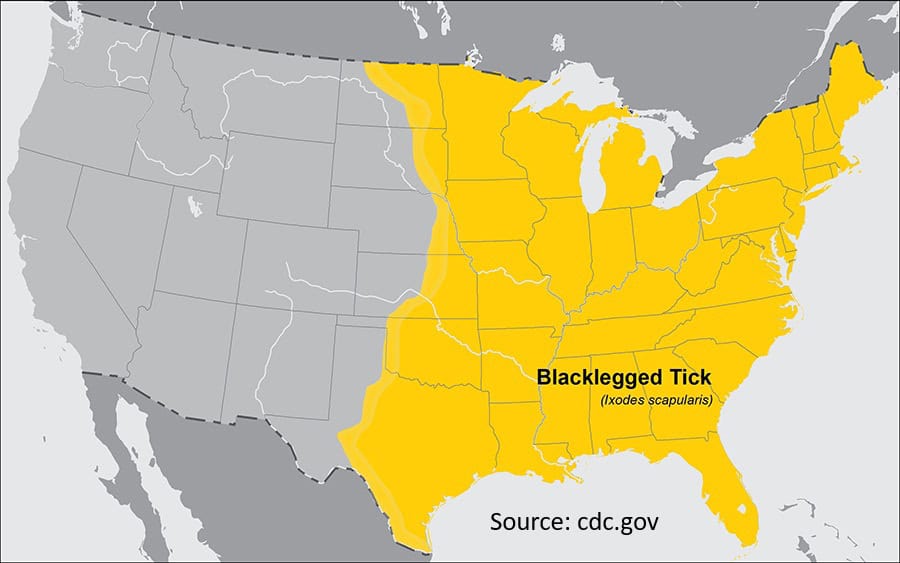 |
| Western Blacklegged Tick | Ixodes pacificus | Lyme disease, Anaplasmosis, Babesiosis, Borrelia miyamotoi disease | 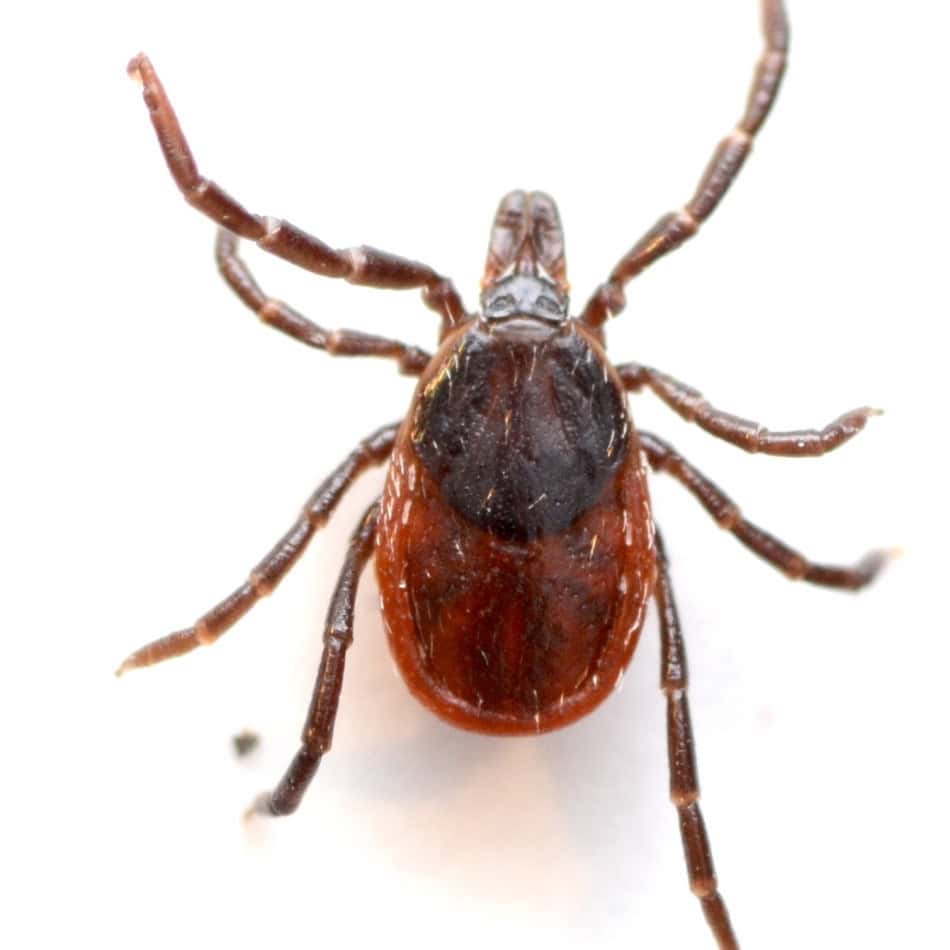 | Pacific Coast states (esp. CA, OR, WA); parts of NV, UT, AZ | 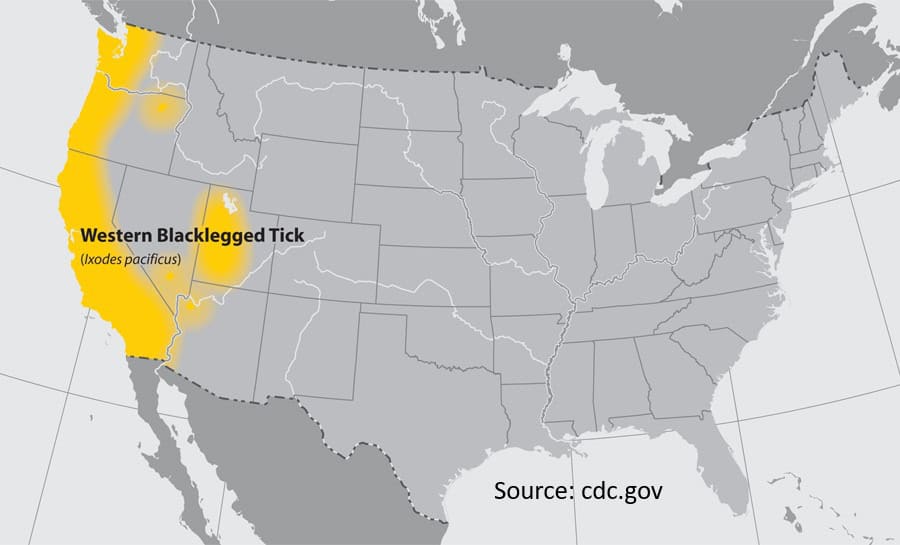 |
| Lone Star Tick | Amblyomma americanum | Ehrlichiosis (E. chaffeensis, E. ewingii), STARI (Southern Tick-Associated Rash Illness), Alpha-gal syndrome (red meat allergy), Tularemia, Heartland virus, Bourbon virus | 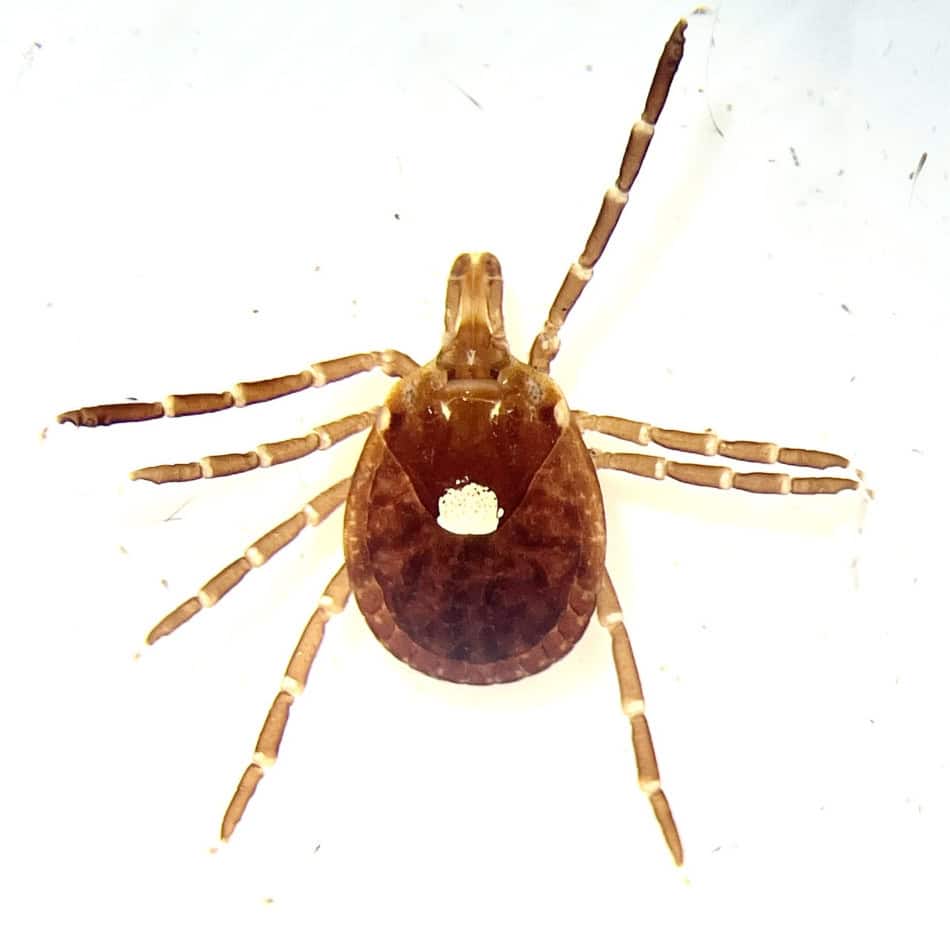 | Southeastern, South-central, and Midwestern/Eastern US; expanding north | 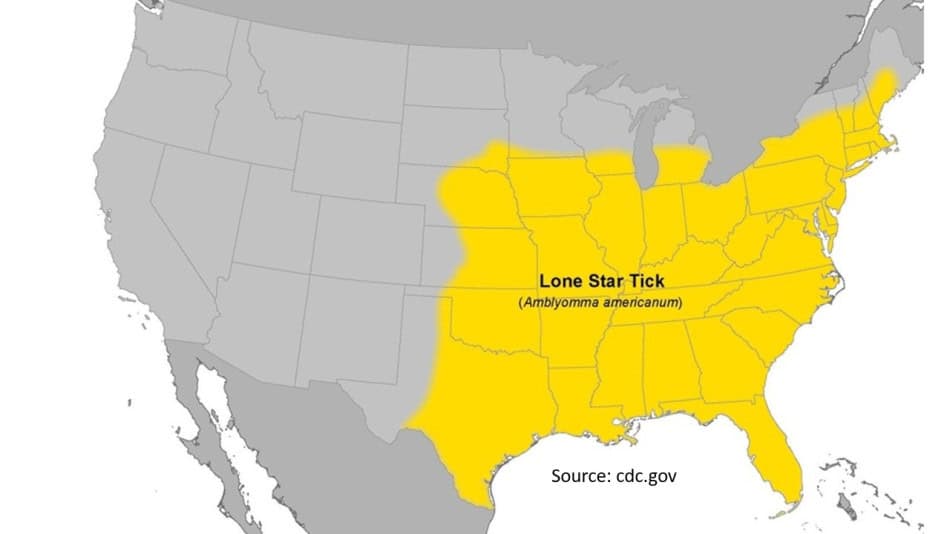 |
| American Dog Tick (Wood Tick) | Dermacentor variabilis | Rocky Mountain Spotted Fever (RMSF), Tularemia | 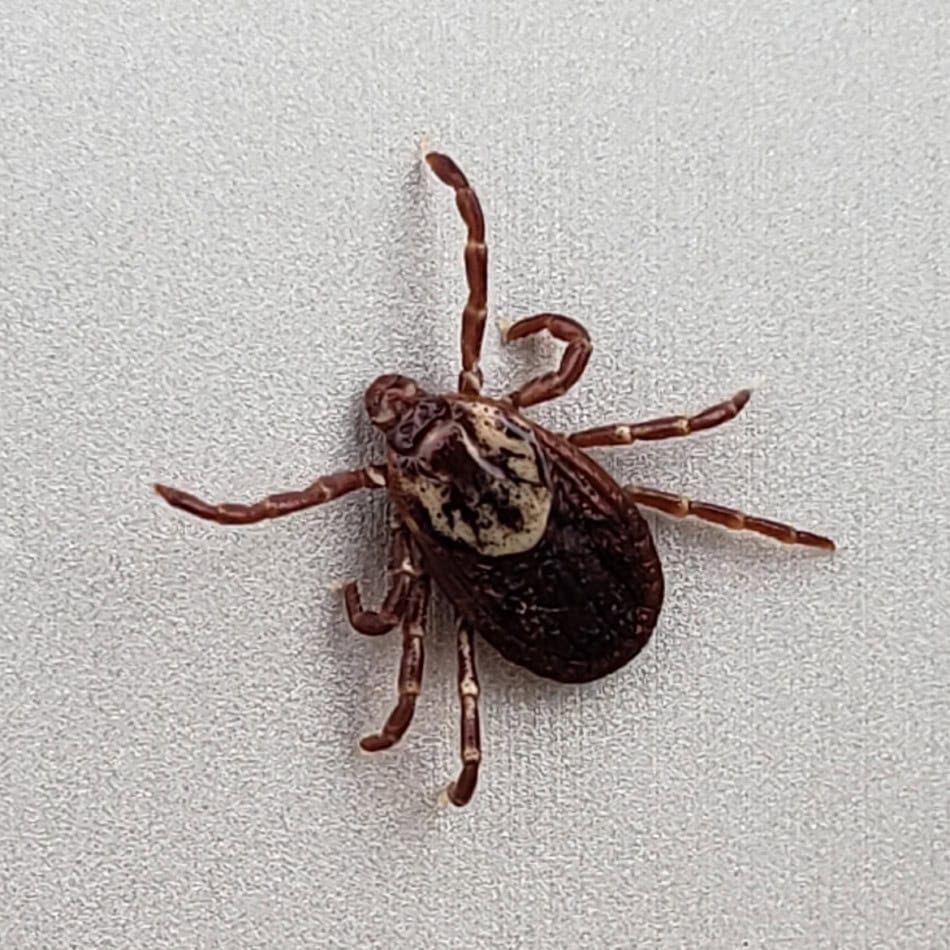 | East of Rocky Mountains; limited areas on Pacific Coast | 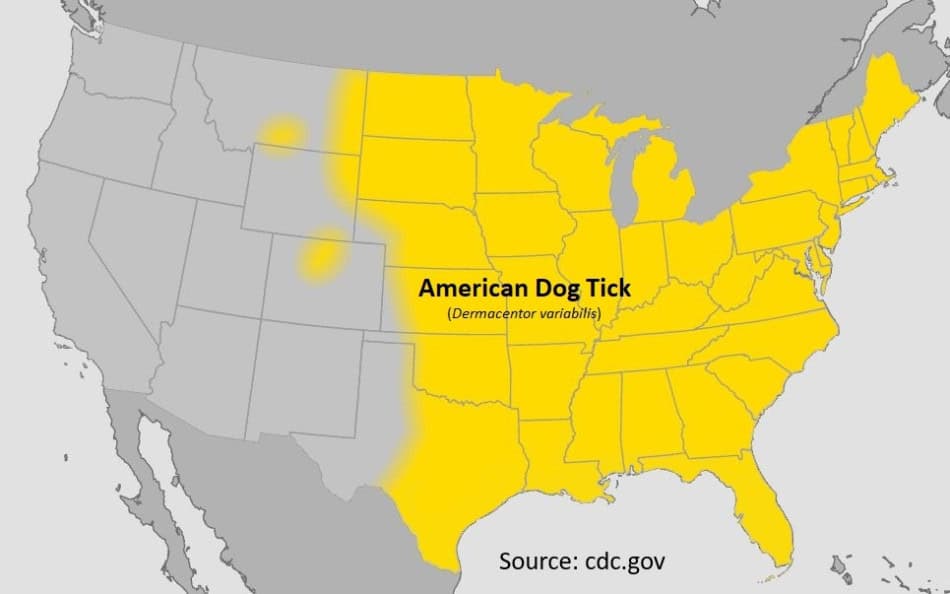 |
| Rocky Mountain Wood Tick | Dermacentor andersoni | RMSF, Colorado Tick Fever, Tularemia, Tick paralysis (toxin) | 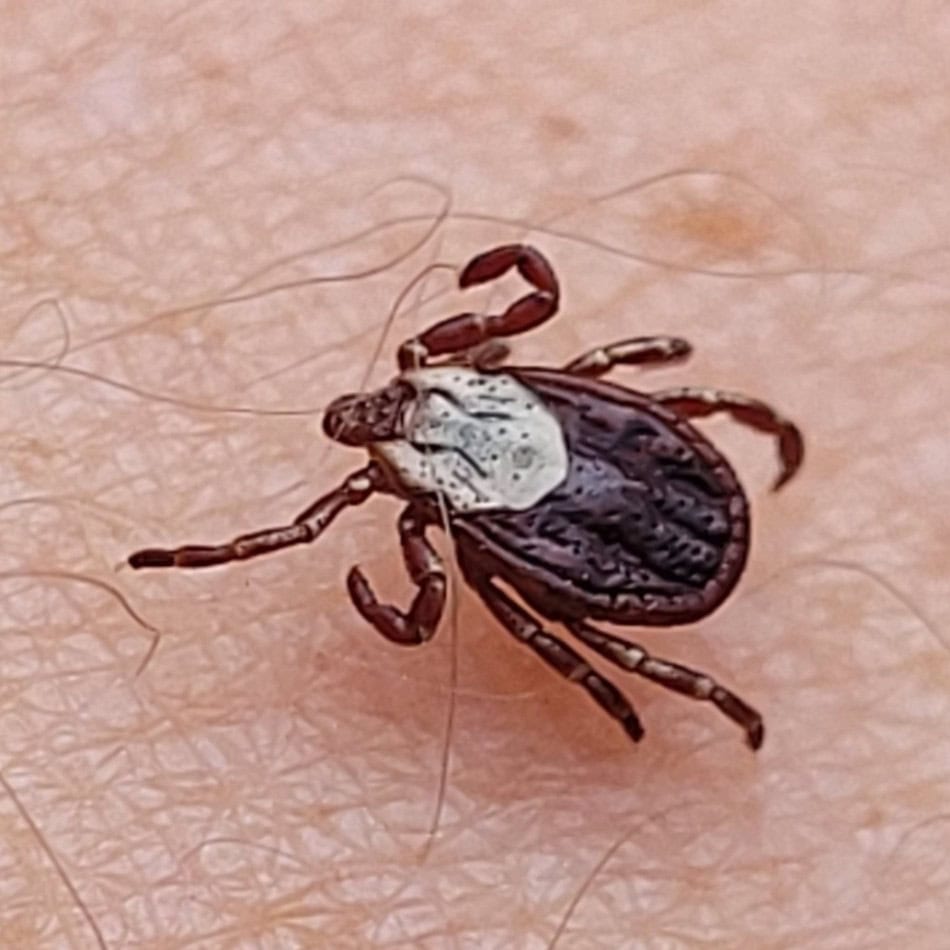 | Rocky Mountain region (western US and Canada) | 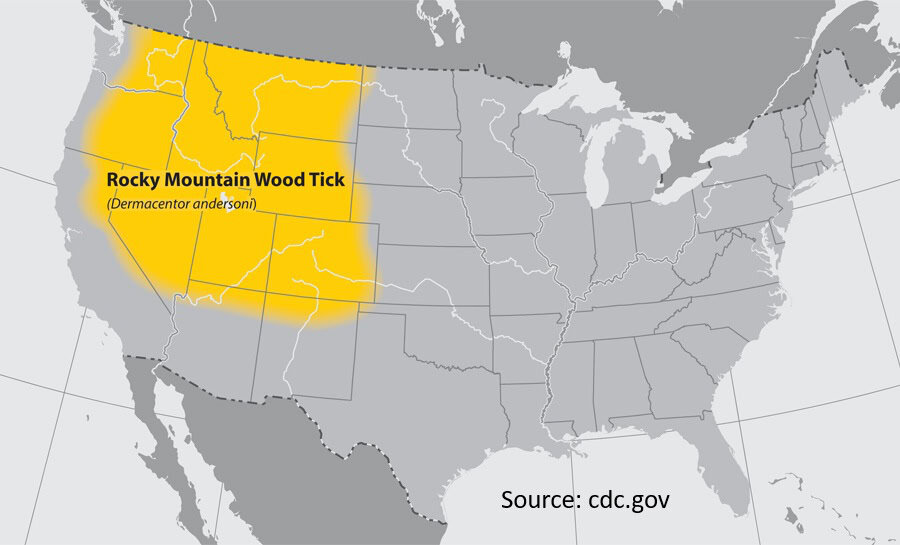 |
| Gulf Coast Tick | Amblyomma maculatum | Rickettsia parkeri rickettsiosis (spotted fever), Tularemia (less common) | 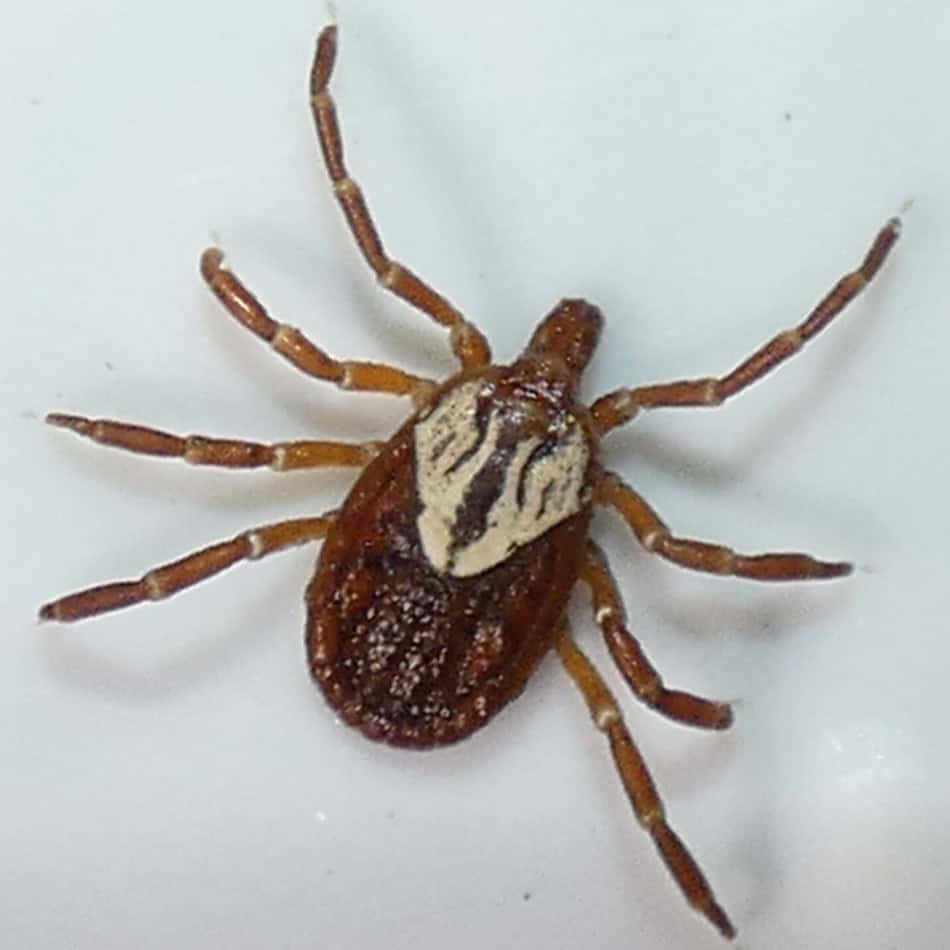 | Gulf Coast and southern Atlantic states; expanding inland/northward | 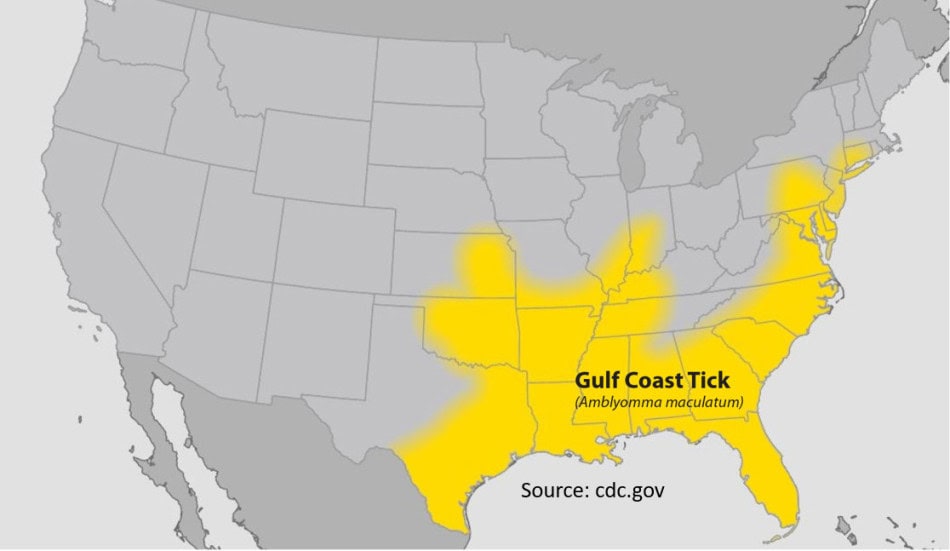 |
| Brown Dog Tick | Rhipicephalus sanguineus | Rocky Mountain Spotted Fever | 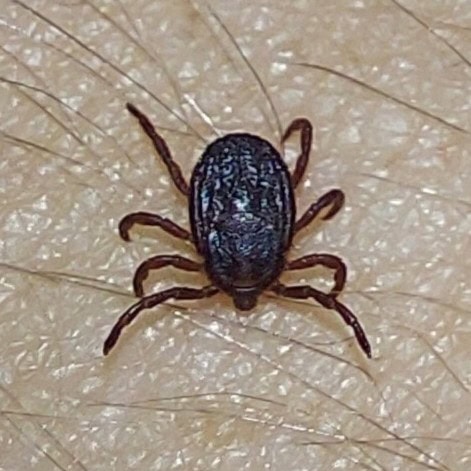 | Worldwide | 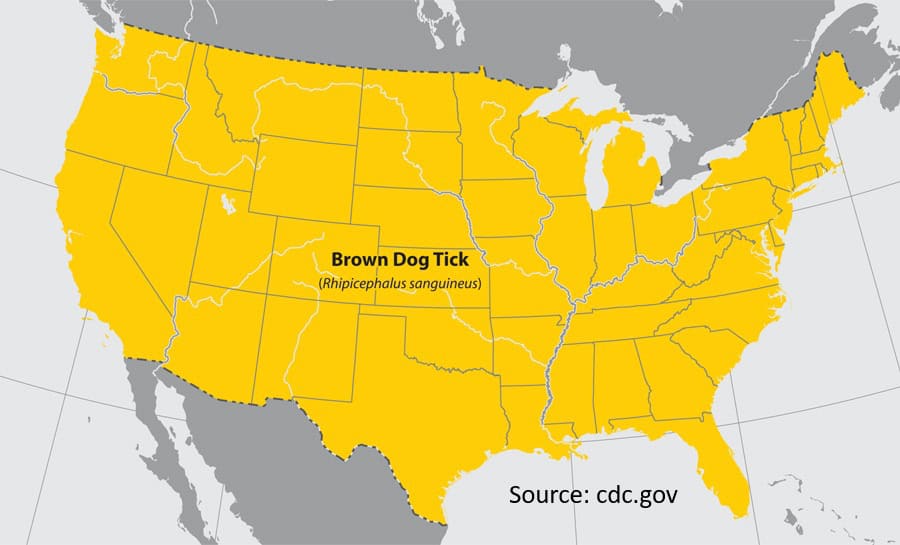 |
Tick lifecycle
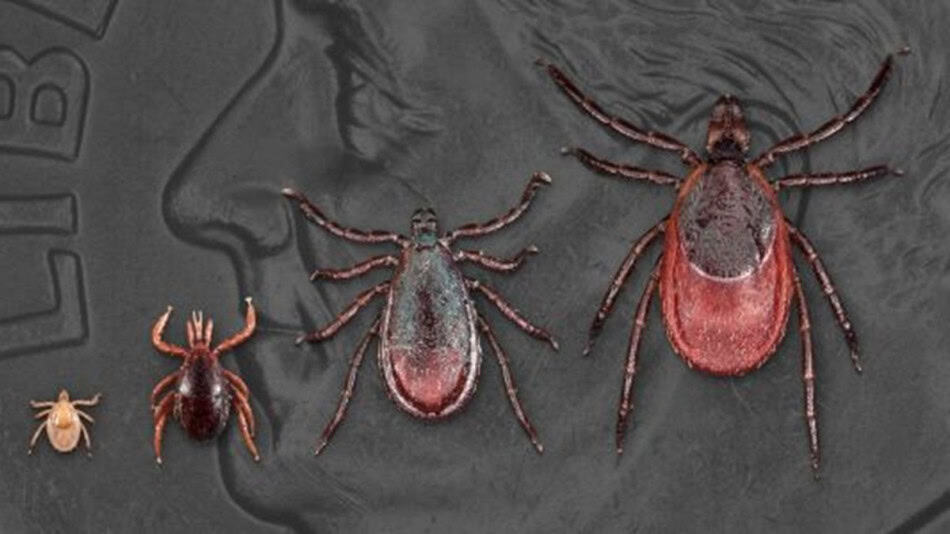
Ticks have four stages in life
- Egg
- six-legged larvae
- Nymph
- Adult
The image at right (Credit CDC) shows the larvae stage at the extreme left, then nymph, and the two adult stages at right.
In general humans are at risk of getting bit by the nymph and adult stages.
Tick habitat
Ticks can live in leaf litter, mulch, wood chips, grass, and just about any other low-lying surrounding vegetation. So, technically, any part of your backyard that isn’t paved can support ticks. That being said, some areas are far more at risk than others depending on what it is, and the atmospheric conditions. Why am I talking about weather and ticks? Well, here is the secret – ticks can’t dry out. They require near constant access to moisture to survive[2] – specifically in the air.
Ticks need humidity
Ticks must maintain some level of moisture in their bodies, and they do this by absorbing moisture through the air. At 92% relative humidity they are in equilibrium (they don’t lose any water). When the humidity is less than this, they begin losing water[3]. Hotter temperatures or lower humidity will accelerate the drying, vastly reducing their ability to survive. So during periods of drier climate, ticks will spend less time questing at the upper portion of vegetation and more time under leaf litter or thatch (dead grass) where the humidity is higher.
If a tick dries out, it dies (yay!). Research in 2007 placed numerous ticks in different humidity levels in a laboratory environment and measured how many survived over time. There was a clear signal that at humidity of 75% or less, the ticks would die over the course of a day.
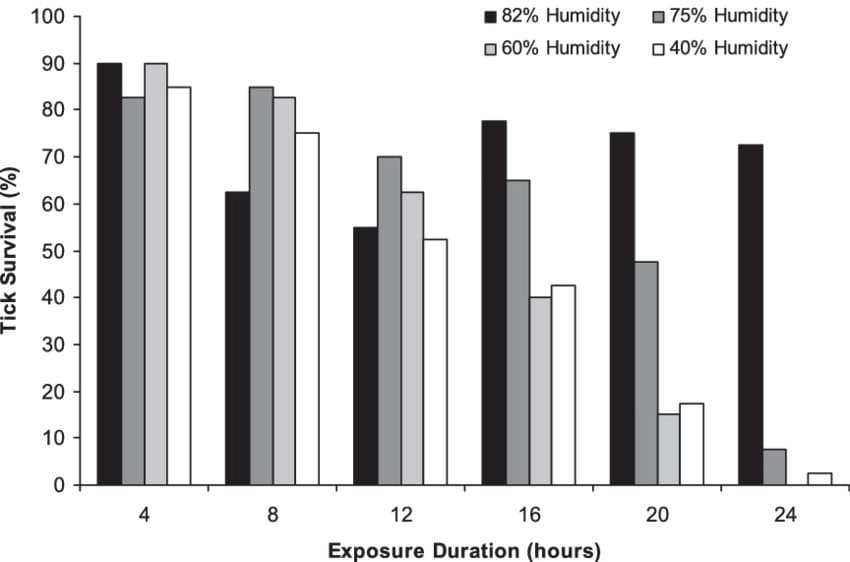
Now you are probably asking yourself, well wait a minute – my area has plenty of days where the air is really dry…why do I have ticks? Well, ticks have natural instincts to help them survive. So, to avoid drying out on the first dry day of summer, they quest for shorter periods, returning to the lower vegetation levels or leaf-litter. These lower levels of vegetation such as leaf litter or under thatch layers have a microclimate that will have higher humidity compared to upper vegetation. So, to gain moisture via absorption through the air, they frequently return to the lower vegetation levels to take advantage of this higher humidity in the microclimate present there.
Since the tick wants to survive, on drier days they mostly hang out in the lower vegetation / thatch layers, where there are higher levels of humidity. On hot, dry days ticks will emerge from the leaf litter for brief periods of 1-2 hours. In the UK, researchers created habitat in plastic bins, controlled the humidity, and measured how many ticks quested. They found that the drier the atmosphere, the fewer ticks were questing for a host. The graph at right is from this study[5].
This study graphed the number of tick nymphs questing vs the saturation deficit, as measured in mm of mercury. The saturation deficit is a measure of how fast a tick will lose moisture via evaporation through it’s skin. The higher the saturation deficit, the faster they dry out. And the study found that higher saturation deficits had fewer ticks questing. They mostly hung out in the lower vegetation levels. We should put a pin in this point to remember later on…..
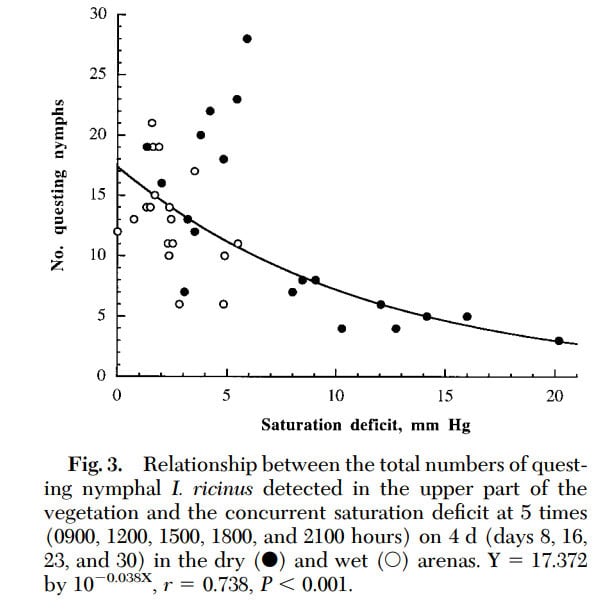
Other research has shown that the duration a tick will be questing to be inversely related to the saturation deficit. Perret et al found that average tick questing time would be 19 hours at 9 mmHG saturation deficit, but at the more moist conditions of a 3.5 mmHG saturation deficit the average questing time was nearly 40 hours!
The number of ticks over time
Alright, so we’ve established that ticks need moisture to survive. But there are two other important factors to whether you will or won’t encounter ticks – time. Both season, and year have a big effect on the number of ticks. And while season is somewhat predictable, at least directionally, year unfortunately is not.
The number of ticks varies by year
The tick population is dynamic over time. Unless you completely live in a paved area, you will likely have some risk of picking up a tick if you are outdoors at all. This risk is not constant though, as the number of ticks and their density changes year over year. Researchers in Poland showed statistically significant differences in tick densities of sites, independent of habitat over a four year study[6]. This is an important point – the number of ticks you encounter can change drastically from one year to the next, and nothing is constant in nature.
The number of ticks by season
One thing that is somewhat predictable though is that the season will effect the number of ticks. Studies have consistently shown that more ticks are encountered in Spring[6] and Summer than other months. This again has to do with available moisture[12]. So, please remember that when going out to observe spring wildflowers or getting outside after a long winter – protect yourself even more so in the Spring!
How habitat effects the number of ticks
Ok, so based on the facts we’ve learned, what areas are at risk of having questing ticks? Well, since they need moisture, you can probably guess that arid landscapes and deserts are lower risk, and you’d be right. But what about forests, forest edges, lawns, and meadows? Do they all carry the same numbers of ticks?
Anywhere area near trees
Studies have consistently shown that forest, and forest edges harbor higher density of ticks than parks, urban, and suburban places[7][8]. Whether it was a dense, natural forest, or a park near a stand of trees, both these types of areas have higher tick populations than open areas free of trees that are frequently mowed.
And this all makes sense. Trees shade the ground, which reduces the amount of water evaporation, which should increase the humidity at the upper areas of the vegetation, as well as in the deeper vegetation and microclimates. So, takes find it easier to live where shade and natural areas are rather than mowed parks.
Parks and open areas
Open areas had fewer ticks. Even more so if those areas were frequently mowed or not near trees[8]. That was the big factor – trees. No trees meant far fewer ticks across all studies.
How far do ticks walk?
Ok, so if Ticks don’t jump and don’t climb high up in the trees, can they walk far distances? Well, first, they generally only walk at night when they are less likely to lose moisture[9]. This alone will limit their ability to cover much distances. Still though, with their tiny size, they generally only move 3-5 m. Adults can traverse distances greater than 4.5 m, and seem to do so based on stimulus (odor or humidity/climate) rather than randomness[10]. One interesting study[11] released ticks in a wild, yet ‘caged’ area that was between a forest and pasture, and they studied their movements. It found that while all could move distances greater than 4.5m (the size of the area), the nymphs were most often found in the woods, while adults were found in a pasture.
Where ticks live in your yard/garden
So based on all this info on tick behavior, what can we infer about our own yards? Well, let’s take a look at some common yard/garden features and what the risk level is. Please note – there is no way to eliminate the risk of ticks completely. Even if one were to spray herbicide over the entire lawn, it would just take one bird carrying on engorged pregnant female tick to fall off to restart an infestation. No, it is better to understand the risks associated with time of year, climate, habitat, and what active protections you can do on your own.
Lawns
Your lawn can harbor ticks. Sometimes an egg sack will be laid in grass. If this happens, you will have a large population of larvae after hatching. This population will likely die out over time due to dehydration and by being picked up by hosts (birds, mice, other mammals). However, a population can be restarted by pregnant females falling off a host, or by a tick wandering in from the woods. Remember the studies that found ticks can traverse upwards of 9m distances?

Mulched flowerbeds
The layer of mulch in a flower bed can absolutely harbor ticks. In times of high humidity ticks can survive long periods questing on top of the mulch. They an also take advantage of the moisture retained within mulch to survive during drought. I have personally picked up at least one tick from one of my mulched flower beds. In fact I believe I got one while weeding directly behind the tree shown in this image!

Vegetable gardens
A well-maintained vegetable garden without mulch is less likely to harbor ticks, as there is not a lower vegetation layer with a humid microclimate. If you use wood chips or leaf mulch though, it is certainly possible, as mulches help maintain humidity, necessary for the tick’s survival. Additionally, there are likely going to be animals passing through to eat some of your crops like rabbits and deer, and both of these host numerous ticks per year. Any tick that falls off a host can certainly find a place to survive in a vegetable garden.
Forest leaf-litter
Oh my…yes, there will be lots of ticks in a forest leaf mulch. Study after study has consistently shown that anywhere with trees or a thick layer of leaves will have the highest density of ticks.
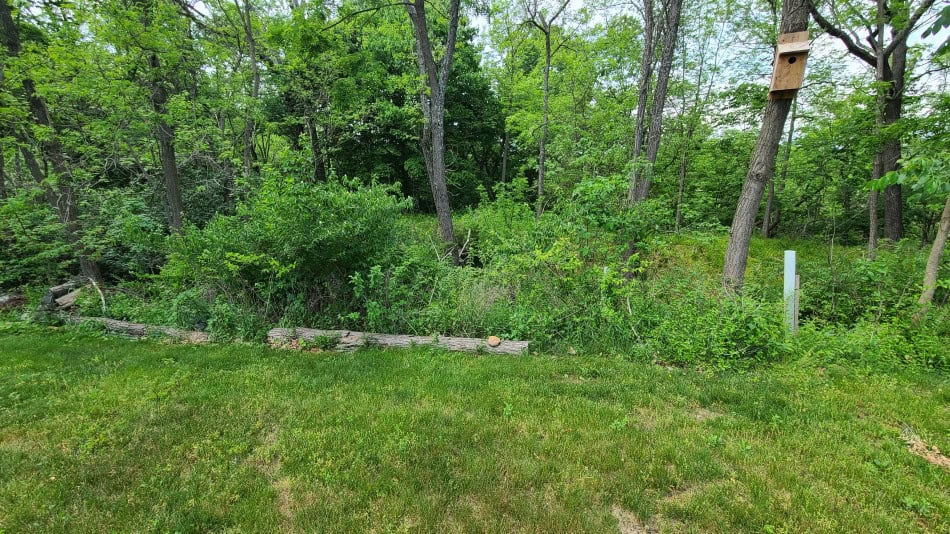
The image at right clearly shows plenty of hardwood trees that can provide leaf litter. And all the ‘knee-high’ vegetation can help retain moisture close to the lower vegetation levels, providing plenty of protection for ticks to avoid drying out. Oh, and lots of places to climb up to ‘quest’.

Meadows
Meadows can certainly harbor ticks. Their dense lower vegetation layer allows for microclimates of high humidity. And the habitat also harbors lots of small mammals which can serve as hosts.
Ways to manage ticks
Ok – this is arguably the most important section – how do you protect yourself? Well, there are a few main strategies to keeping ticks off of you and reducing the chances of picking one up in your garden.
Keeping ticks off your body
This is the most important section – how to keep ticks off your body. Master this, and no matter what environment you enter or conditions you walk through, you can keep yourself safe and significantly reduce the chances of picking up a tick. I personally find the most effective (and easy) method for myself is to have a set of clothes I use for yard work. This is a pair of old jeans and socks that I treat with permethrin spray. I don’t wash these very often, as after a certain number of washings you must reapply. But, wearing these dirty (but treated) clothes keeps pretty much all ticks off of me, or at least it seems to be extremely effective. But, below you’ll find other methods and any personal experience I’ve had with them.
Checking yourself and others
This is, without a doubt the most effective way to protect yourself. Stay vigilant and check yourself! After I’m working in the woods or garden, I’m always checking myself for ticks. You can usually do this yourself if you have a large bathroom mirror and a handheld mirror so you can view your back, legs, and nether regions. Investigate anything that looks like it doesn’t belong. Also, carefully feel your head and investigate any bumps. It helps to have the room well lit. If you have a spouse or partner, they can definitely help (and should).
But we’ve been checking our kids when they spend all afternoon in the yard or when we go hiking. We’ve all heard the expression that an ounce of prevention is worth a pound of cure. And taking 5-10 minutes to check yourself out is absolutely worth if it means avoiding Lyme disease.
Repellents and sprays
When it comes to repellents and sprays, there are a few strategies. I’m going to focus on three chemicals alone, as they are widely available and effective. There are other natural remedies and sprays available, but I really don’t have any first hand experience with them, so I’m going to leave those alone for the time being. But for all of these sprays – read the directions and warnings, and heed them.
DEET
First, let me just get this out of the way, DEET works! DEET smells awful and is hard to clean off, but it absolutely keeps ticks away. Developed by the US Army to protect soldiers from malaria, it has been commercially available since 1957[13]. And it is absolutely effective at keeping ticks and mosquitos away[14]. The only downsides is it doesn’t wash off easily, so you will probably stink long after you’ve come out of the woods. And it is a plasticizer that can damage elastic, rubber, plastic, and vinyl[15]. So, think twice before spraying it on your shoes.
I would like to relay a personal anecdote on DEET. Many years ago when mushroom hunting, I was wearing hiking pants/boots. I sprayed by boots and ankles with a ring of DEET (just regular Deep Woods Off), and then again midway up my thigh. While hunting I noticed a dot on my knee, and well, it was a tick. I could see it was below the ring of DEET I sprayed on my thigh, so I just thought I would wait a minute to see what happened. Well, he continued up my leg until he hit the DEET barrier. He crawled up, then crawled back down and moved laterally a few inches, and then tried crawling up again. This pattern repeated several times until he gave up and just dropped off. So there – that is my endorsement of DEET as a tick repellent.
Picardin
Picardin is another repellent that can be directly applied to clothes or skin. It is often found to be just as effective as DEET, but with less odor[16]. It also doesn’t damage plastic or rubber, so can be sprayed directly on shoes[17]. A lot of people are choosing Picardin over DEET due to odor, but it’s nice because you can spray it on clothes too without much fear of damage.
Permethrin
Pemethrin is an insecticide that is synthetically made to be similar to extracts of the chrysanthemum flower. It negatively effects the nervous system of insects. If an insect touches or consumes permethrin, it can cause muscle spasms and eventual death depending on the concentration. For the purposes of tick prevention, it is commonly sold as a 0.5% concentration spray that you apply to clothes. When a tick crawls on those clothes, they either drop off or die[18]. You need to follow the instructions on the bottle for applying permethrin to clothes. It is best in a well ventilated area, protected from the wind. Yet make sure you wear rubber gloves and let the clothes fully dry before putting them on. Permethrin can be harmful to cats, but isn’t a problem to people and dogs.
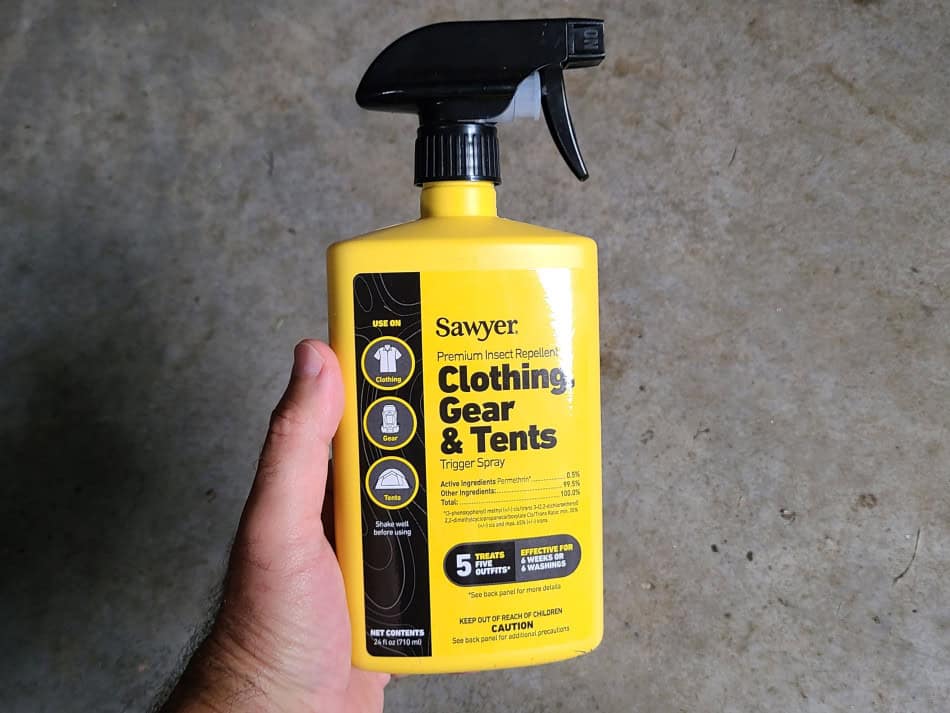
Studies have found that permethrin is very effective at keeping ticks off of people when applied to clothes. One particularly interesting study tested actual humans wearing clothes treated with permethrin (both commercially treated and DIY spray)[19], versus people not treated at all. For the shoes and socks test, they had treated and untreated people, and would place a tick on their shoe. They came back 2.5 hours later to see if the tick was alive/dead or attached to the person. Well, people wearing shoes/socks treated with permethrin were 73 times less likely to have a tick bite. When they did the experiment with shirt/shorts and placed a tick there, again, the subjects wearing treated clothing were 4 times less (shirt) and 2 times less (shorts) likely to have a tick bite. But do you want to hear the most interesting part? Well, when they checked to see if an attached tick was alive or dead, they found that 97% of the ticks attached to people with untreated clothing were alive. But for those with treated clothing, only 23% were alive (the permethrin killed the tick). So, not only will it reduce the chances of getting bitten, but if it can mostly kill the tick, then this is pretty good proof that permethrin will reduce your chances of contracting one of the diseases that ticks can carry.
Ways to manage ticks on your property
Pesticides
There are a number of pesticides that can be sprayed on lawns or gardens that will kill any and all insects, spiders, bee, and butterfly. This is a strategy, and it will kill any tick the spray contacts. It isn’t always the most effective though, as if the ticks are not ‘questing’ then they may be protected in the thatch layer of the lawn or deep in the brush. Also, any tick that is feeding on a deer, mouse, or bird may just drop off later on after the application. I don’t recommend this as a strategy, as it will harm a lot of your local ecosystem for only a temporary reprieve.
Tick tubes
One passive strategy to reduce the number of ticks is to utilize something known as tick tubes. To explain them simply, they are biodegradable cardboard tubes filled with dryer lint of cotton balls that have been sprayed with permethrin. You place them around your property in areas where mice live, and then the mice will gather the soft permethrin-treated material to use in their nests. As the mice have ticks attach to them during the season, when they return to their nests the ticks will come into contact with the treated cotton and die.

I’ve used tick tubes off and on for years, and they are an effective way to passively reduce the tick population. They are available commercially, or you can make your own. I have a whole article explaining the process as well as a video to go along with it too.
Vegetation management
One of the most effective management techniques for ticks is by controlling your vegetation. Remember ticks must have moisture, and they often get this from lower levels of vegetation, thatch, and leaf litter.
Controlled burns
One item that may be tempting is controlled burns. While this is enticing and would seem very effective, I should note that while the initial season of the burn will result in a significantly reduced tick population. However studies have been a bit more mixed, with some finding a significant long term reduction with frequent prescribed burns[20][21], while others have noticed increased population later in the season[22].
Removing invasive species
Numerous studies have found that certain invasive species lead to higher tick density in the underbrush[23]. This seems completely logical, as invasive species often provide excess vegetation cover that could help preserve moisture. And many studies have found that invasive species such as Bush Honeysuckle[24] and Japanese Barberry[25][26] lead to greater numbers of ticks. Other species are a bit more mixed such as one that found forests infested with Multi-floral rose had higher tick concentrations under the multi-floral rose, but fewer ticks in the overall invaded forest compared with un-invaded forests[27].
Making a tick barrier
One simple method that almost anyone can do is to create a tick barrier. A tick barrier is simply a strip of land that can serve as a barrier that would prevent ticks from crossing. Now, you don’t need to go construct anything special, but just leave a strip of ground 3′ wide that can easily dry out. In my back yard I make sure the outer perimeter with the forest is always mowed well so that any tick trying to enter my lawn from the forest would have to cross it, and as long as it isn’t raining, it will be drier than then the tall weeds at the forest edge. If you want to get extravagant, you can put a line of mulch, sand, or gravel[28][29].
Conclusion – an overall strategy
Ok – so what should you do? Well, dealing with ticks often requires a multi-pronged approach. First and foremost, one must understand the risk level for picking up a tick just walking through an area. Spring and humid conditions will be higher risk than the hot, dry summer. Deep vegetation, leaf litter, forest, or meadow is higher risk than a well manicured lawn. And even more important, protecting yourself through vigilant tick checks or by wearing repellents or treated clothing.
If ticks are a major concern based on where you live, then consider keeping your lawn mowed a bit shorter, or removing some of brush surrounding your property. Passive strategies like tick tubes can reduce the amount of ticks, but will not eliminate them. A simple tick barrier, or area where you keep the grass particularly short can help prevent them from migrating to your yard. But again, paying attention and checking yourself and your kids is of the upmost importance.
As of now, I’m middle aged but considering how much time I have spent in the woods hiking, hunting, fishing, and gardening I can proudly say I only received a single tick bite (I believe from our dog). I do lots of yardwork and clear many invasive species each year, and with my strategy of wearing treated clothing I have never had one attach from working those areas that should have a high density of ticks.
Find more gardening tips here
References:
[1] – https://www.cdc.gov/ I linked to specific pages of the CDC’s website numerous times throughout. They were a very important resource for trusted information regarding ticks.
[2] – Milne, A. “The ecology of the sheep tick, Ixodes ricinus L.: microhabitat economy of the adult tick.” Parasitology 40.1-2 (1950): 14-34.
[3] – Lees, A. D. “The water balance in Ixodes ricinus L. and certain other species of ticks.” Parasitology 37.1-2 (1946): 1-20.
[4] – Rodgers, Sarah E., Christine P. Zolnik, and Thomas N. Mather. “Duration of exposure to suboptimal atmospheric moisture affects nymphal blacklegged tick survival.” Journal of medical entomology 44.2 (2007): 372-375.
[5] – Randolph, Sarah E., and Katie Storey. “Impact of microclimate on immature tick-rodent host interactions (Acari: Ixodidae): implications for parasite transmission.” Journal of medical entomology 36.6 (1999): 741-748.
[6] – Kowalec, Maciej, et al. “Ticks and the city-are there any differences between city parks and natural forests in terms of tick abundance and prevalence of spirochaetes?.” Parasites & Vectors 10.1 (2017): 573.
[7] – Cekanac, Radovan, et al. “Prevalence of Borrelia burgdorferi in Ixodes ricinus ticks in Belgrade area.” Vector-Borne and Zoonotic Diseases 10.5 (2010): 447-452.
[8] – Maetzel, Dorothea, Walter A. Maier, and Helge Kampen. “Borrelia burgdorferi infection prevalences in questing Ixodes ricinus ticks (Acari: Ixodidae) in urban and suburban Bonn, western Germany.” Parasitology Research 95.1 (2005): 5-12.
[9] – Perret, Jean-Luc, et al. “Darkness induces mobility, and saturation deficit limits questing duration, in the tick Ixodes ricinus.” Journal of Experimental Biology 206.11 (2003): 1809-1815.
[10] – Crooks, Emily, and Sarah E. Randolph. “Walking by Ixodes ricinus ticks: intrinsic and extrinsic factors determine the attraction of moisture or host odour.” The Journal of Experimental Biology 209: 2138-2142.
[11] – Carroll, J. F., and E. T. Schmidtmann. “Dispersal of blacklegged tick (Acari: Ixodidae) nymphs and adults at the woods–pasture interface.” Journal of Medical Entomology 33.4 (1996): 554-558.
[12] – Berger, Kathryn A., et al. “Adverse moisture events predict seasonal abundance of Lyme disease vector ticks (Ixodes scapularis).” Parasites & vectors 7.1 (2014): 181.
[13]- Jackson, D.; Luukinen, B.; Buhl, K.; Stone, D. 2008. DEET General Fact Sheet; National Pesticide Information Center, Oregon State University Extension Services. npic.orst.edu/factsheets/DEETgen.html.
[14] – Connelly, C. Roxanne, and John E. Gimnig. “
[15] – DEET Technical Fact Sheet, National Pesticide Information Center, accessed 20MAY2026.
[16] – Picaridin, National Pesticide Information Center. Accessed 20MAY2026
[17] – Insect repellents: Components and risks, National Poison Control Center. Accessed 20MAY2026
[18] – Permethrin, National Pesticide Information Center. Accessed 20MAY2026.
[19] – Miller, Nathan J., et al. “Tick bite protection with permethrin-treated summer-weight clothing.” Journal of medical entomology 48.2 (2011): 327-333.
[20] – Gleim, Elizabeth R., et al. “The phenology of ticks and the effects of long-term prescribed burning on tick population dynamics in southwestern Georgia and northwestern Florida.” PLoS One 9.11 (2014): e112174.
[21] – Salazar Aguirre, Andrea. “Seasonal life cycle of the Lone Star Tick (Amblyomma americanum) and the influence of prescribed burning on tick abundance and presence of microorganisms.” (2025).
[22] – Stafford III, Kirby C., Jeffrey S. Ward, and Louis A. Magnarelli. “Impact of controlled burns on the abundance of Ixodes scapularis (Acari: Ixodidae).” Journal of Medical Entomology 35.4 (1998): 510-513.
[23] – Elias, Susan P., et al. “Deer browse resistant exotic-invasive understory: an indicator of elevated human risk of exposure to Ixodes scapularis (Acari: Ixodidae) in southern coastal Maine woodlands.” Journal of medical entomology 43.6 (2006): 1142-1152.
[24] – Allan, Brian F., et al. “Invasive honeysuckle eradication reduces tick-borne disease risk by altering host dynamics.” Proceedings of the National Academy of Sciences 107.43 (2010): 18523-18527.
[25] – Williams, Scott C., Megan A. Linske, and Jeffrey S. Ward. “Long-term effects of Berberis thunbergii (Ranunculales: Berberidaceae) management on Ixodes scapularis (Acari: Ixodidae) abundance and Borrelia burgdorferi (Spirochaetales: Spirochaetaceae) prevalence in Connecticut, USA.” Environmental entomology 46.6 (2017): 1329-1338.
[26] – Lubelczyk, Charles B., et al. “Habitat associations of Ixodes scapularis (Acari: Ixodidae) in Maine.” Environmental entomology 33.4 (2004): 900-906.
[27] – Adalsteinsson SA, D’Amico V, Shriver WG, Brisson D, Buler JJ. Scale-dependent effects of nonnative plant invasion on host-seeking tick abundance. Ecosphere. 2016 Mar;7(3):e01317. doi: 10.1002/ecs2.1317. Epub 2016 Mar 25. PMID: 27088044; PMCID: PMC4827432.
[28] – Fischhoff IR, Keesing F, Pendleton J, DePietro D, Teator M, Duerr STK, Mowry S, Pfister A, LaDeau SL, Ostfeld RS. Assessing Effectiveness of Recommended Residential Yard Management Measures Against Ticks. J Med Entomol. 2019 Sep 3;56(5):1420-1427. doi: 10.1093/jme/tjz077. PMID: 31120510; PMCID: PMC6736118.
[29] – Tick Prevention. Centers for Disease Control. Accessed 20MAY2026.
Recent Posts
So, if you are going to be spending time in the woods, or even anywhere with taller weeds you should take care to protect yourself from ticks. They cause numerous diseases like Lyme disease, and now...
At some point in your life, you are going to have to loosen a rusted, stuck, or seized screw. It is almost guaranteed! So, depending on the situation, one of these will work. I've noticed that lots...