
Blue Stemmed Goldenrod is a herbaceous wildflower native to Eastern North America[1]. Scientifically known as Solidago caesia,it grows up to 3′ tall in part shade to part sun[2]. Blooming numerous yellow flowerheads up to four weeks in late summer to early fall, it is a powerhouse for feeding pollinators and hosts several species of moth and bee[3][4][5][6].
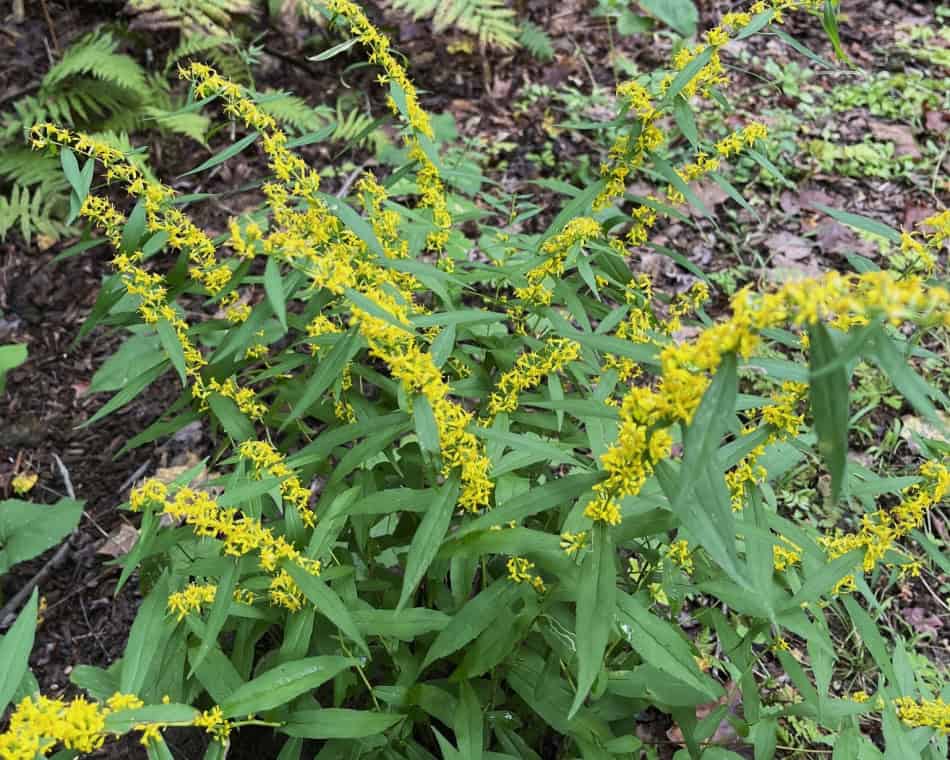
One of the most easy-to-ID species of the Goldenrods, Blue-Stemmed Goldenrod is considered a workhorse plant when it comes to pollinators. Like other Goldenrods, the flowers of this genus just seem to replenish nectar and pollen at a very high rate allowing them to feed a large number of pollinators. This happens to be one of the species of Goldenrod that you may encounter in the woods, seemingly in too shady a location for a member of the Solidago genus.
So, yes, this is a perfect flower for a shady garden. It can grow under trees as long as it gets some dappled sunlight. Just be aware that it may lean or arch a bit, giving way to another common name for it ‘wreath goldenrod’.
This is where I may start a bit of controversy. This flower is often sold or recommended as being a less aggressive form of Goldenrod. But in my experience, it will produce plenty of rhizomes, the same as other species. It may not be *as* aggressive, however, the fact that it can spread via rhizomes should give people pause before planting it in random flowerbeds. There are however, steps you can take to contain this plant (I’ve done this with multiple species over the years). But still, rhizomes are rhizomes. So, understand it’s nature before you plant, and that way you shouldn’t be too surprised if you get volunteers. Note that these are generally easy to manage in the spring once you get used to identifying it as it emerges.
Native Range
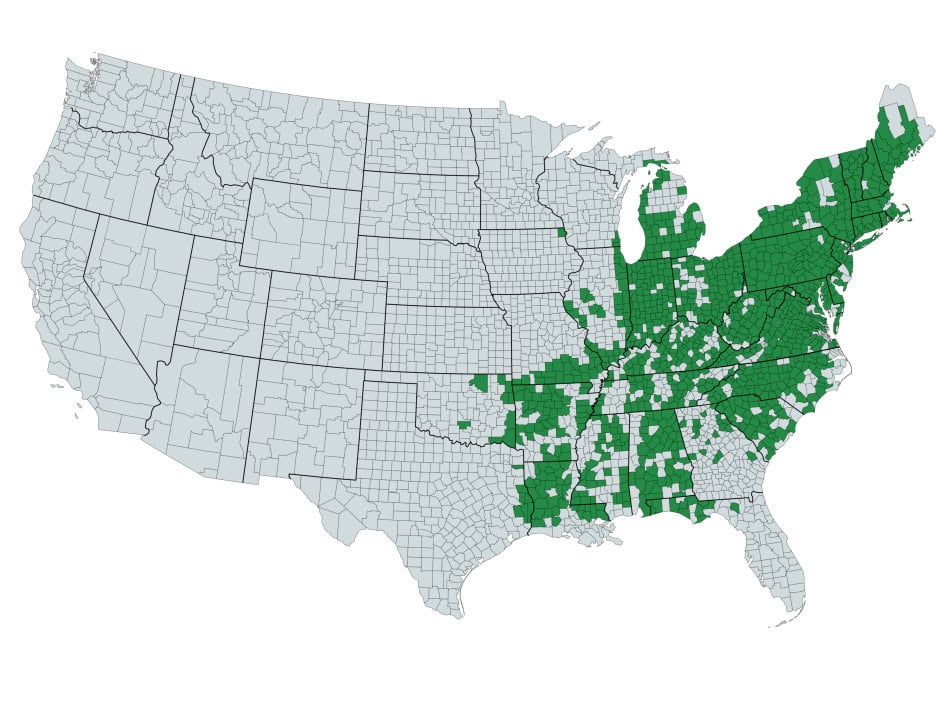
The primary native range of Blue-Stemmed Goldenrod is the Eastern half of North America. From the Texas-Louisiana border to Maine, Michigan, and several isolated pockets throughout the country.
Reference Table
| Scientific Name | Solidago caesia |
| Common Name(s) | Blue Stemmed Goldenrod, Axillary Goldenrod, Woodland Goldenrod, Wreath Goldenrod |
| Native Range, USDA Zone | Eastern North America, USDA Hardiness Zones 4-8 |
| Bloom Time | Late summer |
| Bloom Duration, Color | Four weeks, yellow |
| Height | 2-3′ (but will lean over) |
| Spacing / Spread | 2′ |
| Light Requirements | Part sun to shade |
| Soil Types | Sandy loam to clay loam, must drain well |
| Moisture | Medium to dry |
| Fauna Associations / Larval Hosts | Bees, moths, flies, wasps, butterflies. / Hosts caterpillars of several moths |
Pros and cons
Pro
Beauty
The yellow flowers of Blue-Stemmed Goldenrod really “pop” when contrasted against a dark green forest, which is where you will most often find it growing. Hence, it adds a lot of beauty.
Pollinators
Blue-stemmed Goldenrod flowers make copious amounts of nectar and pollen, and they seem to be replenished very quickly. So, this plant can feed a lot of bees!
Monarchs
We all know that Monarch butterflies only lay eggs on milkweed plants, but did you know that goldenrod is almost as important? Yes, the Monarchs need late season flowers to fuel their migration, and Blue-Stemmed Goldenrod can help do that!
Host plant
Goldenrods are keystone plants, and Blue-Stemmed Goldenrod is a host plant for various species of pollinators. There are 5 different species of moth that will use Blue-Stemmed Goldenrod as a host for their caterpillars.
It’s native
This may not seem like a special benefit, but considering the areas this plant grows are often overrun with invasive species like Bush Honeysuckle and Japanese Stiltgrass, it’s nice to have a list of natives that can compete with those. Mature plants of Blue Stemmed Goldenrod can help fight invasive species.
Con
Rhizomes
This is the primary con for this flower. The rhizomes produced by it’s root system may dissuade some people from planting it, as it has the potential to spread.
Leaning / flopping
Blue Stemmed Goldenrod often will lean or ‘arch’ over. It is important to plant this flower where it can do this, or at least not be surprised if it happens.
Identification and Characteristics
Stalk
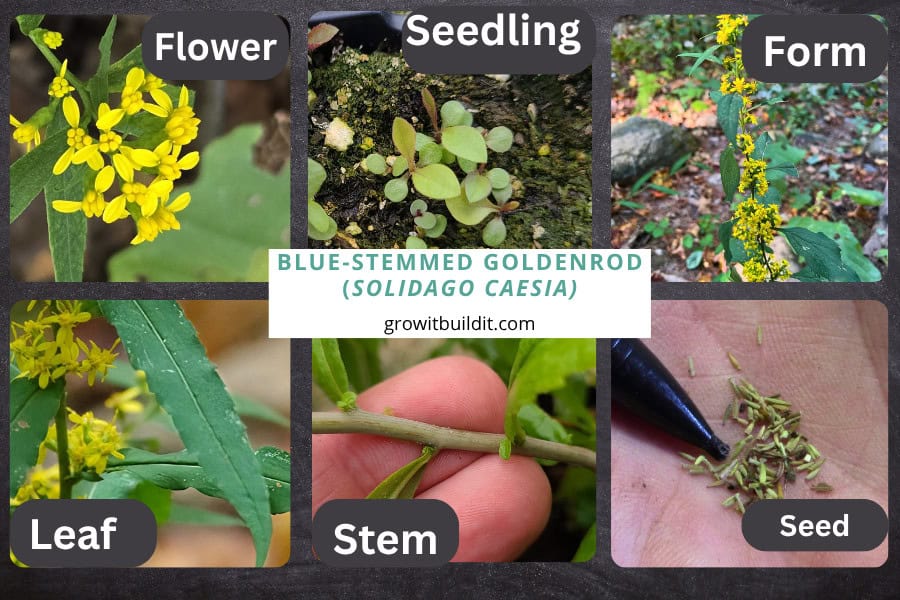
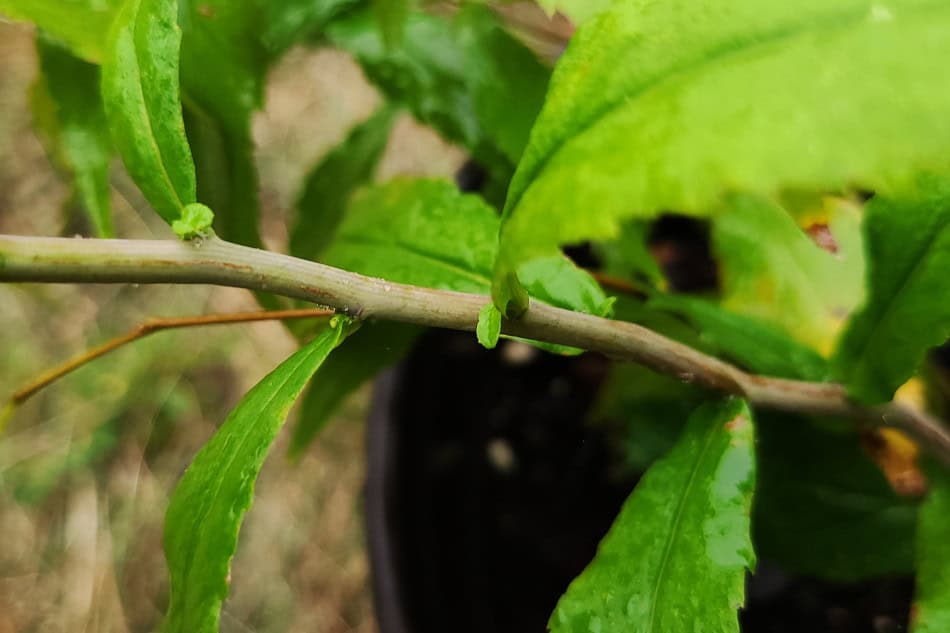
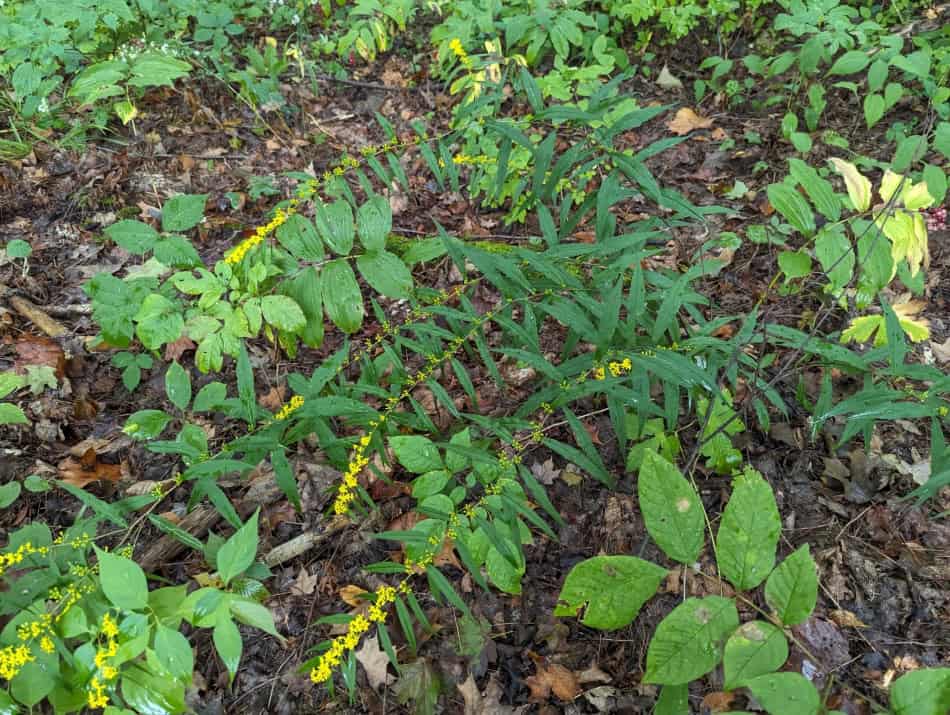
The overall plant grows upwards of 3′ tall and is most often unbranched. Frequently the main stem will arch or lean over, giving the plant a ‘curved’ appearance. The stem will be round and smooth, green in Spring and often changing to a shade of purple-gray color which gives off a blueish hue.
Leaf
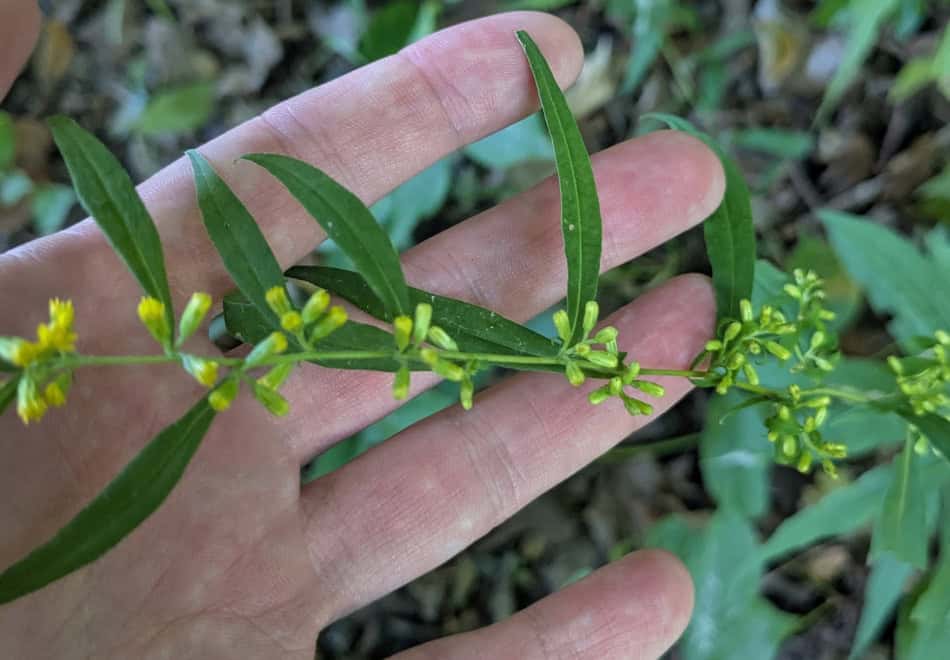
Leaves are alternate, up to 5″ long by 3/4″ wide, elliptic to elliptic-oblong in shape, with serrated margins (sometimes smooth). In general they are medium to dark green in color. The leaves at the lower portion of the stalk are larger, and get smaller as they ascend the stalk.

Flower
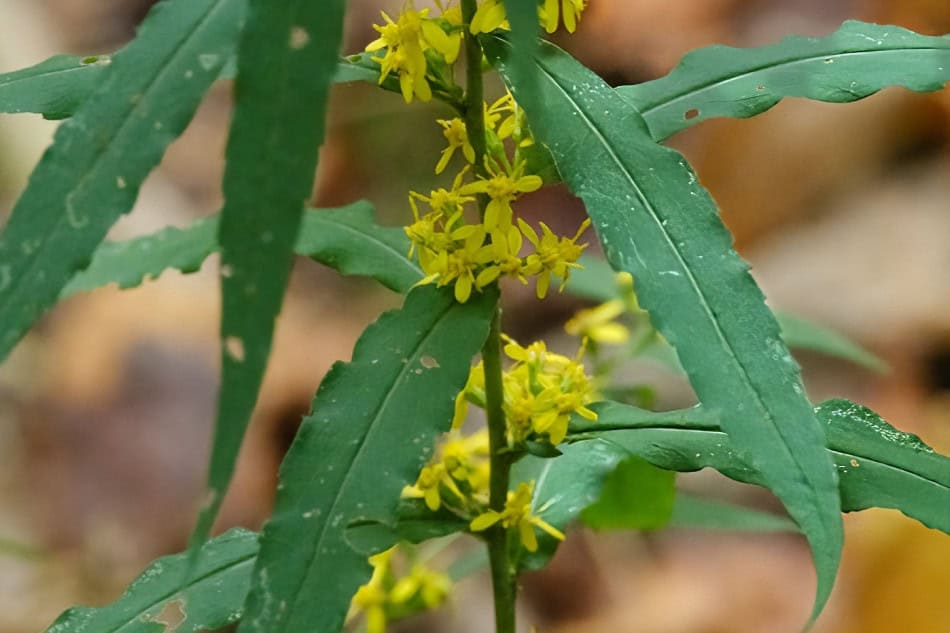
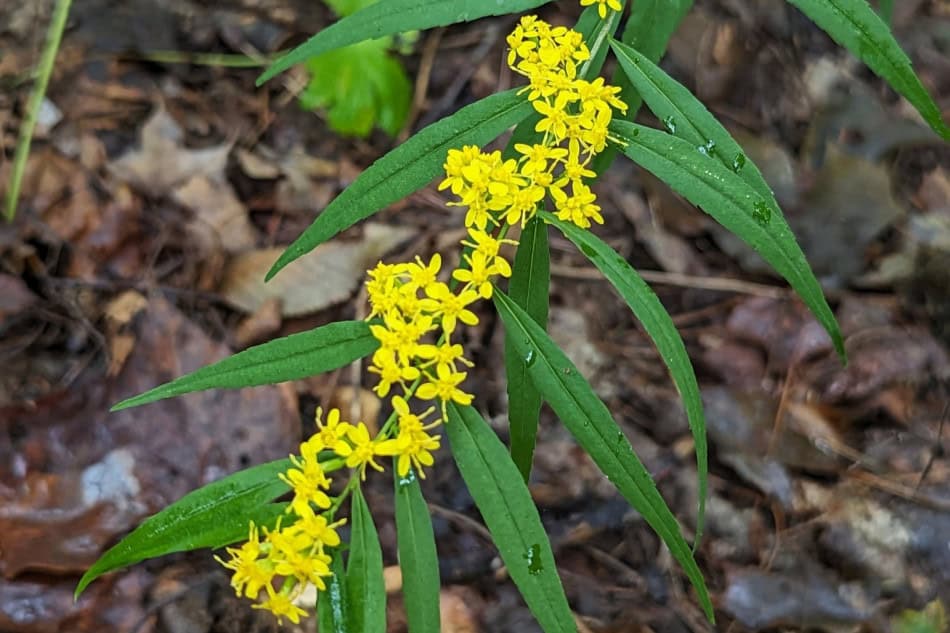
The flowering nature of Blue Stemmed Goldenrod is probably the best single indicator for identification. At the end of the central stem will be a panicle of flowers, usually around 2-3″ long. But at the leaf axils from roughly midway up the stalk to the end will be small clusters of flowers, which is fairly unique.
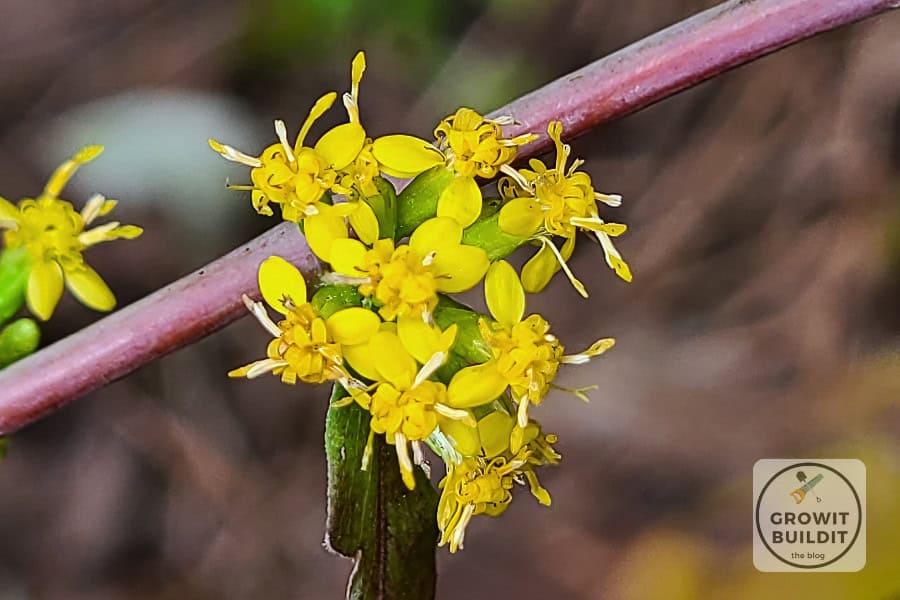
Individual flowerheads are typical for goldenrods, being about 1/8″ diameter with 4-5 petals surrounding several disk florets.
So, this species is similar to other goldenrods in that it has a panicle of flowers at the upper end of the stalk (see here, here, and here for other goldenrods with similar structure). But what sets Blue Stemmed Goldenrod apart is the flowers at the axils of the leaves. This, combined with the stalk color, which is usually purple or blueish at the time of flowering, make identifying this particular species easy.
Root
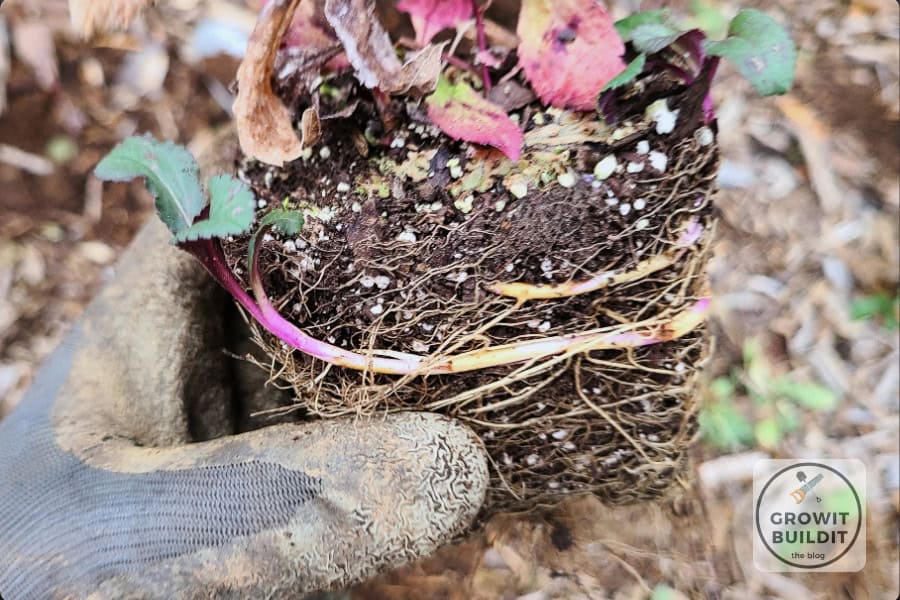
The root system of Blue-Stemmed Goldenrod is fibrous and produces rhizomes. Want proof? See image below:
Growing Conditions
For growing conditions, Blue-Stemmed Goldenrod will prefer part-sun to part-shade, and moist to medium-moist soil that drains. It can tolerate a variety of soil textures provided there is some organic matter (it’s often found in forests), but the key feature is that it should drain.
How to Grow Blue-Stemmed Goldenrod from Seed
The seed of Blue-Stemmed Goldenrod has a dormancy mechanism that will prevent premature germination. In order to get the seed to germinate, you must overcome that mechanism by experiencing a cold-moist environment for about 60 days, and exposure to sunlight. You can overcome the cold-moist dormancy by cold-stratifying seed in a moist paper towel, in a bag, in the fridge for two months. Alternatively (and much more easily) you could just winter sow the seed around Christmas time.
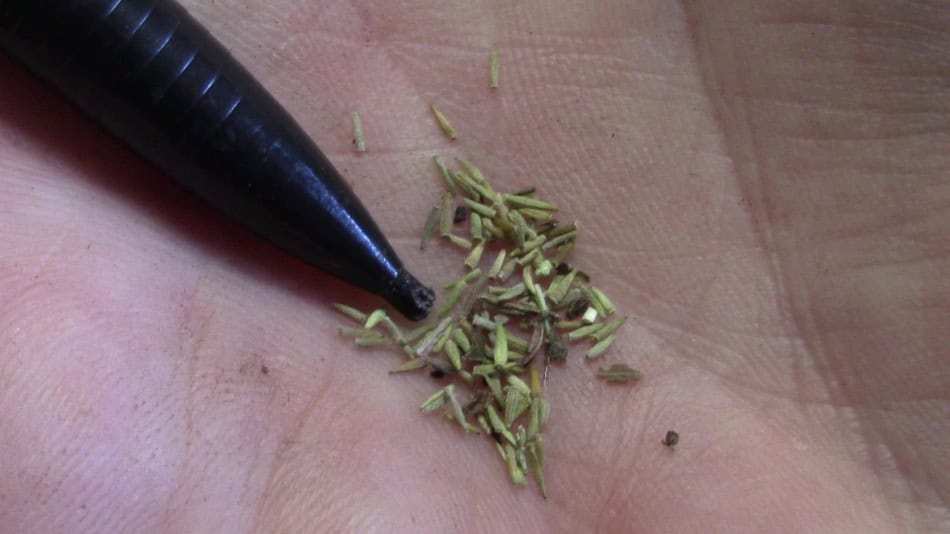
But to plant seed, whether pre-stratified in the fridge or winter sowing, simply fill a suitable container with moist potting soil, tamping it firm, but leaving a 1/2″ gap at the top. Sprinkle the seed on top of the soil, then press it in with your thumb. Take care not to bury it, as the seed must have exposure to sunlight to germinate.
Move the container to a location that gets morning sun and afternoon shade. Water it by misting only, so you don’t wash away the seed. Germination will take place once daytime temperatures regularly get into the 50’s or 60’s.
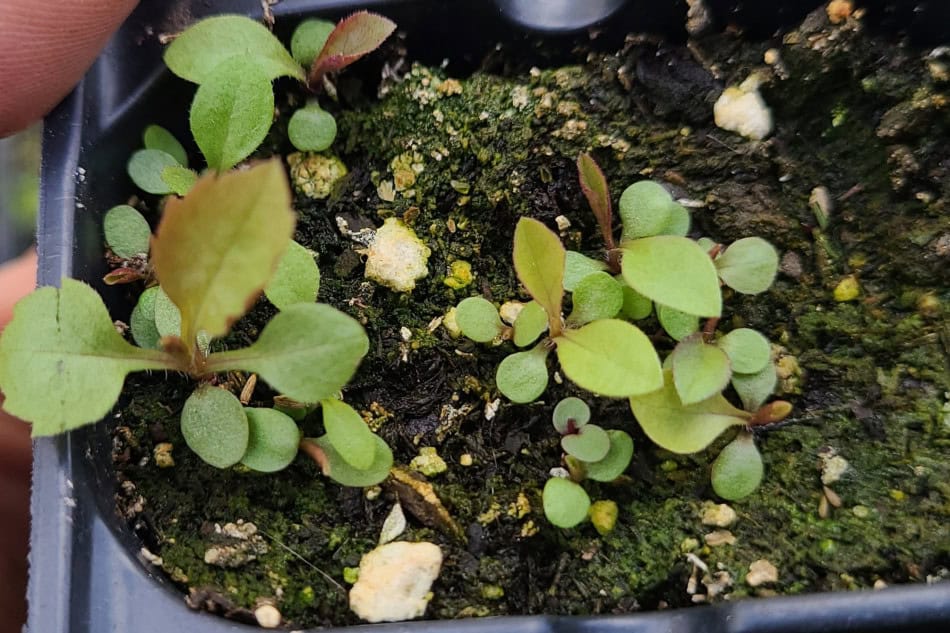
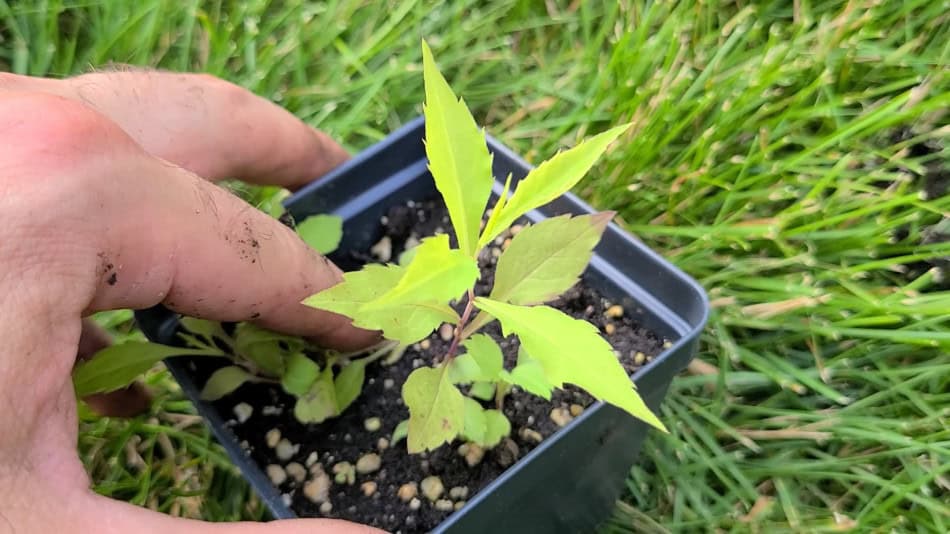
Once you have several sets of true leaves, you can plant out to it’s final location, or separate seedlings into larger pots. If planting in it’s final location, you should offer some protection like a cage or liquid fence, as even though most goldenrods are deer/rabbit resistant, in my experience new growth or young seedlings will be browsed/eaten.
Transplanting Blue-Stemmed Goldenrod
Since this species has fibrous root system, you can easily transplant mature plants or new rhizome offshoots shortly after emerging in Spring or when it is nearly dormant in fall. Simply dig up the clump and move it to a prepared hole. If dealing with rhizomes, try to make sure there are some root hairs present. Also, the reason for doing this during the cool seasons is that the soil is more likely to be moist and the heat demands on the plant are low. If you try to move plants around during hotter times of the year, or if it’s blooming or producing seed you are likely to kill the plant (ask me how I know this).
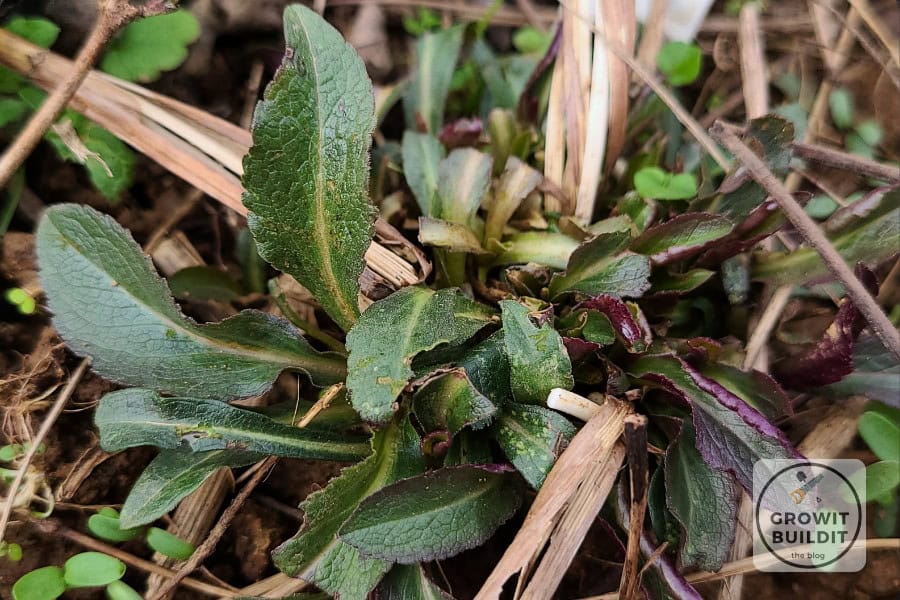
Wildlife, Pests, and Diseases
Pollinators
Blue-Stemmed Goldenrod is a workhorse when it comes to feeding pollinators (as all goldenrods are). It servers (and hosts) several sepcialist bees as well[5][6]. The flowers produce large amounts of nectar and pollen that feed numerous species of bee, butterfly, moth, pollinating flies, and wasps. This is also a host plant for moth caterpillars, specifically the following: Coleophora duplicis, Cremastobombycia solidaginis, Dichomeris leuconotella, Gnorimoschema gallaeasterella.
Deer and Rabbits
Although many people list this (& other goldenrods) as deer/rabbit resistant, I have seen browsing damage in my plants. It is wise to plant mature plants in winter, just after they have gone dormant or protect seedlings with liquid fence.
Disease
Blue Stemmed Goldenrod isn’t typically effected by disease, at least not significantly. However as the plant matures, the lower leaves often turn yellow and fall off. This often happens due to drought, or them being shaded by the upper portion of the plant.
Where you can buy Blue-Stemmed Goldenrod
Blue-Stemmed Goldenrod is not typically sold in nurseries, as it isn’t a typical ‘garden friendly’ plant. But it can be purchased at specialty nurseries that deal in Native Plants. You can find native plant nurseries near you on our interactive map.
Where to buy seeds
We have ordered a variety of native flower seeds from Everwilde Farms, which you can order right from Amazon through our link on our RECOMMENDED PRODUCTS PAGE. (We may earn a small commission when you purchase through our links, at no cost to you. This helps support our website.)

Uses
Landscaping Uses
For landscaping, Blue-Stemmed Goldenrod is an excellent choice for slopes in part shade or along the edge of a forest. But it is more suited for wilder areas where it can be expected to run. And, just know that this plant is likely to lean/arch over. So, don’t be surprised by it, expect it. Plant clusters of plants to attract more pollinators. And if you don’t want volunteers, then make sure you deadhead your plants to prevent self-seeding and dig up any unwanted sprouts in the Spring.
Companion Plants
When it comes to companion plants, there are a surprisingly large number of shade tolerant perennials and shrubs. Some examples of plants that would grow well with Blue Stemmed Goldenrod are below:
- Aromatic Aster
- American Bellflower
- American Germander
- Big Leaf Aster
- Crooked Stem Aster
- Short’s Aster
- Columbine
- False Solomon’s Seal
- Hairy Wood Mint
- Jack in the pulpit (for very shady areas)
- Sweet Goldenrod
- Solomon’s Seal
- Tall Thimbleweed
- Wild Geranium
A few grasses would grow nicely with it. Really, just about any sedge, but Pennsylvania sedge would be a great choice as it also spreads, and can help keep the Japanese Stiltgrass down. Also, Bottlebrush grass would look great intermixed with it.
Final Thoughts
They say every plant has it’s place, and Blue-Stemmed Goldenrod is no exception. If you’re trying to garden for wildlife, then you should be having at least some goldenrods in your garden. This one can get a bit on the wild side in that it will spread via rhizome, and it doesn’t always stand tall (it arches/leans). But, it provides valuable food for pollinators, hosts several species of caterpillar, and it can grow in the shade. So, if you have a semi-shaded area, this is definitely a plant you can consider adding, as the wildlife benefits are immense.
Find more native plants here
References:
[1] – Solidago caesia L. USDA NRCS. Accessed 16JUN2026
[2] – Richardson, Mark. Native Plants for New England Gardens. Simon and Schuster, 2018.
[3] – Federal Highway Division, Ecoregional Revegetation Application (ERA)
[4] – Solidago caesia, NC State Plant Extension. Accessed 16JUN2026
[5] – Fowler, J. “Specialist bees of the Mid-Atlantic: Host plants and habitat conservation.” The Maryland Entomologist 6.4 (2016): 2-40.
[6] – Jarrod Fowler & Sam Droege. “Pollen Specialist Bees of the Eastern United States”. jarrodfowler.com. 2020. Accessed Jun 16th 2026
Recent Posts
So, if you are going to be spending time in the woods, or even anywhere with taller weeds you should take care to protect yourself from ticks. They cause numerous diseases like Lyme disease, and now...
At some point in your life, you are going to have to loosen a rusted, stuck, or seized screw. It is almost guaranteed! So, depending on the situation, one of these will work. I've noticed that lots...