
Tall Thimbleweed is a herbaceous perennial native to central and Eastern North America[1]. Scientifically known as Anemone virginiana, it can grow 2-3′ tall in full sun or partial shade, and medium moisture. Blooming white flowers in Spring to early Summer, it feeds several species of pollinator. Additionally, the flowers, foliage, and seed heads provide year round interest[2][3].

Look, I’m going to be up front with you here. Tall Thimbleweed will make white flowers, and they are attractive. But they don’t produce that many, and while it would be possible to get a large specimen to throw up a lot of stalks/flowers, there are often showier alternatives. But why grow this plant then? Well, I will give you a few reasons.

First, it can tolerate a wide variety of light conditions, and established plants can compete with Japanese Stiltgrass and even plants can persist in a quasi-prairie setting. So, you’ll get a native plant that feeds pollinators that can fend off advances in invasives. Oh, and it looks cool most of the year.
Facts
- The roots produce a chemical that inhibits seed germination of many plants[3]
- Several medicinal uses exist such as a poultice of the pounded root was used to treat burns[4]
- Tall Thimbleweed can compete with invasives in shady environments
- One of the most cold-tolerant plants, Tall Thimbleweed is cold hardy to zone 2!
Native Range
The primary native range of Tall Thimbleweed is central and eastern North America.

Reference Table
| Scientific Name | Anemone virginiana |
| Common Name(s) | Tall Thimbleweed, Tall Anemone, Thimbleweed |
| Native Range, USDA Zone | Central and Eastern North America, USDA Hardiness Zones 2-8 |
| Bloom Time | Spring |
| Bloom Duration, Color | 4-6 weeks, white |
| Height | 2-3′ |
| Spacing / Spread | 12-18″ |
| Light Requirements | Full sun to partial shade |
| Soil Types | Sandy loam to clay loam. |
| Moisture | Medium moisture. |
| Fauna Associations / Larval Hosts | Smaller bees, small butterflies, and pollinating flies |
Benefits
Pollinators
Tall Thimbleweed will feed a variety of pollinators including small bees, butterflies, and pollinating flies. The long bloom time ensure that it can feed them in mid-Spring.
Native
As a native, this plant is adapted to your local ecosystem. So, it will naturally be disease resistant and work well with other plants and organisms.
Adaptable
This is a very adaptable plant – it can grow in both somewhat shady conditions to full sun. There aren’t too many plants that can tolerate those kind of conditions.
Identification and Characteristics

Stalk
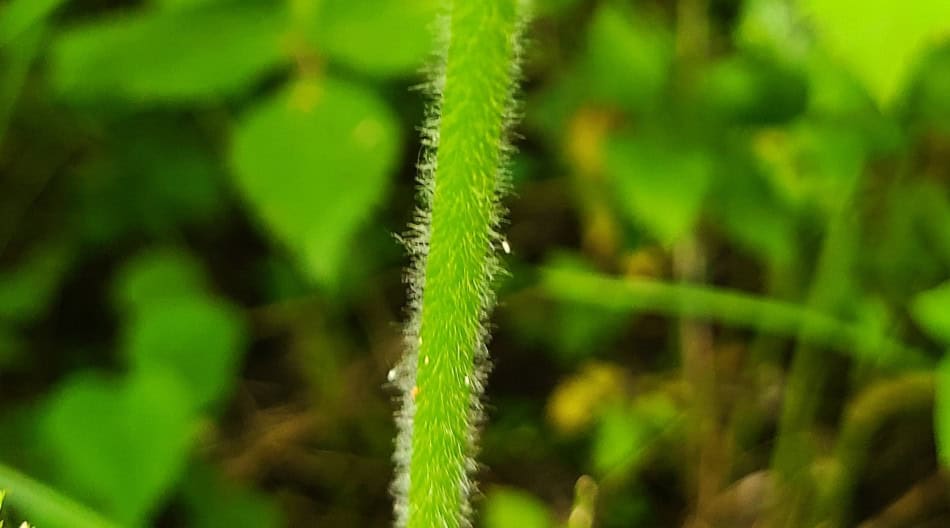
The overall plant can reach 3′ tall, but is most often 18-24″ in the wild. The stem is round, green, and has white hairs. Branching occurs where it makes stalks for flowers.
Leaf
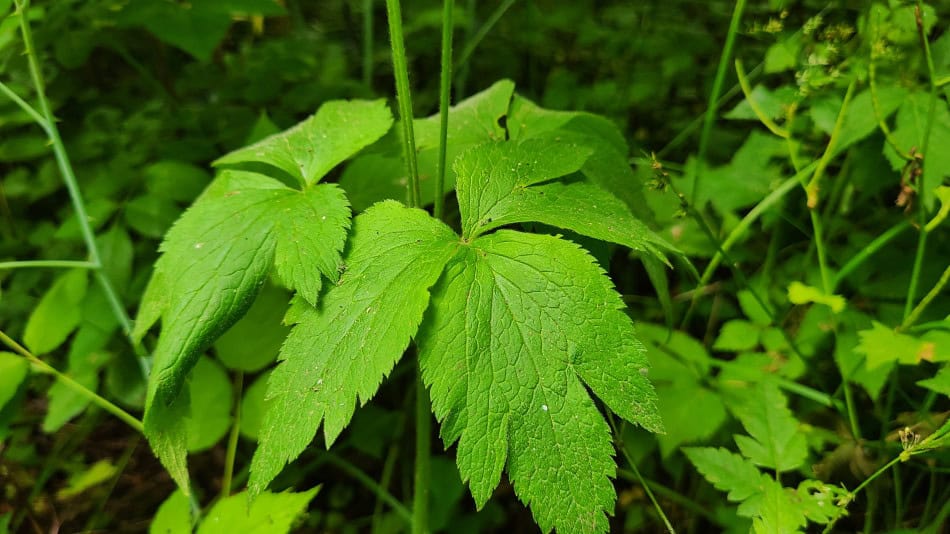
Leaves are very distinct and have an ornate appearance. There will be leaves at the base, and then again half-way up the stalk. They are in groups of two or three, whorled on the stem. Typically they are 2-5″ long and wide with several deep lobes, which are further divided into shallower lobes. Margins are are coarsely serrated. The underside of the leaves will have hairy veins

Flower
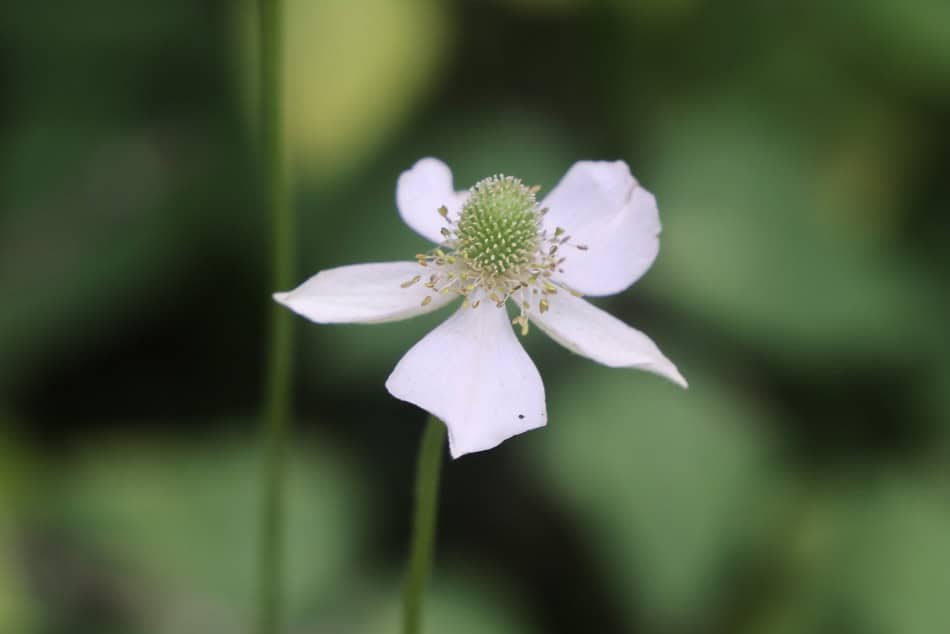
Above the leaves there will be a long stalk that has a single flower 1/2″-1″ diameter. What appear to be 5 white petals are actually sepals, and in the center will be lots of stamens. Overtime, as the sepals fall off after pollination, the central structure will grow in size, eventually resembling a thimble.
Overtime, this thimble-shaped capsule will turn brown, and then open up reveling white fluff. This is the point where you can save the seed. When the capsule easily can be removed, you should place them into a paper bag, and allow the capsule to open. Keep this in a cool dry place. Fully dried seed can be stored in an envelope in a drawer.

Root
The roots are rhizomatous, and will sprout new plants/stems.
Growing Conditions
This plant is very adaptable, provided that the soil drains and doesn’t totally dry out. But, given those two characteristics, the plant can survive in full sun to nearly full shade. It prefers open woods, borders, and shorter prairies as long as the soil has some organic matter.
Fertilizer
Do not fertilize this plant, as excessive nitrogen could make it grow too tall and topple over. Also, this plant should not be chelsea chopped. For the record though, I have never seen a specimen in a wild environment tip over, even with the ‘thimble’.
How to Grow Tall Thimbleweed from Seed
Seed from Tall Thimbleweed needs a cold-moist stratification period of sixty days. This can be achieved either using a moist paper towel in a zip-lock baggy, or via winter sowing. For the record, Winter Sowing is by far my preferred method of starting seeds, and I highly recommend you do it.

But to plant the stratified seed or via winter sowing, fill a suitable container with moist potting soil. Scatter some seed on top of the soil, and then provide a light dusting of potting soil so that the planting depth is 0-1/8″ (3 mm) deep[5]. Press the soil with your thumb, so that even the uncovered seeds have good contact with moist potting soil. Germination will occur in early Spring.

Seedlings are somewhat slow to develop their first year. What I have done is to germiante the seed by late April, and then separate/transplant seedlings into larger 4″ pots, which I took care of until Autumn, at which point I planted them out in the open woods behind my home.

Wildlife, Pests, and Diseases associated with Tall Thimbleweed
Pollinators
This plant attracts a variety of smaller bees, pollinating flies, and even small butterflies (see photos below). It isn’t overly busy with pollinators, but it has a somewhat steady visitation rate.

Deer and Rabbits
The foliage of this plant is avoided by deer and rabbits, which is a necessary condition for the environments that this plant grows. Some references state that there is a chemical in the foliage that can cause blisters. And this may be the case. But observationally you can see that the plant is not prolific, which would be necessary for it to survive being a preferred food source of those hungry herbivores.
Disease
This plant is not bothered by diseases, and generally looks good throughout the growing season.
Where you can buy Tall Thimbleweed
Tall Thimbleweed is not typically sold in nurseries, as it isn’t a typically ‘showy’ plant. But it can be purchased at specialty nurseries that deal in Native Plants. You can find native plant nurseries near you on our interactive map.
Where to buy seeds
We have ordered a variety of native flower seeds from Everwilde Farms, which you can order right from Amazon through our link on our RECOMMENDED PRODUCTS PAGE. (We may earn a small commission when you purchase through our links, at no cost to you. This helps support our website.)

Uses of Tall Thimbleweed
Garden Uses
This plant could be used ornamentally in somewhat shady areas, or on the North or East side of structures where it could be protected from hot afternoon sun. It would make attractive flowers in Spring, and interesting seed heads throughout the Summer.
Another use of this plant is to fight off invasives like Japanese Stiltgrass or Garlic Mustard. Since the growing conditions of Tall Thimbleweed and Japanese Stiltgrass are very similar, that means they can share the same area. However, Tall Thimbleweed will grow up tall rather quickly in Spring, allowing it to compete with Japanese Stiltgrass. To relate some personal experience, while foraging for Pawpaws I have personally seen it among a see of stiltgrass that can often blanket the State Game Lands near my home.
Companion Plants
This plant grows well with other species that enjoy similar growing conditions. For flowering plants, American Bellflower, Columbine, Crooked Stem Aster, Short’s Aster, Aromatic Aster, Blue Mistflower (in part-sun conditions), Hairy Wood Mint, and White Wood Aster would grow well with Tall Thimbleweed. For grasses, try Bottlebrush grass or Virginia Wild Rye.
Medicinal Uses of Tall Thimbleweed
Several traditional medicinal uses of Tall Thimbleweed exist. It is an astringent, and the root and seed are the medicinal portions. Several ailments have been treated with it such as whooping cough, tuberculosis, diarrhea, and boils[6]. Traditionally several Native American Tribes would make a poultice of the root to treat burns and boils. Smoke from burning seed pods was used to revive people who fainted. The smoke was also used for decongestion and clearing mucous pathways associated with catarrh[3].
Final Thoughts
Tall Thimbleweed is a valuable native plant for pollinators that can look great as an isolated ornamental, or part of a wilder border or grown in the open woods. It’s flowers are attractive in Spring, while the foliage and seed heads look great all season. Finally, this plant can be of help in fighting of invasive species, particularly in woodlands (where it is desperately needed).
Find more native plants here
References:
[1] – Anemone virginiana. USDA NRCS.
[2] – Levy, Donna. Green dragons and doll’s-eyes. Cornell University. 1986, pp 116
[3] – Turner, Nancy J. “Counter-irritant and other medicinal uses of plants in Ranunculaceae by native peoples in British Columbia and neighbouring areas.” Journal of ethnopharmacology 11.2 (1984): 181-201.
[4] – Fielder, Mildred. Plant medicine and folklore. New York : Winchester Press, 1975, pp228
[5] – Mitchell, Esther. “Germination of seeds of plants native to Dutchess County, New York.” Botanical Gazette 81.1 (1926): 108-112.
[6] – Hao, Da-Cheng, Xiaojie Gu, and Peigen Xiao. “Anemone medicinal plants: ethnopharmacology, phytochemistry and biology.” Acta pharmaceutica sinica B 7.2 (2017): 146-158.
Recent Posts
Green Milkweed is a herbaceous wildflower native to North America[1], and is a host plant for caterpillars of the Monarch Butterfly[2]. Scientifically known as Asclepias viridis, it grows up to...
Keystone Plants - What Are They, And Why Are They Important?
If you've been researching native plants, you may have come across the term "Keystone Plant" or "Keystone Species". Often spoken or reverence or casually noted for their importance. So, what exactly...