
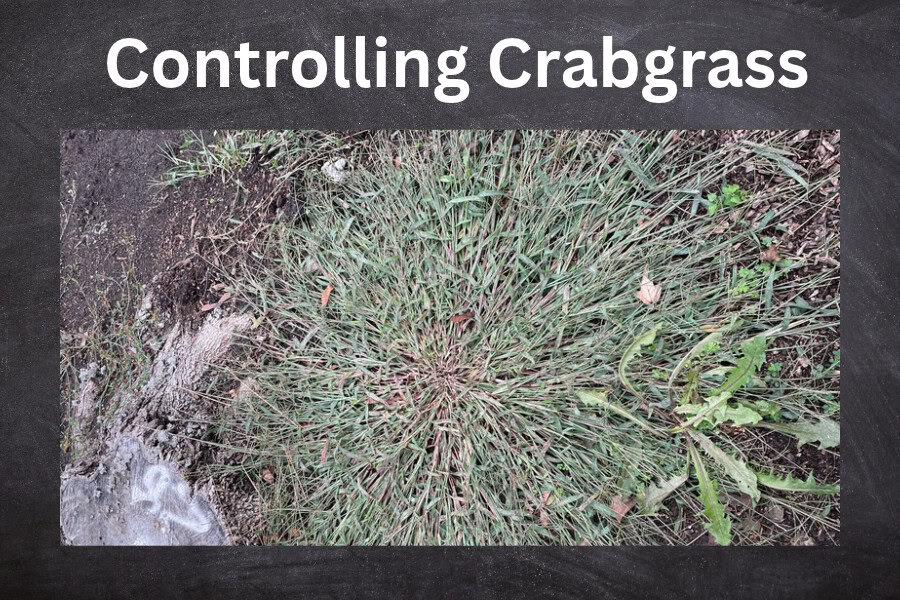
Crabgrass is an invasive weed from Eurasia that plagues gardens and lawns alike across the world. A creeping annual grass that is a more pale shade of green then regular turfgrass making it unsightly. Additionally it crowds out and forces back native perennial grasses, leaves bare spots in the winter as it dies and disintegrates from freezing temperatures, which leaves lawns muddy and ugly. Controlling this weed is big business in North America, and I’ve been doing so for many years in my own lawn. In this guide I will demystify the different methods you can employ, discussing the different types available, how to apply, and how long they last.
Prevention
You may have heard people say that the best defense against crabgrass in the lawn, is to have a healthy thick lawn. This advice is absolutely correct, as crabgrass seed germination is stimulated by exposure to sunlight. Research has consistently shown that, although not required, exposing crabgrass seed to sunlight will increase the germination rate substantially[1][2]. Having a thick lawn that is a bit taller will help shade out the underlying soil, reducing the amount of crabgrass seed that will germinate. However, if your lawn is thin, or you just want to make sure it stays out of your lawn, an application of granular herbicide in Spring is one of the best defenses.
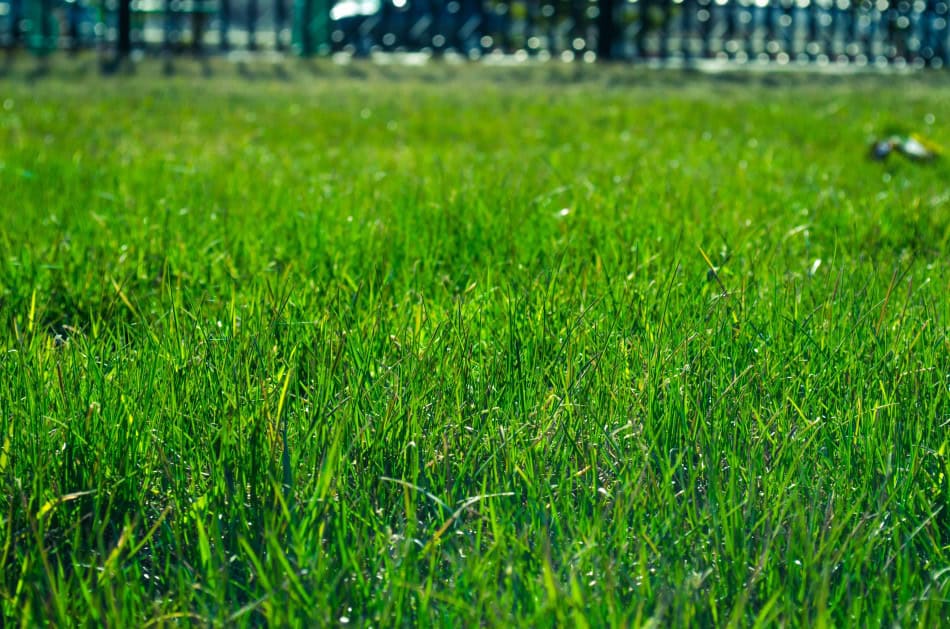
Preemergent herbicides
There are numerous pre-emergent pesticides sold commercially that any DIY’er can use on their lawn or garden. Just about all of these don’t actually prevent a crabgrass seed from germinating, but disrupt the initial plant cells ability to divide and grow right after germinating.
Now, basically all of these preventers are granular. You buy a big bag of it, dump it into a broadcast spreader, adjust the spreader setting to what it needs to be and then you apply it. If you have a broadcast spreader, then you just need to make sure you overlap a bit. One year I tried to maintain a ‘proper’ gap between between passes, and then I ended up with ‘landing strips’ in my lawn of crabgrass, and then no crabgrass. It looked kind of stupid, and ever since then I try to just keep 1 to 1-1/2 spreader widths between passes.
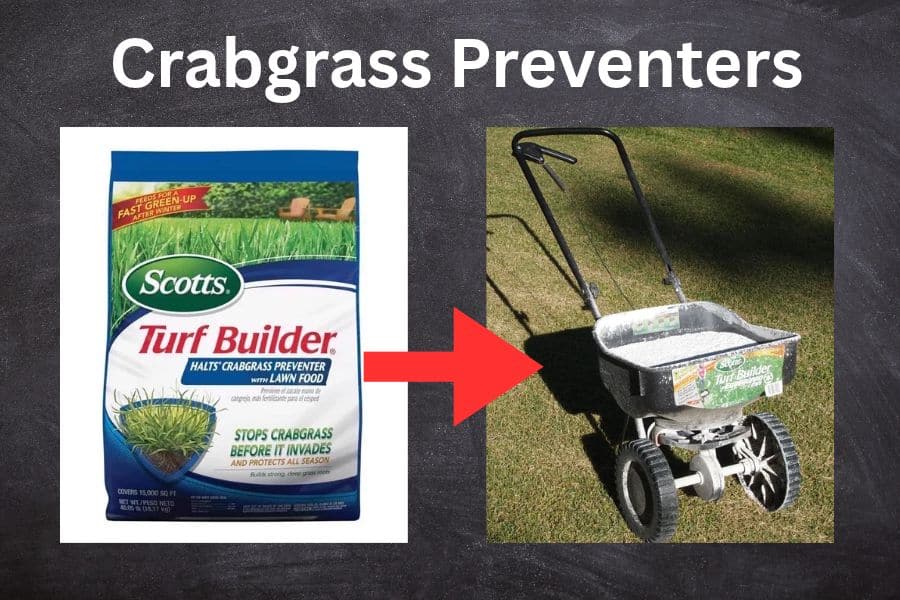
A brief summary of what is available on the market is in the table below.
| Herbicide | Typical granluar concentration | Typical duration | $/ 1000 sqft | Common Brand Name Product |
|---|---|---|---|---|
| Pendimethalin | 1.71% | Most products claim season-long control. Typical experience is usually 3 months or so | $ 9.00 | Scott’s brands (pictured above) |
| Prodiamine | 0.48% | Around 10–16 weeks in field/landscape use; actual lawn performance varies | $ 8.00 | Barricade |
| Dithiopyr | 0.15% | Up to about 12 weeks; two applications may be needed for full-season control | $ 6.80 | Dimension |
| Mesotrione | 0.08% | About 4 weeks in seeding-use guidance | $ 7.50 | Mesotrione |
| Siduron | 3.50% | About 4 weeks in seeding-use guidance | $ 10.00 | Tupersan |
Pendimethalin
Pendimethalin is probably the most commonly used crabgrass prevention herbicide used in United States, as it is sold at every single big box store in Spring under the Scotts and other brand names. It actually does not prevent seed germination, but is actually a herbicide that works by disrupting tiny microtubule structures that are required for cell division and growth early after the plant has germinated. Plants that have already emerged from the soil will not be effected.
I use Pendimethalin on my own lawn each Spring, as it is convenient, available, and you can often find large bags that cover 15k feet. The only time I’ve ever had it fail me was not a problem with the chemical – it was when I didn’t overlap with my spreader. I have a broadcast spreader, and I’ve learned to skip rows rather than worry about the 5′ spacing.
Prodiamine
Prodiamine acts similar to Pendimethalin in that it effects microtubules in seedlings that are just emerging after germination. It has a longer residual than Pendimthalin.
Dithiopyr
Also disrupting microtubules of newly germinated crabgrass plants, Dithiopyr does differ in one significant aspect. It can harm newly germinated plants before it starts tillering[3] (stalk shooting up).
Mesotrione (granular)
This herbicide acts in a somewhat unique way – this active ingredient will block an enzyme that helps a crabgrass plant make carotenoid pigments, which will protect the plant from damage caused by UV radiation / sunlight. So, small seedlings lose their protective pigments, and turn a bleach-white color, and ultimately die. This particular herbicide can be used with new seeded turfgrass, depending on the species of turfgrass used[4]. One note of caution, this can be harmful to some warm-season perennial grasses like Buffalo Grass.
Siduron
Sold as Tupersan, this preemergent is a selective herbicide in that it stops certain annual-grass seedlings like crabgrass from being able to establish themselves. Like Mesotrione, it can allow certain species of perennial turfgrass to germinate and grow, although timing is species specific.
When to apply the crabgrass pre-emergents
Crabgrass preemergent spreads need to be applied before it’s possible for the seed to germinate. And the seed will begin to germinate once the soil temperatures reach 55F for several days in a row. In many locations this is 4-6 weeks before the planting date for the area. You don’t want to miss this window, but you also do not want to apply it too early as you lose some of the residual time the herbicide is effective.
Post-emergent control
If you are reading this late in Summer, and you are noticing an explosion of crabgrass in your lawn you have some options. Many of these are sprays, and although some are available in ‘ready-to-use’, many are only available as concentrate. So, you may need to mix them up yourself with a funnel and sprayer.
Pulling
Yes, you can pull crabgrass plants whether in the seedling or mature plant stage. This is most effective when the plant has not formed seedheads yet. If you have a large infestation, then I strongly suggest using a potato or pitch fork, or even a shovel to loosen the soil first. Also, watering the night before will make pulling much easier. If there are no seed heads, you can just leave the plants lying in your lawn and then just mow them up. If seedheads are present, then you should be putting them into a bucket for proper disposal so the seed doesn’t just get dispersed.
Quinclorac
Multiple brand-name herbicide sprays (methylated seed oil) contain Qunclorac. It mostly works on young plants, and it’s effectiveness on more mature crabgrass may be inconsistent. Quinclorac is also effective on various broad-leaf weeds.
Fenoxaprop-P-ethyl
Sold for controlling numerous species of annual grass, Fenoxaprop-P-ethyl is effective on mature crabgrass, goosegrass, foxtail grasses, and even Japaense Stiltgrass. The brand name ‘Acclaim’ usually contains this as a primary ingredient. This is a slower working herbicide that is systemic, and usually only needs a single application. However, it temps are high or under drought stress, it could harm Kentucky bluegrass if that is present in your lawn.
Mesotrione (as a spray)
Yes, Mesotrione makes this article twice. First as a preemergent granular herbicide, and now as a post-emergent spray. Sold as Tenacity, it is a systemic postemergence herbicide that can control a number of annual grasses including crabgrass, yellow foxtail, and other broadleaf weeds (even nutsedge). This is most often used in newly seeded grass lawns with ryegrass, bluegrass, and fescue. Other species of newly seeded lawns may be damaged or killed though, such as fine fescues – so take care and read labels if using this one after emergence[5].
Topramezone
Sold as Pylex, this herbicide is systemic and behaves similarly to Mesotrione. This kills a variety of annual grasses (crabgrass, foxtail, goosegrass), but can be applied prior to seeding, or 28 days after.
The best option for most homeowners
The best option for homeowners is generally going to be Pendimethalin. It is by far the most commonly sold crabgrass preventer (Ace Hardware, Scott’s Brands) and is usually combined with a nitrogen fertilizer. This one will harm other grass seed the same as crabgrass seed though, so you need to seed much earlier (4 weeks before application) or just skip over-seeding until the Fall. Get a broadcast spreader (try Facebook marketplace or Craigslist for a deal), and overlap the spread to ensure a thorough application, and you can expect to have little to no crabgrass that whole season.
Find more gardening tips here
References:
[1] – Chauhan, Bhagirath S., and David E. Johnson. “Germination ecology of southern crabgrass (Digitaria ciliaris) and India crabgrass (Digitaria longiflora): two important weeds of rice in tropics.” Weed Science 56.5 (2008): 722-728.
[2] – Wang, Y. H., et al. “Abiotic factors affecting seed germination and early seedling emergence of large crabgrass (Digitaria sanguinalis).” Planta Daninha 36 (2018): e018166895.
[3] – “Crabgrass Control in Lawns for Homeowners in the Northern US”, Rutgers Cooperative Factsheet FS1308. Accessed 12NOV2026.
[4] – “When Do I Apply My Crabgrass Preventer”, Iowa State Extension Outreach. Accessed 12NOV2026.
[5] – PennState Extension, “Postemergence Control of Crabgrass and Other Summer Annual Grasses in Lawns”, accessed 23NOV2026.
Recent Posts
Bald Cypress is one of the more curious native trees to grace North America. Being semi-evergreen, it's leaves/needles turn a orange-bronze color in Autumn that can look truly stunning. Growing it...
So, if you are going to be spending time in the woods, or even anywhere with taller weeds you should take care to protect yourself from ticks. They cause numerous diseases like Lyme disease, and now...