
Showy Milkweed is a wildflower native to Western North America. Scientifically known as Asclepias speciosa[1], it typically grows 1-3′ tall in full sun and well draining soil[2]. Blooming showy white-pink flowers from June through September, it attracts numerous species of bee, butterfly, and hummingbirds, as well as serving as a host plant for the Monarch Butterfly[3][4].

If you’ve ever taken a trip out west to some America’s amazing national parks like the Badlands, Yellowstone, or Yosemite, you very well may have come across Showy Milkweed. This tough native has evolved to be one of the more adaptable milkweeds that inhabit North America. It can compete in the western prairies, grow on mountain slopes, and even pop up near small streams or canals. This milkweed is very common, which is good because Monarch butterflys depend on it for their survival.
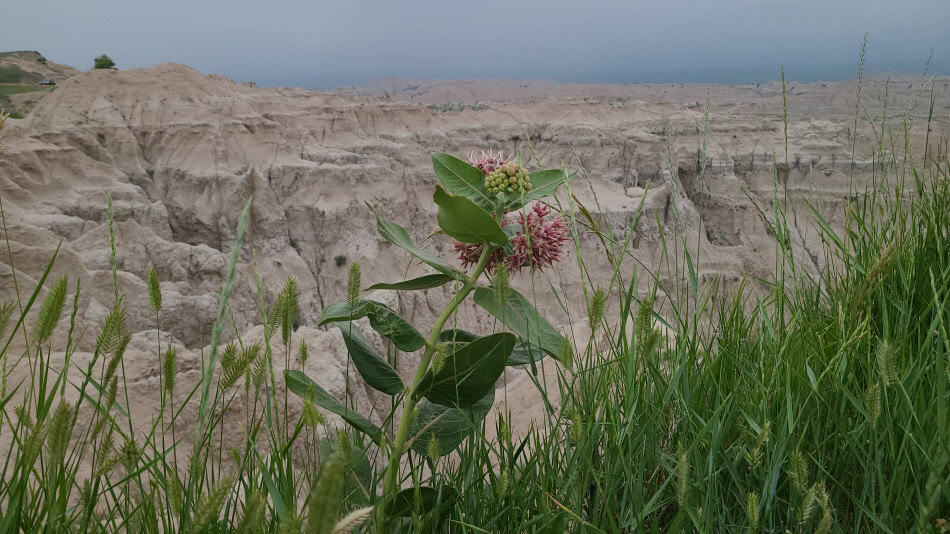
But this plant has a reputation for begin aggressive, which is well earned. It spreads not just by it’s fluffy seed pods that open in late Summer, but also by underground rhizomes. Rhizomes are horizontal stems that spread beneath the soil and send up new shoots in open patches of soil….sometimes a long way from the mother plant! And this spreading action dissuades many people from planting Showy Milkweed. However, if you are inclined for a bit more effort, I have invented a method for containing it’s spread.

But this plant is beautiful, tough, and incredibly important for wildlife. So, if you are curious about it and want to investigate growing it in your yard then read on, as I will teach you what information you need to know to identify, grow it successfully from seed, and landscape with it.
Facts
- The sap inside Showy Milkweed is a mixture of cardenolides, which is specifically poisonous to the heart.
- One of the most adaptable of the milkweeds, it can be found in semi-desert environments or along streams/canals that occasionally flood.
- Fibers from the stems of Showy Milkweed were woven into rope/cordage by native American tribes. It would take approximately 5 stalks to make 1 foot of cordage
- Young leaves, buds, and shoots were boiled and eaten by Native Americans.
- Like all members of the Asclepias genus, Showy Milkweed is a host for the Monarch Butterfly
Native Range
The primary native range of Showy Milkweed is Western North America. From Minnesota South to Oklahoma, and East to the Pacific Ocean.

Reference Table
| Scientific Name | Asclepias speciosa |
| Common Name(s) | Showy Milkweed |
| Native Range, USDA Zone | Western North America |
| Bloom Time | Spring – Summer |
| Bloom Duration, Color | 4 weeks, White/Pink |
| Height | 1-5′ |
| Spacing / Spread | 12-18″ |
| Light Requirements | Full sun |
| Soil Types | Sandy to clay loam |
| Moisture | Dry to medium-moist, can tolerate occasional flooding |
| Fauna Associations / Larval Hosts | Bees, butterflies, wasps, hummingbirds / Hosts Monarch Butterfly |
Pros and cons
Pro
Beauty
The flowers of Showy Milkweed are gorgeous. Seeing them blow in the breeze while large bumblebees try to hang on is a lot of fun! But a mass planting of this all blooming simultaneously puts on a heck of a show.
Tough
It takes some grit to be able to survive in the harsh environment that Western North America can throw at you, but Showy Milkweed is more than able to meet that challenge. It has survived prairies, the inhospitable badlands, and the Rocky Mountains without issue. Once established, this plant is in it for the long haul!
Wildlife
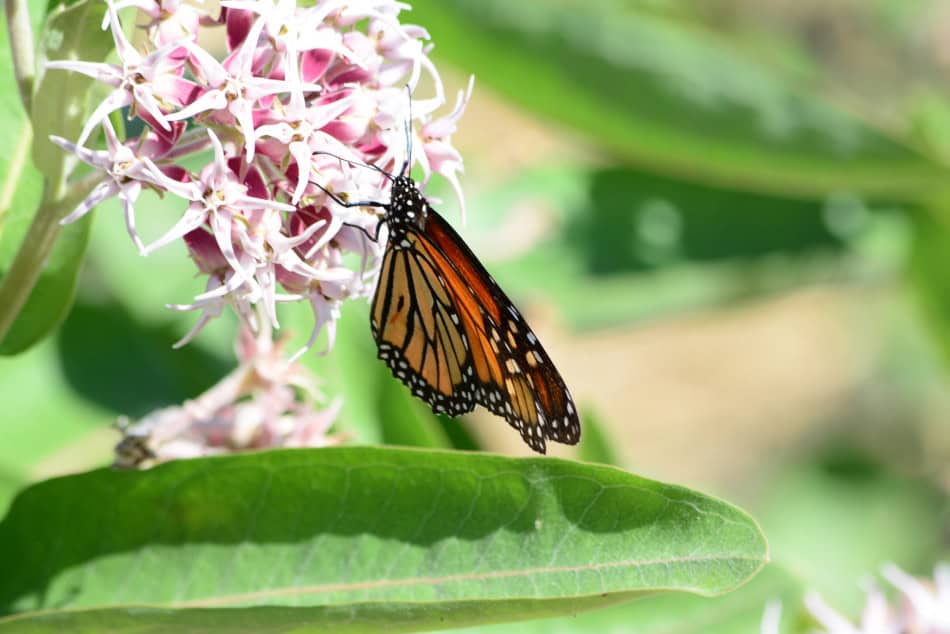
The amount of nectar produced by this plant is immense. And it keeps the bees and butterflies coming back to feed. Plant several of these and you will be treated to a heck of a show.
Con
Aggressive
Showy Milkweed spreads by seed, and underground rhizome. And it has the spreading kind, not the clump-forming kind…. An underground rhizome (also known as runners) is a horizontal stem that moves beneath the soil surface, and will sprout new plants. This species will be aggressive in formal flower beds unless special measures are taken to contain it.
RELATED ==> There are other types of Milkweed that don’t spread. See what kinds here.
Identification and Characteristics

Stalk
Ascending/erect stalks can reach up to 5′ tall in optimum conditions, but are often shorter at 3′ tall. They are round, light green, and hairy.

Leaf
Leaves are opposite, up to 7″ long by 3-4″ wide, oval shaped with smooth margins. They are covered in small, velvet-like hairs, and medium green in color and will have a prominent central vein that is reddish purple in color. If you tear a leaf, a milky-white sap will be secreted from the wound. Do not touch this, as it can cause temporary blindness and is toxic if consumed.

Flower
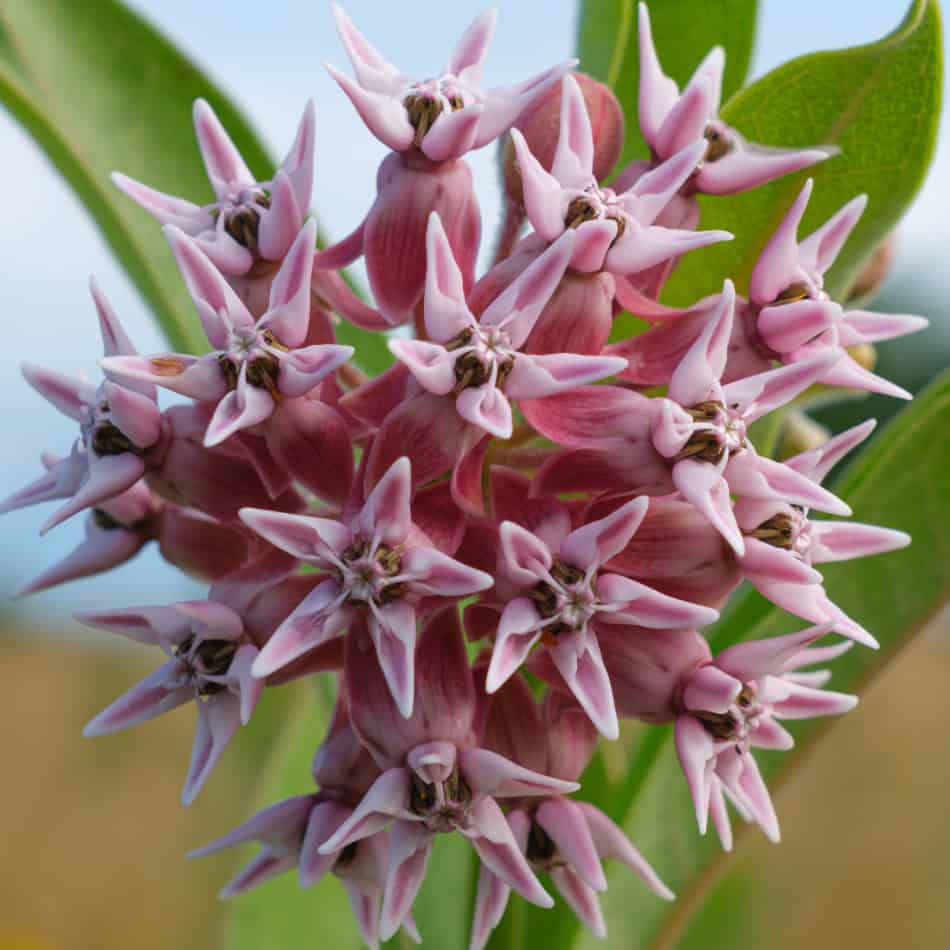
Flowers occur in loose clusters at the end of the stems and bloom from May to September. Individual flowers will have 5 petals, and then a colored hood behind the corolla. Milkweed ‘style’ flowers are incredibly unique, and once you recognize them you will begin to notice other species everywhere.
How to save seed
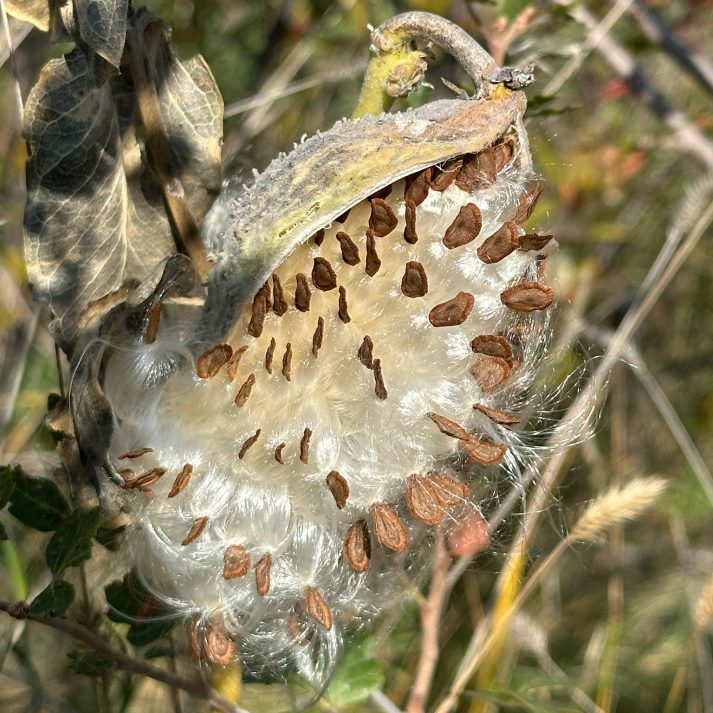
You can easily save seed from Showy Milkweed. Once you see the pods forming, simply return to the plant weekly and pay attention to when they begin opening. Once you see a pod opening, the seed should be ripe in the other pods. So, collect a pod and return home. If you want to really be sure the pod is ripe, wrap a twist-tie around the pod and then just return a few weeks later to see if it begins to open.
Outside, with your pod, rub it between your hands firmly. Then, open the pod and the seed/silk should all be contained in the pod and not be ‘bursting’. Alternatively, if your hands are large enough, open the top of the pod. You can then reach into it and find the central portion of the silky fiber. With your other hand, grip the pod tightly below the opened portion. Pull the central stalk of fiber out, and you should effectively strip the seed from the fibers. See this video for more instruction.
Ripe seed can be stored in an envelop for several years in a cool, dry, dark place.
Root
The root system is fibrous and spreading rhizomes. This is an aggressive plant.
Growing Conditions
This is one of the more adaptable Milkweeds when it comes to soil texture and moisture. It can be found in semi-desert environments (where it grows in depressions) and also along canals or water. It is best is the soil is well draining though, even if it tolerates occasional flooding. For sun, this plant basically needs full sun and is not shade tolerant.
Fertilizer
Do not fertilize Showy Milkweed. As a native, it does not require fertilization and has adapted to poor soils. Applying a conventional fertilizer will likely result in excessively large plants that will flop over.
How to Grow Showy Milkweed from Seed
Showy Milkweed seeds need to experience a cold-moist stratification period of 30-90 days to achieve a high germination rate[2]. To do this, you can cold stratify them in a moist-paper towel/baggy in the fridge, or winter sow the seeds. My personal preference is by far to winter sow the plant.

But, to plant stratified seed or for winter sowing, fill a suitable container with moist potting soil. Then, place 5-10 seeds on the soil and gently press them in with your thumb. Next, give a dusting of soil. Water by misting so you don’t was the seed to one side, and place the container in a location that receives morning sun and afternoon shade. Germination will occur in early Spring once temperatures are reliably above 50-60F.

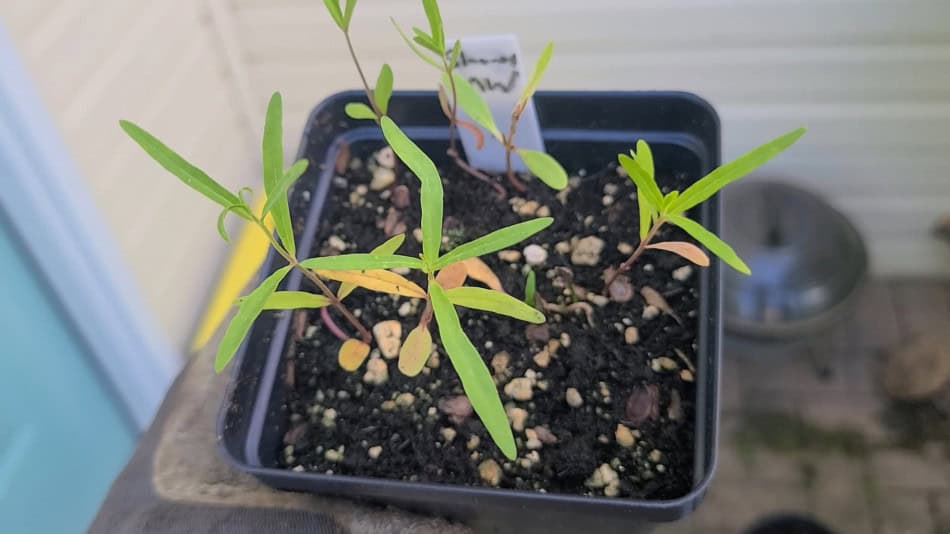
Once a seedling has grown 2-3 sets of true leaves, you can separate or thin seedlings. Or, you can transplant to it’s final location. However, be sure to protect the young seedlings from rabbits by using liquid fence.
Propagation through division
The spreading rhizomes of this plant make dividing it, or propagating via transplanting very easy. If you notice a new plant emerging from the ground in Spring, and wish to relocate it somewhere else you can easily do so by simply digging it up. You need to make a hole large enough to get at least 6″ of the horizontal runner (rhizome). See my detailed guide on this topic, where I transplant common milkweed (which is very similar).
Wildlife, Pests, and Diseases associated with Showy Milkweed
Pollinators
Showy Milkweed produces copious amounts of nectar that attracts numerous species of pollinators including all manner of native bees, honey bees, butterflies, hummingbirds, pollinating flies, wasps[4]….this is a pollinator powerhouse. And all that is to say nothing of the fact that it does host the Monarch Butterfly. The image below shows some of the variety of pollinators you can attract with a strong planting of Showy Milkweed.

Other insects
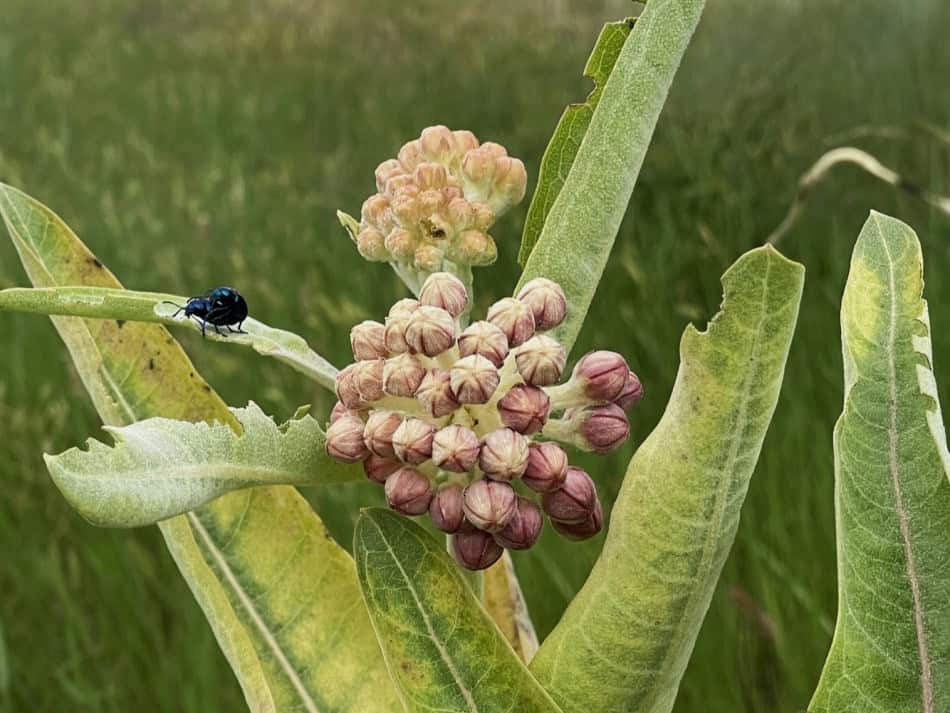
There are a number of other insects that feed destructively on the foliage and seed pods of Showy Milkweed. These insects should not be considered as pests, but are just part of the larger ecosystem and food web. Milkweed beetles are one of the more common of these insects.
Deer and Rabbits
In general, Showy Milkweed is deer and rabbit resistant. The toxic sap inside the stem and leaves keeps them away. However, young tender foliage and seedlings can be eaten. So, if you are planting seedlings you should protect them with Liquid Fence until the plant is established.
Livestock
Showy Milkweed is toxic to cattle and livestock[5] although it isn’t a preferred foodsource. Many farmers have worked to eliminate it from fields which puts further pressure on Monarchs, as they have less host plants available.
Disease
In general Showy Milkweed is not bothered by diseases.
Where you can buy Showy Milkweed
Showy Milkweed is not typically sold in nurseries, as it isn’t a typical ‘garden friendly’ plant because of it’s spreading rhizomes. But it can be purchased at specialty nurseries that deal in Native Plants. You can find native plant nurseries near you on our interactive map.
Where to buy seeds
We have ordered a variety of native flower seeds from Everwilde Farms, which you can order right from Amazon through our link on our RECOMMENDED PRODUCTS PAGE. (We may earn a small commission when you purchase through our links, at no cost to you. This helps support our website.)

Uses of Showy Milkweed
Landscaping
Showy Milkweed can be successfully used in landscaping in several different ways. First, you can have a small designated ‘wildflower’ or microprairie area and just let it run wild. Second, it can be used as a border with other grasses or plants like Little Bluestem or Sideoats Grama. And third, you can actually have it as an ornamental and keep it contained (see below).

The important thing to remember, and this is important, is that if you want your plants to serve as hosts for Monarch caterpillars, it is incredibly important that you plant several plants. In fact, I would argue that you need to have 5 plants (at minimum) to be able to host caterpillars. I have several species of milkweed all around my property, and while I have massive plantings of Butterfly Weed, sometimes I have caterpillars completely devour an isolated specimen of Poke Milkweed, and I have to manually move the caterpillars to other patches after they have defoliated them.
How to contain Showy Milkweed
So, many people avoid using rhizome spreaders because they don’t want them to take over or begin to pop up in their yard, which is completely understandable. But, I pioneered a method that has worked for keeping other rhizome spreaders contained for many years. You basically plant the Showy Milkweed in a large pot (9″ diameter x 9″ tall) that is lined with landscape fabric, in the ground. Here is a link to my article and video describing this process and showing the results.
Native American Uses
Numerous Native American Tribes used Showy Milkweed for a variety of uses. Fibers were extracted from the stems (after drying) to be used as a textile for clothing or cordage. The silky seed fibers were also spun to make a yard, which could then be used as a textile[2].
When it comes to food, young leaves, stems, and buds were also boiled and eaten as a food. The milky sap (poisonous) was allowed to dry and then used as a chewing gum. The inner layer of the fruit was used for food. The flowers would be boiled with soup or meat and used as a gravy[6].
A decotion of the tops of plants was used as an eyewash for blindness by the Cheyenne[6]. Fresh roots were boiled and used for stomachaches. The sap would be applied to warts or skin sores, decoction of root in small doses was used as a treatment for venereal disease, cough medicine, and to draw poison from snakebites. A poultice of root was used to treat rheumatism.

Final Thoughts
Showy Milkweed is an amazing plant that is not only pretty, but valuable to many pollinators and butterflies. Planting it in our yards (where it is native) is an easy way you can directly benefit your local habitat. And, although it is aggressive, it can be well contained with a bit of effort by using a pot lined with landscape fabric. Just remember to plant enough to support Monarch caterpillars!
Find more native plants here
References:
[1] – Asclepias speciosa Torr. USDA NRCS. Accessed 15DEC2025.
[2] – Stevens, Michelle. SHOWY MILKWEED Asclepias speciosa Torr. USDA NRCS Plant Guide. 2000.
Accessed 15DEC2025.
[3] – Gudžinskas, Zigmantas, Lukas Petrulaitis, and Egidijus Žalneravičius. “Asclepiasspeciosa (Apocynaceae, Asclepiadoideae): a rare or unrecognized alien species in Europe?.” PhytoKeys 121 (2019): 29.
[4] – – Federal Highway Division, Ecoregional Revegetation Application (ERA)
[5] – Fleming, C.E., The Narrow-leaved milkweed (Asclepias Mexicana) and the broad- leaved or showy milkweed (Asclepias speciosa) : plants poisonous to live stock in Nevada. University of Nevada, 1920.
[6] – Asclepias speciosa Torr. North American Ethnobotany Database. Accessed 16DEC2025.
Recent Posts
Green Milkweed is a herbaceous wildflower native to North America[1], and is a host plant for caterpillars of the Monarch Butterfly[2]. Scientifically known as Asclepias viridis, it grows up to...
Keystone Plants - What Are They, And Why Are They Important?
If you've been researching native plants, you may have come across the term "Keystone Plant" or "Keystone Species". Often spoken or reverence or casually noted for their importance. So, what exactly...