
Alright – so if you have ever researched vegetable gardening, or planting certain species of flowers (like orchids or hydrangeas) then you’ve probably come across some comments talking about soil pH, and how it is important to get it right. Soil is a fascinating topic, and I find that pH often confuses people and can be a bit mysterious. So, whether you’ve been gardening for a long time, or are just getting started, I’m going to dive into this topic a bit more deeply. By the end of this guide you will know the following:
- What is soil pH
- How will the extreme pH levels effect plants?
- What are the best ways to measure it?
- What pH is good enough to garden in ?
- How did my soil get it’s pH level?
- Can I change the pH of my soil?
What is pH?
The pH level is a measure of how acidic or basic water is. So, when we measure the pH of soil, we aren’t measuring the soil itself, but the water within the soil. Specifically, it is a measure of the concentration of hydrogen ions and is a logarithmic scale. So, that means it is base 10 (not linear like weight or torque). So, a pH level of 6 is 10x more acidic than a pH level of 7…..
Why does the soil pH matter?
So, the soil pH level will effect what base nutrients are available for plants. You see, the lack of hydrogen ions, or a surplus of them will cause various elements to form precipitates and be no longer available for plants to take up. So, if your soil pH is to far acidic or basic, then your plants will not only suffer, but possibly die.
For most people, their soil will be somewhere between 6-7.5, which is perfectly fine for the vast majority of plants. But, if you are outside of that range, then it is important to understand why and either change your gardening plan, or take steps to modify the pH. I consider this to be of importance, similar to testing your texture or drainage.

Related ==> We made a new Vegetable Gardening App! GardenBoost is an AI Powered App, Trained on our videos and content, it is designed to be 100% customized to your situation. Upload a picture or sketch of your garden (or future garden) and it will help you manage it year round, 100%. No missed planting windows, get lessons, suggestions on other vegetables to try, succession planting, disease or pest diagnosis (just upload pictures) – this app does it all. You can find it here!.
What happens in extreme acidic soils?
So, extreme acidic soils Phosphorus will become fixed and no longer available as it reacts with iron, aluminum and manganese at pH levels below 5.5. Additionally potassium, calcium, and molybdenum leach through soils.
What happens in alkaline soils?
At the other end of the spectrum, soils with high pH levels (typically greater than 8.0) have nutrients that are no longer available for uptake by roots. For example, Iron, manganese, zinc, and copper will form various hydroxides or carbonates. This is typically shows itself by plant leaves yellowing while the veins remain green. Likewise phosphorus can bond with calcium and mineralize, becoming unavailable. In highly alkaline soils, nitrogen can escape to the atmosphere via ammonia gas.
These nutrients are critical for plant functions. An important example would be phosphorus, in that it promotes root and fruit growth. Nitrogen is what makes plant tall and produce many leaves, which in turn convert sunlight to sugars for the plant. And calcium is important for strong cells.
What is the best way to measure pH?
Alright, so we know this pH thing is important. But how do we determine it? Well, there are several different methods.
- Send it to a lab
- Use test strips
- Electrical conductivity (no battery)
- Glass electrode pH meter
Using a lab
First, and most effective is to just send a soil sample to a lab. You can use a professional lab, or your local state ag extension. Your local ag extension will be very cheap, but may take a bit of time to get the results. In general, state labs cost around $10 while professional outfits charge $40-$60.
Look, I’ve done this, and you will learn a ton about your soil. All the nutrients, the pH, etc. And it is a fun thing to do, however, contrary to what farmers or some youtubers say, you do not need to do this every year. Heck, once is probably enough for the vast, vast majority of people.
Using test strips
There are numerous soil test-kit strips available on amazon. And they will work, just make sure you get ones that have an overall range of 3-10, with at least 3-4 color graduations per strip.
Measuring via electrical conductivity (cheap analog soil meter)
Ok – these are the cheap $10 soil testers you can get at any garden center or amazon. They have no battery, and are usually just a dial with two long prongs. They work, within reason. Your soil needs to be sopping wet, and near room temperature. The accuracy is a bit wanting, in that you will probably only be able to tell if you are between two levels, but they are good enough in most cases. If you use one, and it says your soil is a pH of 4, or 9, then that is just an indication that you need to send away to the local ag extension for a proper soil test.
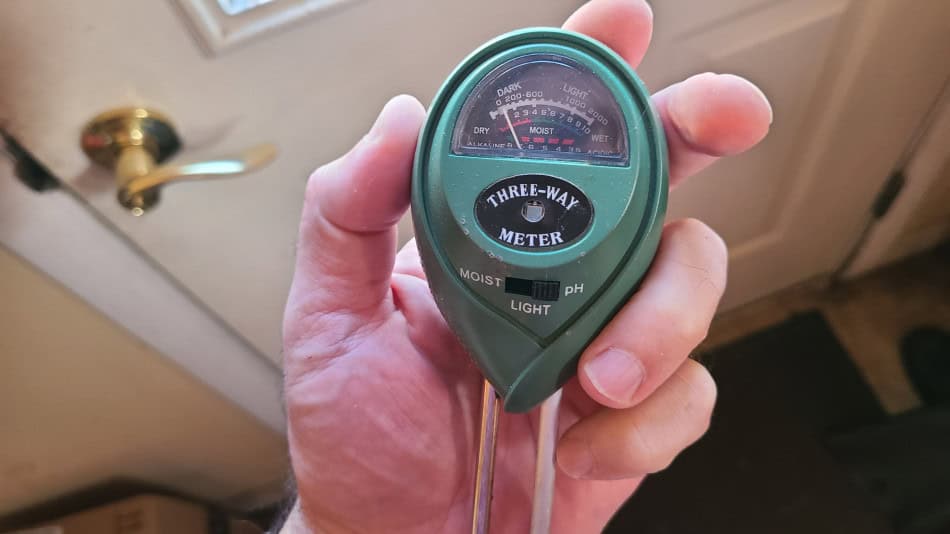
The thing about this meter is….it’s basically measuring the conductivity of your soil. So, get a bucket full, and get it sopping wet. Then drain, and insert the probe. You should see some sort of change in the meter. I’ve tested mine by making acidic solutions, and it seems to respond well.
Using a glass electrode pH meter
These are a more advanced form of the above meter in that they have a different measurement system, and can actually be calibrated by the user. So, you will get a pretty accurate measurement from one of these. They are more expensive (roughly $60), but more accurate.
What do you actually need?
For most situations, expensive testing is not necessary. If you just want to grow some tomatoes and peppers, maybe some cabbage, then don’t bother – first, just get the cheap tester from the previous section, and as long as that is between 5-8, then don’t worry about anything. It is extremely likely that you will be able to garden without issue as long as you use a fair amount of compost, etc.
What pH is acceptable to garden in?
Alright, so here is the important part. If your soil pH is between 5.5-8, then you need not worry about pH. Amazingly, your plants can actually regulate the pH in the small area surrounding their roots, in an area known as the rhizosphere. So, if you are at a 7.5 but your tomato wants 6.8, well, often it’s roots can condition the soil immediately surrounding the roots. This makes the nutrient and water uptake more efficient.
How does your soil get it’s pH level?
So, your soil is basically small particles of rock that have been breaking down via freeze thaw cycles for millions of years. And the base material is probably single most important factor in determining a soil pH. If the underlying rock is granite, volcanic, or sandstone then it is likely going to be more acidic. Other factors include the amount of rainfall in that humid or temperate areas have more acidic soils, while arid regions retain more salts, leading to more basic or alkaline soils.
Can you change your soil pH?
In short, yes, you can change your soil pH, but there is a catch – it generally will not last long. What I mean is that you can use various types of lime to raise pH, and use elemental sulfur or an acidifying fertilizer to lower pH. But, they don’t last! So, you will need to plan on reapplying them periodically. Now, doing this is not as simple as throwing a few handfuls of lime onto your garden – you need to determine the amounts, and types of amendments. This will generally require an actual soil sample lab report. So, plan on getting a full report from your local ag extension before you do anything.
But, the key take away here is that the pH change to your entire yard will not be permanent. Like soil texture, in order to change your existing soil you would need to add so much soil of a different, natural pH, that it would likely not be worth the time/effort or cost.
Alternative ways to modify pH
There are two other strategies for modifying pH. First, adding compost or significant amounts of organic matter can bring soil pH closer to neutral (have you started your compost pile?). In fact, that is exactly what I found when I tested my garden soil against my adjacent lawn soil. The soil within my vegetable garden, which has had multiple years of compost and leaf mulch had a pH of 7-7.2, while the adjacent lawn 10′ away had pH levels 6.4-6.8. And those results showed a massive difference in organic matter, with the lawn being around 5% organic matter while my vegetable garden was over 15%!

In the above image, the two soils are only about 10′ apart (3 m). The black soil is from my vegetable garden, while the brown soil is the natural soil from my lawn.

Permanently changing the pH
Ok – so while I did just say that you can’t permanently change the pH of soil, there is a way for you to grow something that prefers a lower/higher pH on your existing yard. And that thing is, raised beds. Yes, the famous raised beds that I so dislike are actually a great way to have full control over the pH of your soil. You see, if you need acidic soil but have alkaline, well, you just need to find a source of acidic soil, buy it, and fill a raised bed with it. How much do you need? Well, that will depend on how deep the roots want to go. But, this can be an excellent way to get blueberry bushes to taste right that will be a more permanent solution rather than amending your soil each year.
Find more gardening tips here
References:
[1] – Oklahoma Soil Fertility Handbook. Oklahoma State University Ag Extension. Accessed 21AUG2026.
[2] – Soil Acidity and Liming for Agricultural Soils. North Carolina State Ag Extension.
[3] – University of Alaska Cooperative Extension Service
[4] – Blossom-End Rot and Calcium Nutrition of Pepper and Tomato. University of Georgia.
[5] – University of Connecticut Ag Extension
[6] – Put an End to Blossom-End Rot: Water and Nutrient Management is Key. University of Connecticut.
[7] – Kabir, Md. Yamin, and Juan Carlos Díaz-Pérez. 2025. “Calcium Route in the Plant and Blossom-End Rot Incidence” Horticulturae 11, no. 7: 807. https://doi.org/10.3390/horticulturae11070807
[8] – Holz M, Zarebanadkouki M, Benard P, Hoffmann M and Dubbert M (2024) Root and rhizosphere traits for enhanced water and nutrients uptake efficiency in dynamic environments. Front. Plant Sci. 15:1383373. doi: 10.3389/fpls.2024.1383373
Recent Posts
So, if you are going to be spending time in the woods, or even anywhere with taller weeds you should take care to protect yourself from ticks. They cause numerous diseases like Lyme disease, and now...
At some point in your life, you are going to have to loosen a rusted, stuck, or seized screw. It is almost guaranteed! So, depending on the situation, one of these will work. I've noticed that lots...