
Purple Reed Grass is a native clump-forming grass that ranges from New Mexico to Alaska, and covers all the Canadian Provinces[1]. It reaches heights of 30″ in optimum growing conditions of full sun and well draining soil[2]. A pretty grass, it flowers purple spikelets in Spring at the top of the stalks. Although grasses are generally lower value to pollinators, this one does host caterpillars of two different skippers.

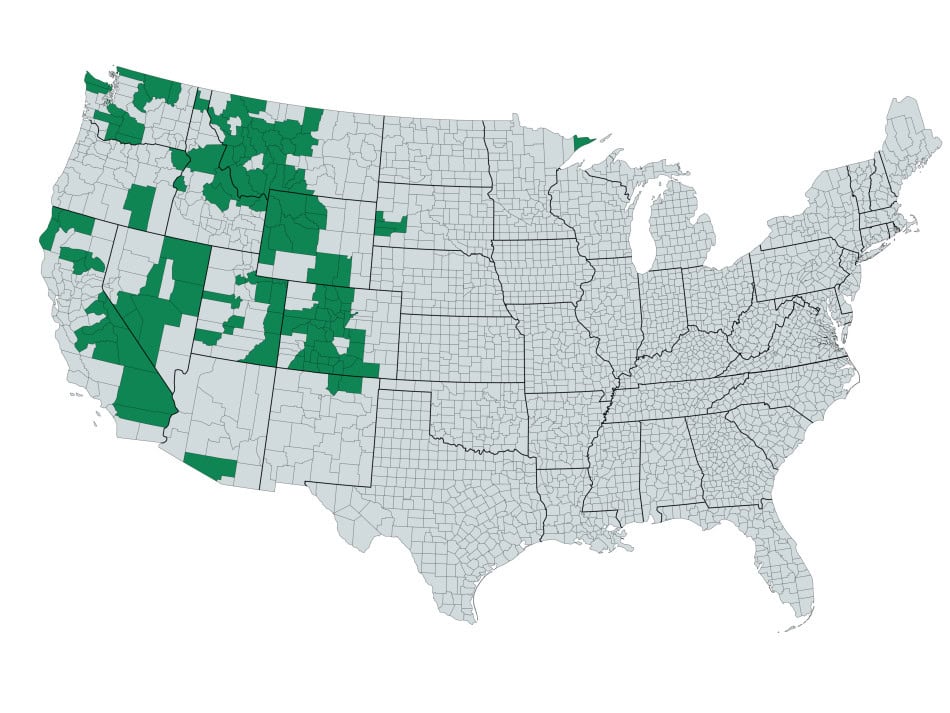
At our website, most of what we write about focuses on Midwest or Eastern plants, as that is where we are based. But the range of this grass is such that we encountered it on vacation in the Black Hills of South Dakota, specifically near the summit of Little Devil’s Tower and thought it was quite pretty. Upon further research I found it had a really interesting native range, covering all Canadian Provinces, but in the continental US it is mainly found in the Rocky Mountains with isolated pockets in other strange locations like Louisiana, likely a product of seed falling off retreating glaciers.

If one was able to gather seed you could easily landscape with this attractive grass, especially if you had dry well-draining soil. It’s modest height of 30″ means it could act as a natural barrier between groupings of other perennials, and it would provide cover and seed for birds. But let’s cover some basic facts and identification to give you a better overview of this plant.
Native Range
The native range for this grass is primarily the Western United States in the Rocky Mountains, with isolated pockets in the Black Hills. But also, this grass is native to just about all Canadian Provinces and Alaska (not shown in map).
Reference Table
| Scientific Name | Calamagrostis purpurascens |
| Common Name(s) | Purple Reed Grass, Purple Reedgrass |
| Native Range, USDA Zone | Western North America, USDA Hardiness Zones 2-9 |
| Bloom Time | May to August |
| Bloom Duration, Color | 4 weeks, Purple / Red |
| Height | 12-30″ |
| Spacing / Spread | 18-36″ |
| Light Requirements | Full sun to part shade |
| Soil Types | Sandy to loam, must drain well |
| Moisture | Dry to medium |
| Fauna Associations / Larval Hosts | Hosts chequered skipper and arctic skipper |
Identification and Characteristics
Stalk
The main blades (culms) are 6-24″ tall and grow from short rhizomes[3]. There will be short branches near the top that support the spikelet flowers.
Leaf
The main leaves are 2-4 mm wide and waxy to rough when touched[3]. They are alternate along the culm. Old leaves are typically present at the base of the plant (shown below).


Flower
At the top of the culms, there will be purple or red tinged spikelets that are wind pollinated[2]. These are on short branches at the top of the culm. Glumes are 5-8 mm long and lemmas are short being only 1-2mm long with wavy tips that are blunt[3].

Root
The root system is fibrous with short rhizomes.
Growing Conditions
The general conditions for Purple Reedgrass are full sun to part-shade, and well draining soil. It is drought tolerant, but can also be found in moist meadows.
In it’s natural habitat, Purple Reedgrass can be found growing in the alpine region above the timberline in dry slopes, hills, forests. But it can also grow in moist meadows. The US Forest Service notes that it is generally found above 8000′ to above 13000′[2].
How to Grow from Seed
Germination protocol for this seed showed higher germination rates provided the seed was sown on the surface and experienced a cold-moist stratification period of 60 days. You can achieve the cold moist stratification period by using a zip-lock bag with a moist paper towel, or just winter sowing it. Personally – winter sowing is the easiest way to achieve the cold-moist stratification requirement and have the earliest germination of seeds with the least amount of effort.

Wildlife associations
Pollinators
No pollinators feed directly on the grass flowers, but it does host two skipper caterpillars. Both the Arctic and Chequered Skipper will lay eggs on the plants[4].
Cover for wildlife
This grass is clump forming, and as colonies develop it can provide good cover for small mammals and songbirds. And it can provide decent or fair cover for game birds and slightly larger mammals[5].
Forage value
This grass is rated as ok for energy value in grazing and low in protein value. However, it is palatable early in the season for cattle, horses, and bighorn sheep[5].
Where you can buy Purple Reedgrass
Purple Reedgrass is not typically sold in nurseries, as it isn’t a typical ‘showy’ garden plant. But it may be possible to purchas at specialty nurseries that deal in Native Plants. You can find native plant nurseries near you on our interactive map.
Uses of Purple Reedgrass
Landscaping
Purple Reedgrass could be used ornamentally at higher evaluations in well draining soil. It would be a great choice for erosion control, or just as an ornamental addition in that it does look really nice while flowering, but the seed heads also add winter interest.
Final Thoughts
This is an interesting native grass that looks great, can add some value for wildlife in that it hosts two species of caterpillar, and also provides decent cover for small animals and song birds. It isn’t too difficult to germinate, provided you give it cold-moist stratification and surface sow the seed. So, it can be a cost effective grass for landscaping, erosion, or habitat restoration provided you can locate a source of seed.
Find more native plants here
References:
[1] – Calamagrostis purpurascens, USDA NRCS. Accessed 26NOV2025.
[2] – Calamagrostis purpurascens, Fire Effects Information System (FEIS), US Forest Service. Accessed 26NOV2025.
[3] – Lackschewitz, Klaus. 1991. Vascular plants of west-central Montana–identification guidebook. Gen. Tech. Rep. INT-227. Ogden, UT:U.S. Department of Agriculture, Forest Service, Intermountain Research Station. 648 p.
[4] – – Federal Highway Division, Ecoregional Revegetation Application (ERA)
[5] – Dittberner, Phillip L., and Michael R. Olson. “The plant information network (PIN) data base: Colorado, Montana, North Dakota, Utah, and Wyoming.” (1983).
[6] – Chambers, J. C., J. A. MacMahon, and R. W. Brown. “Germination characteristics of alpine grasses and forbs: a comparison of early and late seral dominants with reclamation potential.” (1987): 235-249.
Recent Posts
Green Milkweed is a herbaceous wildflower native to North America[1], and is a host plant for caterpillars of the Monarch Butterfly[2]. Scientifically known as Asclepias viridis, it grows up to...
Keystone Plants - What Are They, And Why Are They Important?
If you've been researching native plants, you may have come across the term "Keystone Plant" or "Keystone Species". Often spoken or reverence or casually noted for their importance. So, what exactly...