
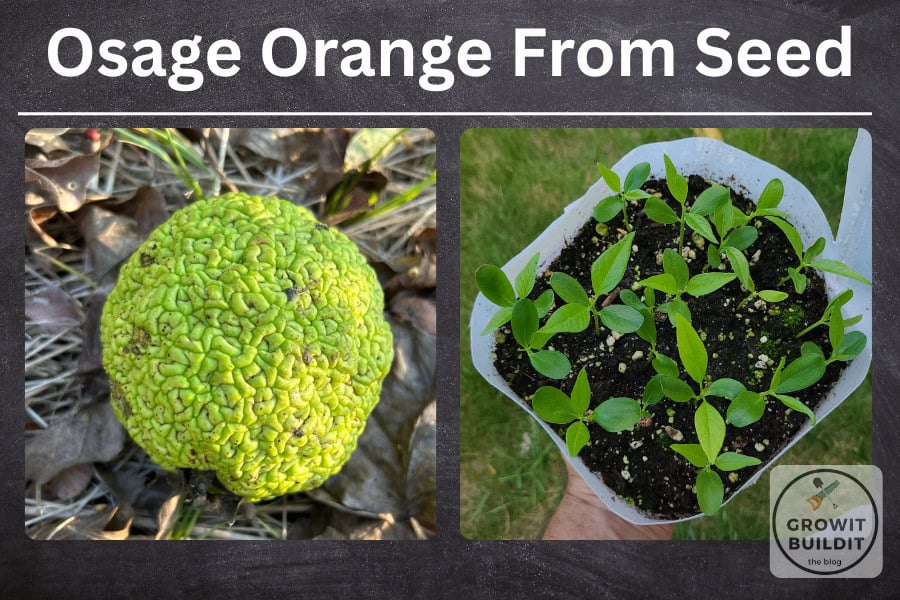
This is going to be a brief article explaining and documenting how to grow Hedge Apples from seed. If you need a windbreak, hedge, or just want to try to grow them as a fun project, well, you’ve come to the right place.
Osage Orange are medium sized trees (25′-60′) with thorny branches. Scientifically known as Maclura pomifera, they are native to Oklahoma, Arkansas, and Texas but have been introduced (& established) to much of North America[1][2]. They were very popular in the past as a natural hedge or fence to control the movement of livestock. Additionally they are planted for windbreaks, as their strong but flexible wind can withstand wind better than most trees.
Collecting seed
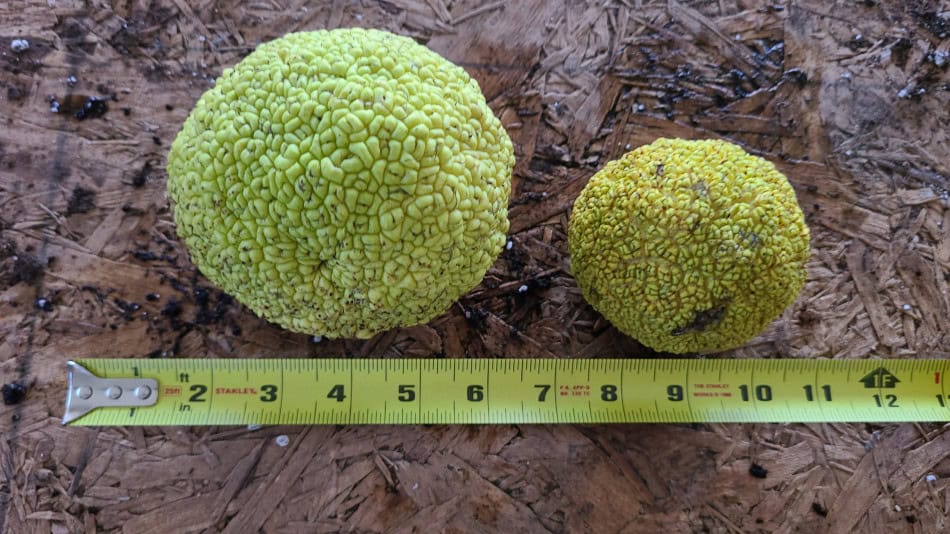
Osage Orange fruits will fall to the ground naturally in Autumn or Winter, where they can be simply picked up from the ground. The fruits are not preferred foods, but can be eaten by cattle or horses if they are in overgrazed pastures. Squirrels likely eat the seeds, but again, they are not a preferred food source so the fruits often persist well into Winter.
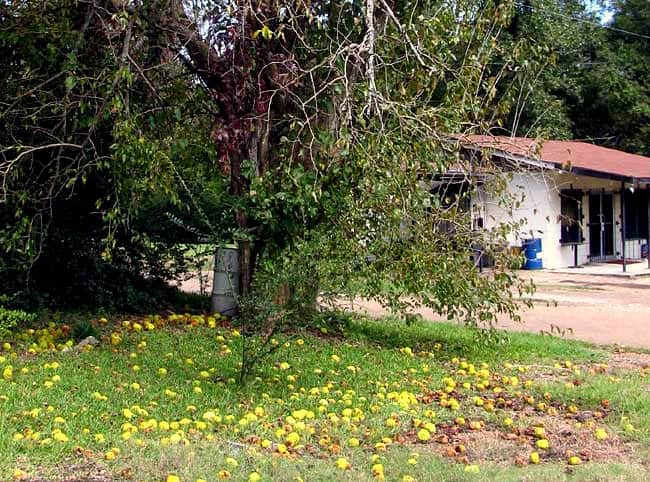
Take them home, and store them in an unheated garage or basement until you are read to process them. Note – these can be allowed to decay/ferment. It will make getting the seed an easier, but much messier job.
Cleaning / preparation
In late winter or very early Spring, you can now clean/prepare the seed. If the fruits are firm, then you absolutely will want to put on rubber or latex gloves. I did not wear gloves when I extracted the seed, and my hands got very sticky.
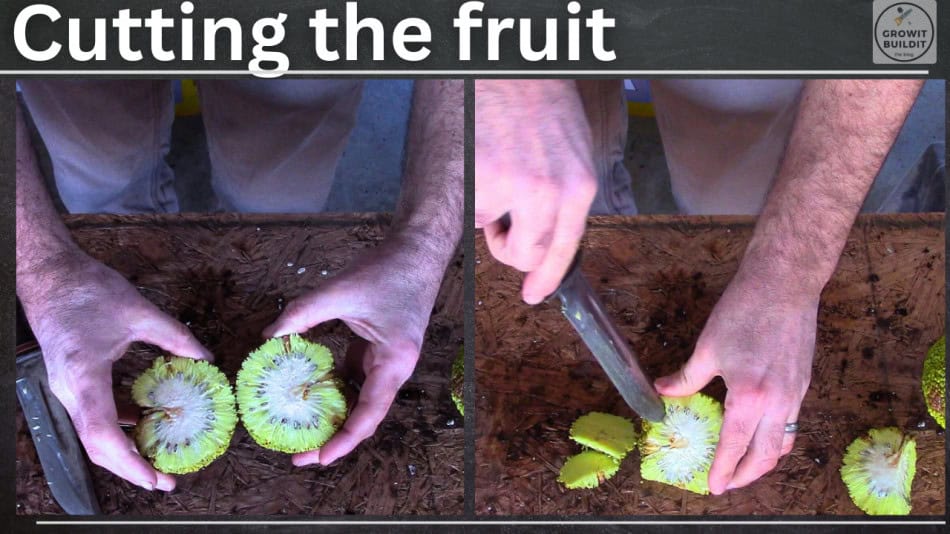
Cut open the fruit on a cutting board or scrap piece of plywood. Slice the fruit in half, and then begin cutting away the outer layer that does not contain seeds. You see, when you just cut or quarter the hedge apple you will inevitably slice some seeds in half, basically killing them. But slicing away the outer flesh allows you to squeeze out some seeds with your fingers, as removing the outer layer weakens the fruit greatly.
As you get seeds out, place them onto a paper towel. The seeds are so sticky that they won’t want to stay on a plate very well. But the texture of a paper towel will grip them.
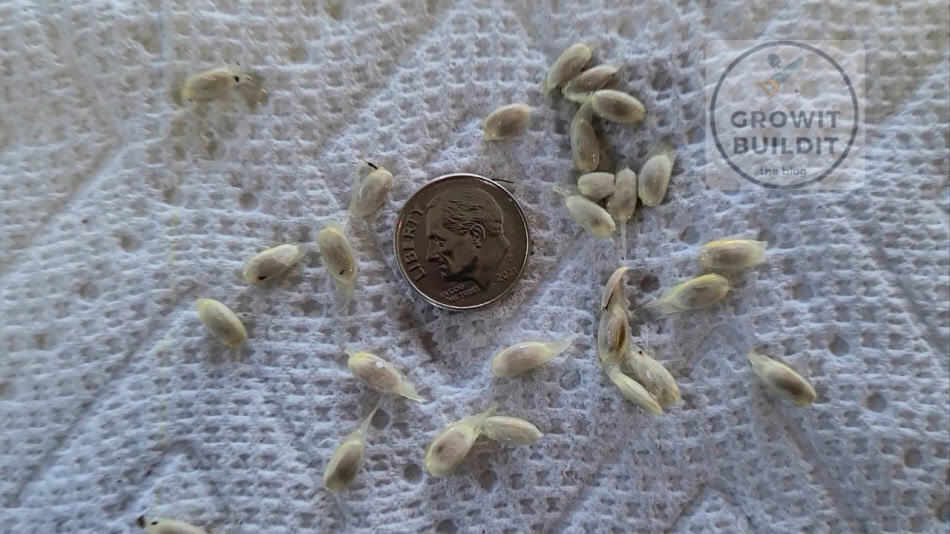
This seed is noted for having a somewhat short shelf life, so you should plan on planting it very close after extracting it. If you need to store it, keep it in a sealed container in the refrigerator.
Planting / winter sowing
The seeds should experience a cold-moist stratification period of 30 days to germinate[3]. You can accomplish this by either keeping them double wrapped in a moist (not wet) paper towel, inside a zip-lock bag in the refrigerator. Or, you can simply winter sow them. I’m going to show you the winter sowing method here (I did this in January, for reference). If you winter sow them, please note that the seeds should not experienced prolonged freezing temperatures. So, keep them in an unheated garage or shed.
But, if using cold-stratified seed or winter sowing, here is how you plant them. I used a milkjug for planting, the preparation of which you can find here (don’t forget drainage holes).
But fill a suitable container with moist potting soil, but leave a 1″ gap at the top. Then, place your seeds on the soil. Next you should give it a light covering of soil, giving the seeds an approximate 1/8″ to 1/4″ planting depth (3-6 mm). Place your container in a location that will stay cool but not freeze. I just kept it on the floor of my unheated garage.
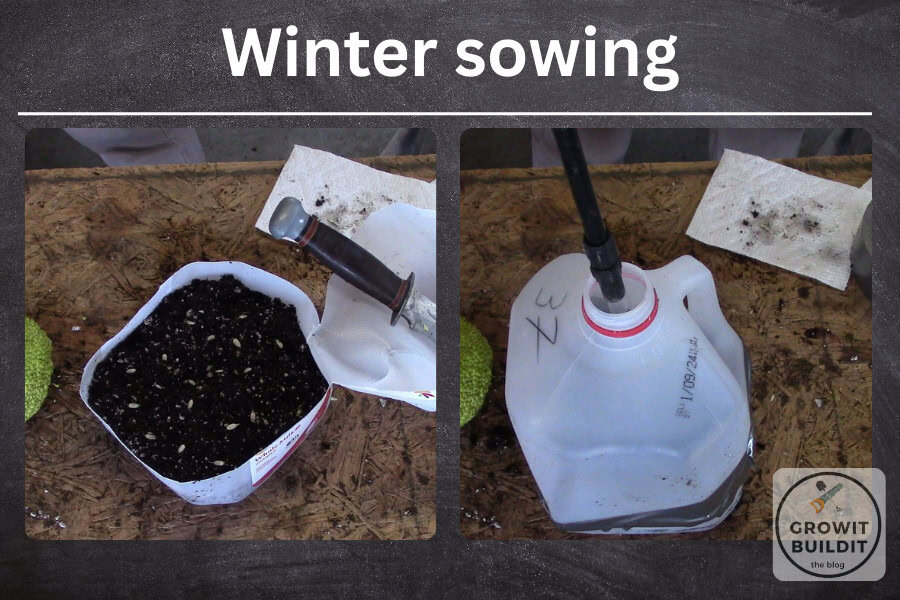
You’ll need to keep it moist throughout the winter. If you use a milk-jug, you probably won’t need to water it. If you just use a regular pot though, plan on adding a small amount of water once a week to make sure it doesn’t dry out.
Once the coldest part of winter has passed, and freezing temperatures aren’t much of a concern you can move the container outside to a place that gets morning sun and afternoon shade. For reference, I moved the jug outside in mid-March. It can still freeze at night, but the temperature is around 40-50 during the day.
Germination
Germination will happen once outdoor temperatures are regularly above 60F. This occurred for me about mid-April. I never checked my germination rate, but it sure seemed pretty high.
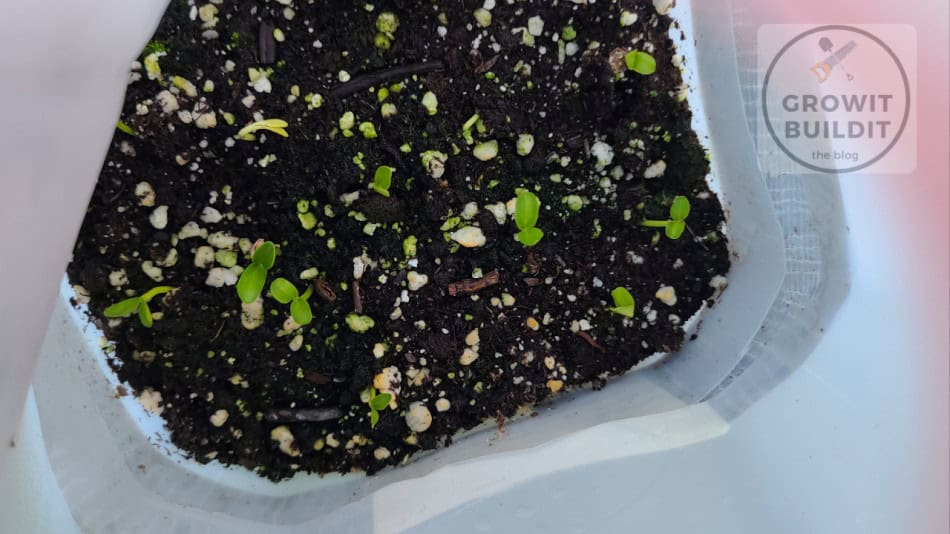
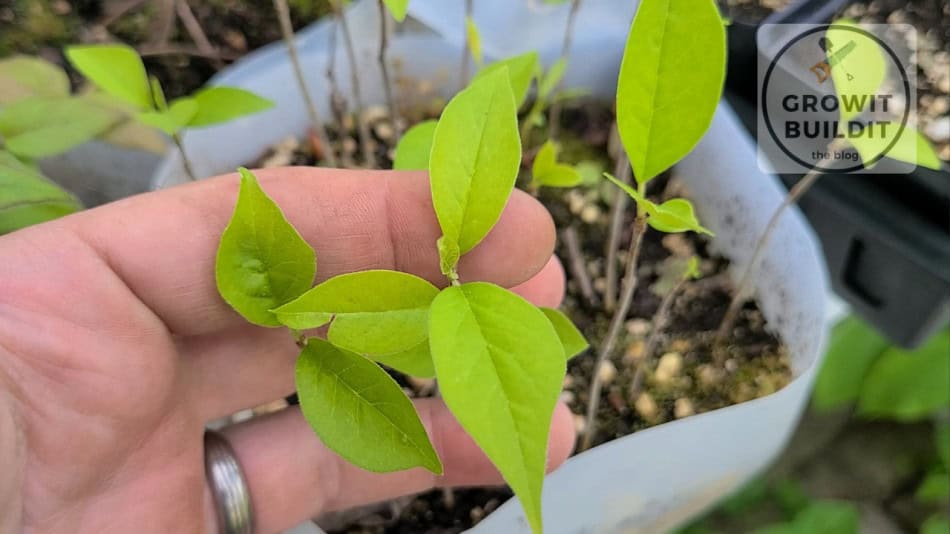
Once freezing isn’t a concern you can remove the tape and open the milk-jug. The seedlings will grow rather quickly. Here is what they looked like after three weeks.
Establishment
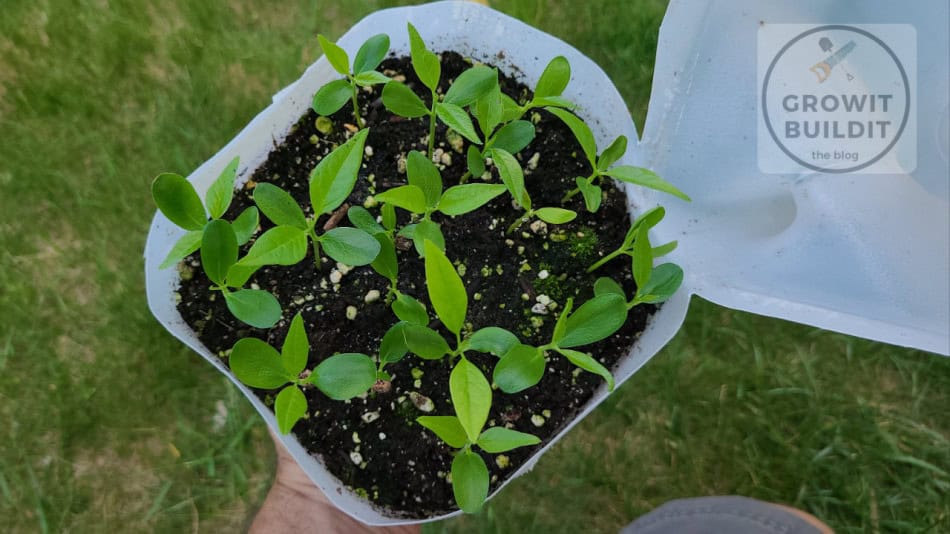
After six weeks all seedlings had 2-3 sets of true leaves. At this point you can either plant them to their final location or carefully separate the seedlings and transplant them to larger containers. If you opt to move them to their final location, you should consider protecting them with a cage or plastic tree shelter. This is because even though they are deer/rabbit resistant, young tender twigs and leaves often don’t contain the chemical defense that make them taste bad.
For location, Osage Orange prefers full sun, well-draining soil and dry to medium-moist conditions. See here for how to test your soils drainage, as this is important. Not having well-draining soil can result in disease and fungal problems.
Video Guide
Below is a short video I filmed showing the entire process start to finish. Hope it helps you out!
Conclusion

Growing Osage Orange from seed is a fun little gardening project you can do in the winter, and an absolutely cheap way to get seedlings. A single fruit can yield hundreds of seeds, so you don’t need to over harvest them! But just wear gloves when cleaning the seed to avoid some of the sticky sap, and plan on winter sowing right at the same time you collect.
Click here for more native tree guides
References:
[1] – Maclura pomifera (Raf.) C.K. Schneid. USDA NRCS. Accessed 19DEC2025
[2] – Wynia, Richard. OSAGE ORANGE Maclura pomifera (Rafin.) C.K. Schneider. USDA NRCS Plant Fact Sheet. 2011. Accessed 19DEC2025.
[3] – U.S. Dept. of Agriculture. 1948. Asimina triloba (L.) Dunal, pawpaw, p. 92. In: Woody plant seed manual. U.S. Dept. Agr., Washington, D.C., Misc. Publ. 654. Accessed 17NOV2023.
Recent Posts
Green Milkweed is a herbaceous wildflower native to North America[1], and is a host plant for caterpillars of the Monarch Butterfly[2]. Scientifically known as Asclepias viridis, it grows up to...
Keystone Plants - What Are They, And Why Are They Important?
If you've been researching native plants, you may have come across the term "Keystone Plant" or "Keystone Species". Often spoken or reverence or casually noted for their importance. So, what exactly...