
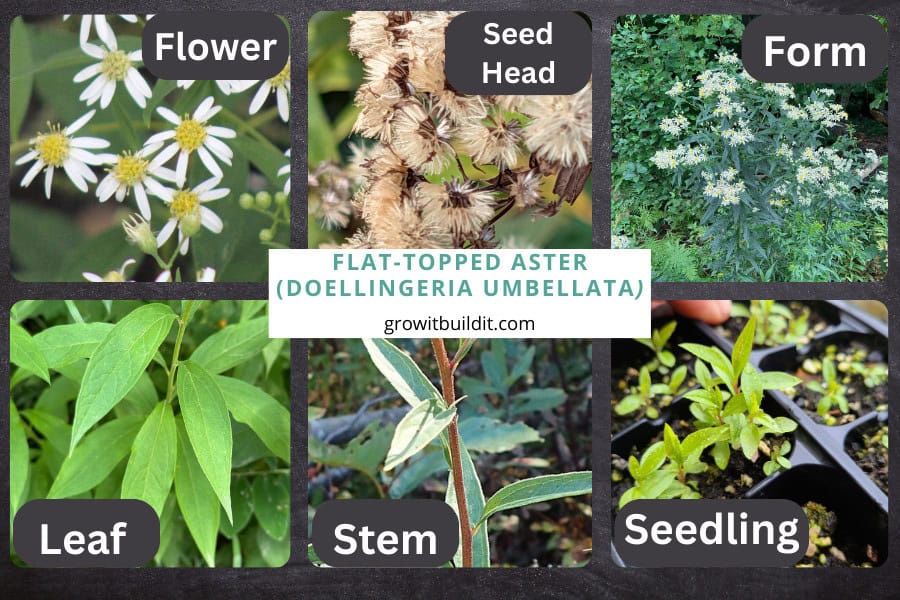
Flat-Topped Aster is a herbaceous perennial flower native to North America[1]. Scientifically known as Doellingeria umbellata, it grows up to 5′ tall in full sun and moist to medium-moist soils. Blooming clusters of white flowers in late Summer for up to two months, it’s nectar and pollen feed numerous pollinators and insects, while the seeds feed various birds[3][4][5].
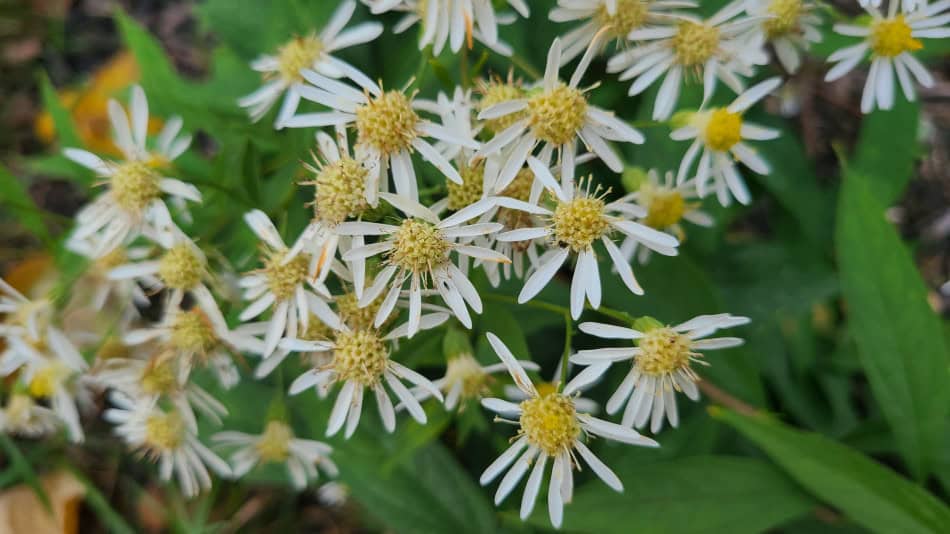
If you enjoy white flowers and lots of pollinator action, Flat Topped Aster can be a great addition to any garden. There are a few key points to know though. First, it isn’t very drought tolerant. That doesn’t mean it can be in drier conditions, but you should either provide it with water or make sure it gets afternoon shade during the hottest parts of the day. Second, if it does receive adequate moisture, it has a tendency to lean or flop once it gets above three or four feet. So, do the Chelsea Chop or surround it with grasses. In fact, I featured it here in my video on the Chelsea Chop. At that time-stamped link, I chop one plant half-way, and then show another Flat-Topped Aster later in the video that is leaning that I didn’t cut.
But it really does well bringing lots of pollinators. It is clump forming, so you will need to root-prune this to keep it to a size you want. That is a simple job, you just use a spade each Spring when it emerges to chop around the outside diameter of the sprouts, removing the outer ones you don’t want. Incidentally, if you want to spread this plant, you can simply replant those rhizomes somewhere else. And as long as you do it early enough in Spring, they should grow just fine.
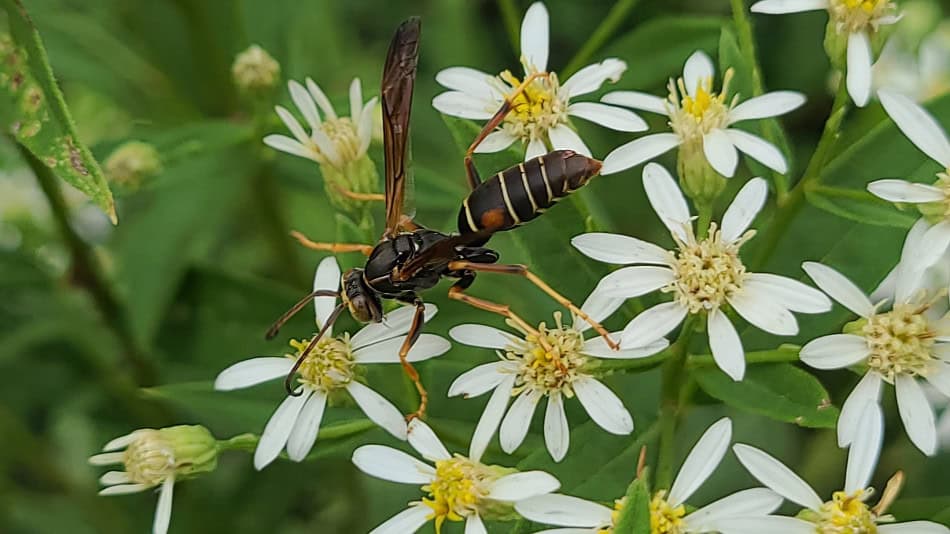
But my relationship with this flower is one of those happy accidents that occasionally happens to me in my gardening. My seed supplier mislabeled a package and sent me Flat-topped Aster instead of the other Aster species I wanted. And well, I didn’t discover the error until it was blooming in it’s second year! Needless to say, it all worked out, as I got some nice flowers that do an amazing job for pollinators, and after contacting the supplier (it was Everwilde), they sent me a free seed packet of the ones I had intended to grow!
Enough about that though – let’s take a closer look at the details of this pretty little flower.
Native Range
The primary Native Range for Flat-Topped Aster is the North Central and Northeast parts of North America. It covers the Canadian Provinces from Saskatchewan to Nova Scotia. In the United States it runs from Main, down to Virginia, then North East through the upper Midwest to North Dakota. There are also scattered and isolated populations in the Gulf Coast and in-between.

Reference Table
| Scientific Name | Doellingeria umbellata |
| Common Name(s) | Flat-topped Aster |
| Native Range, USDA Zone | Eastern United States, USDA Hardiness zones 3-8 |
| Bloom Time | Late Summer |
| Bloom Duration, Color | 4-8 weeks, White |
| Height | 2-5′ tall |
| Spacing / Spread | 1-3′ |
| Light Requirements | Full to part sun |
| Soil Types | Sandy loam to clay loam |
| Moisture | Moist to medium-moisture |
| Fauna Associations / Larval Hosts | Bees, butterflies, moths. / Hosts over 20 species of pollinator |
Benefits
Beauty
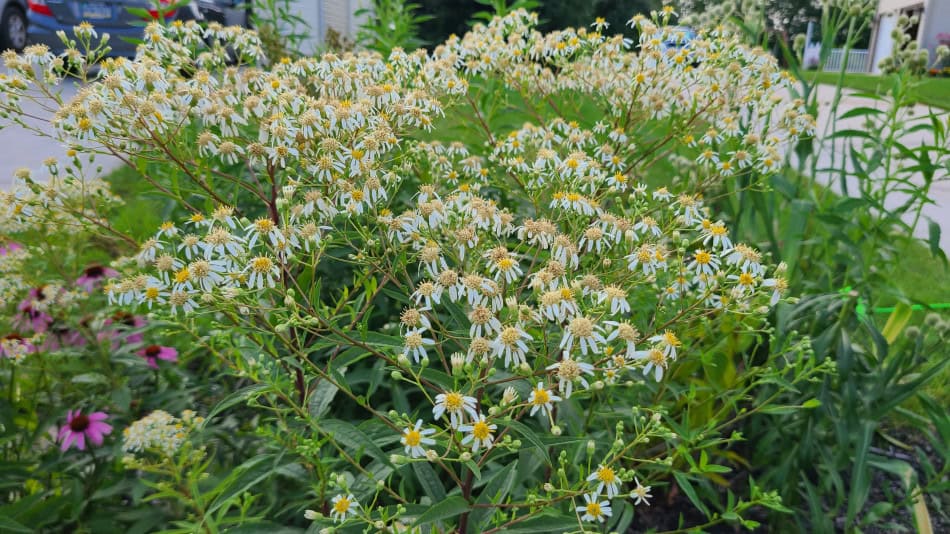
The daisy-like flowers of Flat-topped Aster are very pretty. Mass plantings can create a powerful display. Isolated specimens can also go with any other flower, so can provide a nice background.
Wildlife
This flower really brings in pollinators! A single plant can produce dozens of blooms. I normally recommend planting multiple of any species to attract more wildlife. And while that is always true, this one seems to do a great job even with a single specimen. It may be that it replenishes it’s nectar quickly enough to keep the bees and wasps coming.
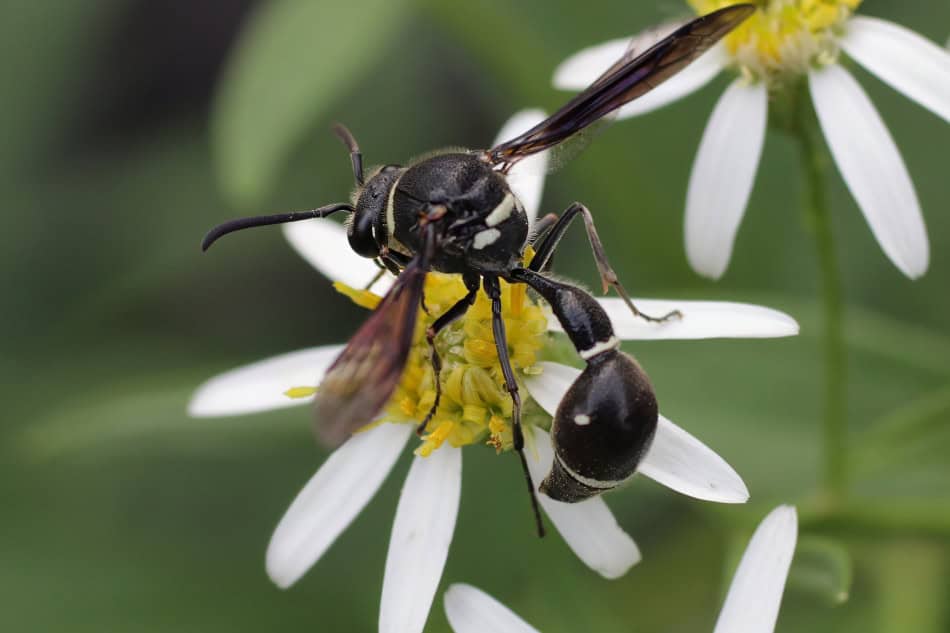
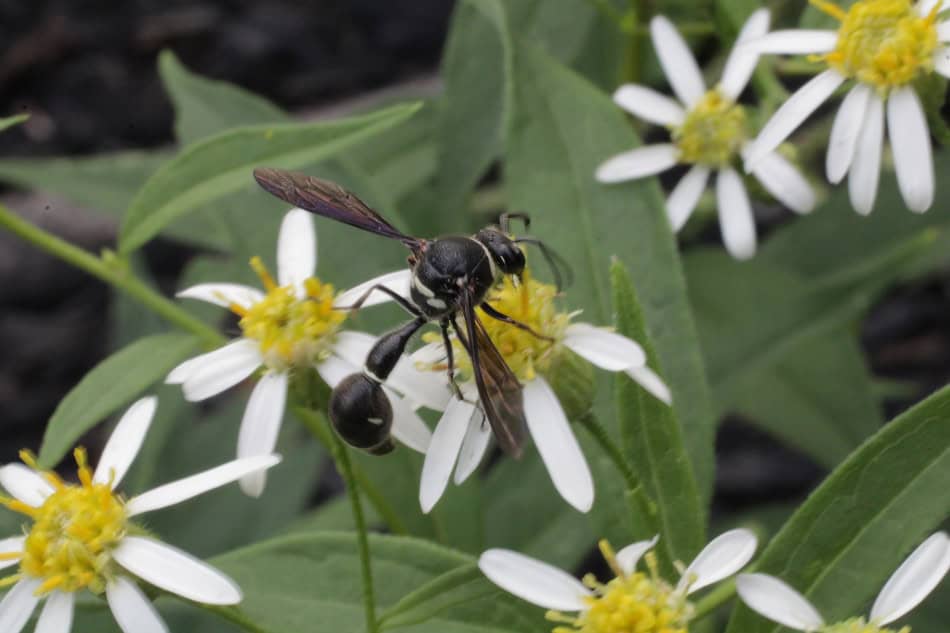
I find wasps to be some of the most interesting of all of God’s creations. The body on this one (Fraternal Potter Wasp) is amazing – just look how the abdomen necks down to almost nothing on this specimen!
Also – while most flowers, if they host anything at all it is usually only a handful of caterpillar species. But Flat-Topped Aster hosts 21 different species of pollinator.
A special note on wildlife, if you are fascinated by wasps, then this is a plant for you. Now look, wasps have a bad reputation, and it is well-earned. But you have to trust me here….I can almost touch wasps on this plant with zero chance of getting stung. While wasps will defend a nest, they are more docile when they are just feeding on flowers. If you saw how close I was when taking some of these photos….you would be amazed! I never get stung by photographing wasps near flowers.
Tough
This plant is pretty rugged. Rhizome producing plants tend to have a will to live greater than most other plants. And this one is no exception. I have dug up, split/divided it, chelsea chopped it, and probably abused it in other ways and yet it keeps coming back.
Identification and Characteristics
Stalk
The stalk is round, light green to purple-red, and usually unbranched until where the flowers form.
Leaf
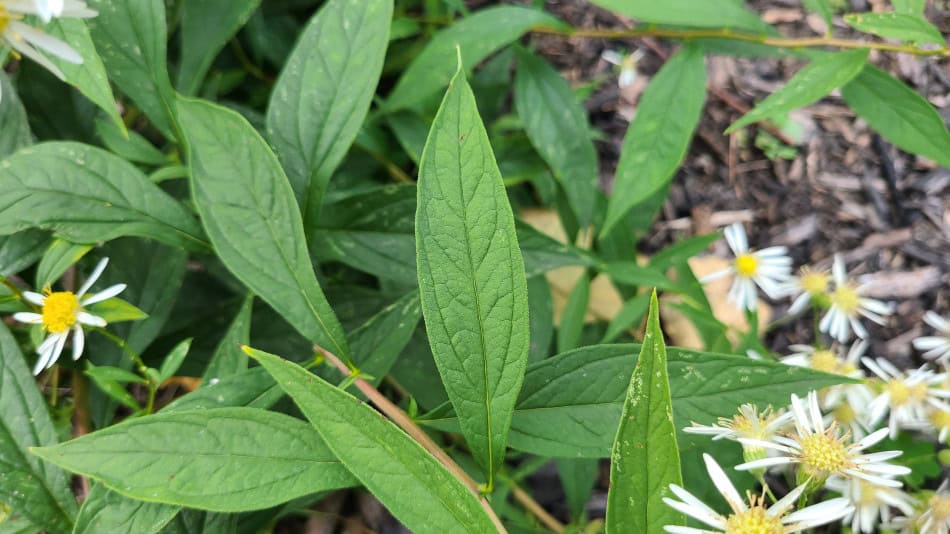
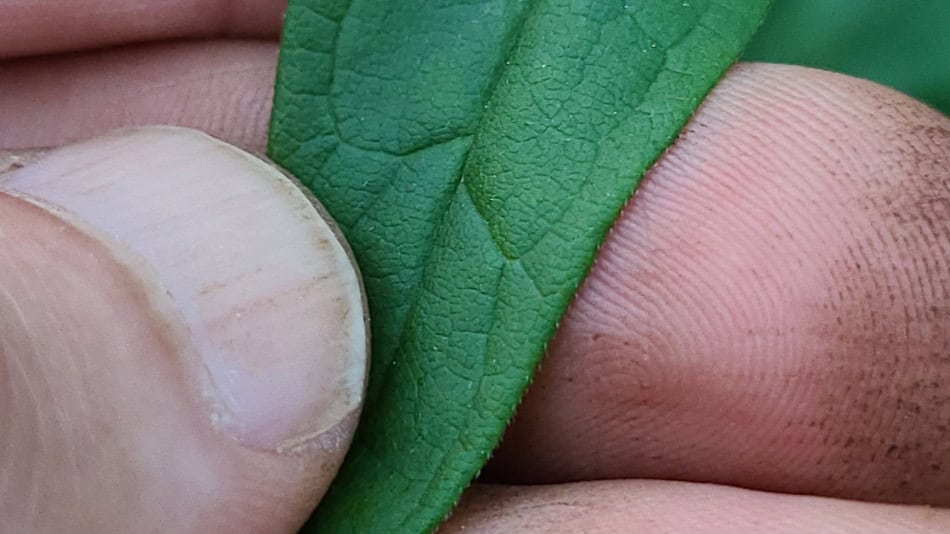
For leaves, they are alternately arranged, up to 5″ long by 1″ wide, and lanceolate to elliptic in shape, they have ciliate margins, and are dark-green in color. They have short stems, and often have small leaflets at the base.
Flower
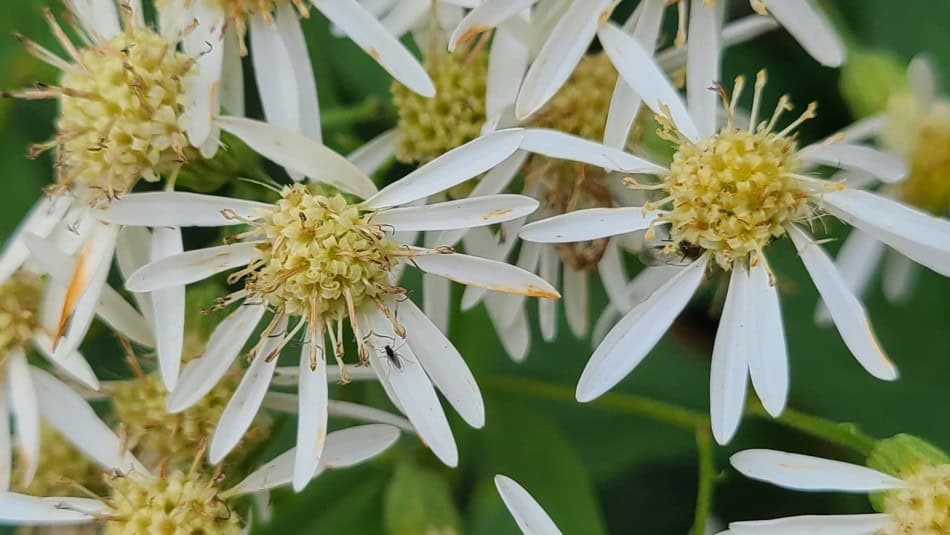
Stems terminate in to panicles of flowerheads that are up to 12″ wide. Individual flowerheads are approximately 1/2″ diameter with 6-15 white florets (petals). There are central disc florets that are yellow, giving it a daisy-like appearance.
Root
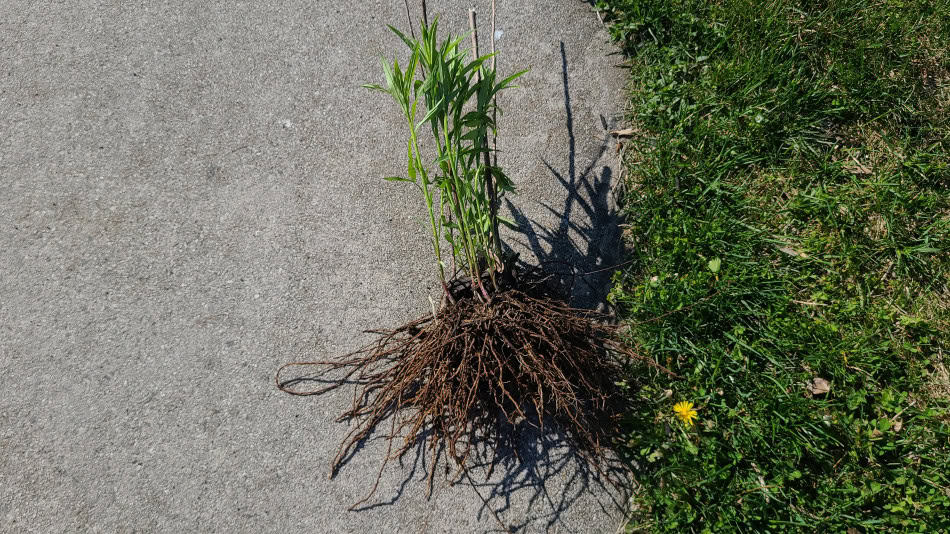
The root system is thick short rhizomes that are clump forming. Below is a picture of a mature one that I transplanted.
Growing Conditions
The primary preference of this flower is full sun, but it can tolerate part-sun as well. It likes more moist conditions, but it’s not drought tolerant. So, if in full sun, make sure it never runs dry, but in part-sun, it is more tolerant of dry conditions. I have grown this flower in 8-10 hours of direct sun per day, with afternoon shade and medium to dry conditions.
How to Grow from Seed
Seed for Flat Topped Aster has a dormancy mechanism preventing premature germination. To overcome this, it needs a cold-moist stratification period of 60 days. You can achieve this by winter sowing or using the refrigerator. The easiest way is to winter sow it, just purchase your seed from Fall to late Winter, then winter sow them.
But for planting stratified seed or winter sowing, simply fill a suitable container with moist potting soil. Scatter the seed on top of the soil, and give it a light dusting (don’t bury them). Press them into the soil with your thumb, and keep it moist by misting. Place the container in a location that gets morning sun or afternoon shade (East side of structures work great), and seed should germinate in mid-Spring.
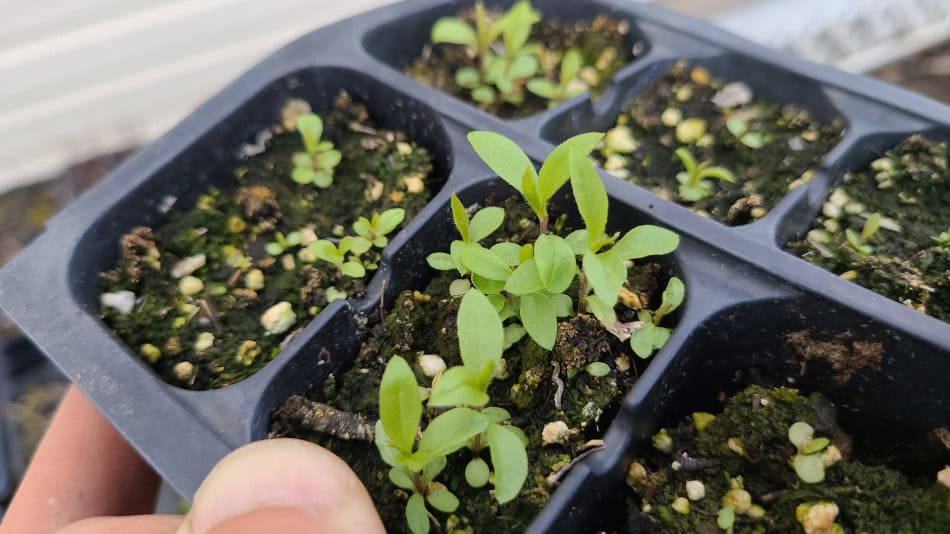
Once a seedling has 2-3 sets of true leaves, it can either be planted out in it’s final location. Or you could separate the seedlings and transfer to larger containers. Seedlings of Flat-topped Aster should be protected with Liquid Fence, as deer are known to browse it.
Propagate by division
This plant is really easy to divide in Spring. When the shoots have emerged, but before they are 12″ tall, simply dig up the clump and chop it in 2-6 sections. You can also take individual shoots and cut them off near the root ball, and replant them in other locations. Spring is the best time to do this, as the ground is moist and cool.
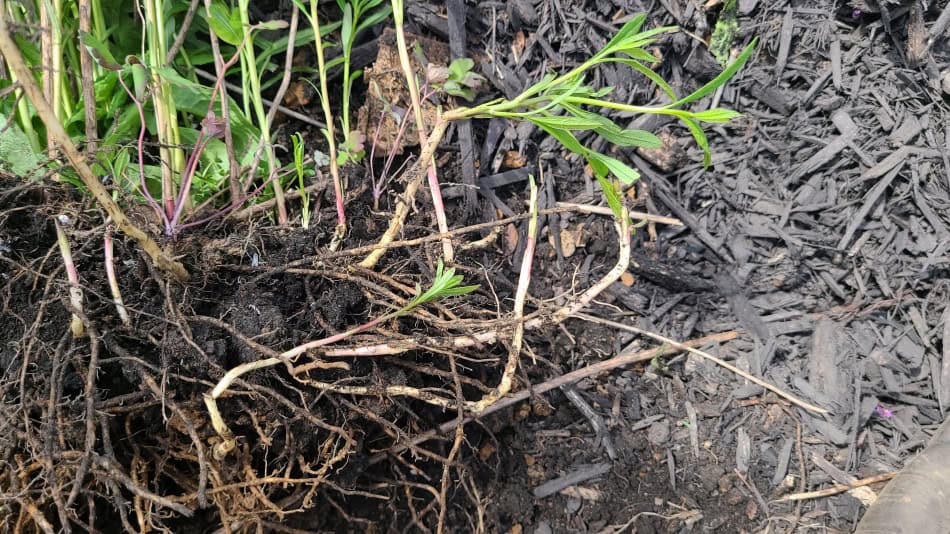
As you would guess from the image above, it is very easy to transplant these too!
Wildlife, Pests, and Diseases associated with Flat Topped Aster
Pollinators
This plant is a pollinator powerhouse. It really does attract a large variety of bees, wasps, butterflies, and other insects. The fact that it hosts so many species of caterpillar makes it quite unique when it comes to flowers. In fact it even hosts more insects than some trees!
Birds
Several species of bird are noted to eat the seeds of Asters. These include Grouse, Turkey, and Sparrows.
Deer and Rabbits
Deer and rabbits will browse the foliage of Flat-topped Aster. If there is a high population of deer, I strongly recommend using Liquid Fence for the first and maybe second year, until you have lots of sprouts for a single plant.
Where you can buy Flat Topped Aster
Flat Topped Aster is not typically sold in nurseries, as it isn’t a typical ‘garden friendly’ plant. But it can be purchased at specialty nurseries that deal in Native Plants. You can find native plant nurseries near you on our interactive map.
Where to buy seeds
We have ordered a variety of native flower seeds from Everwilde Farms, which you can order right from Amazon through our link on our RECOMMENDED PRODUCTS PAGE. Heck, I got seeds for this plant by mistake when Everwilde mis-packed them! So maybe you will just get lucky! (We may earn a small commission when you purchase through our links, at no cost to you. This helps support our website.)

Uses of Flat Topped Aster
Landscaping
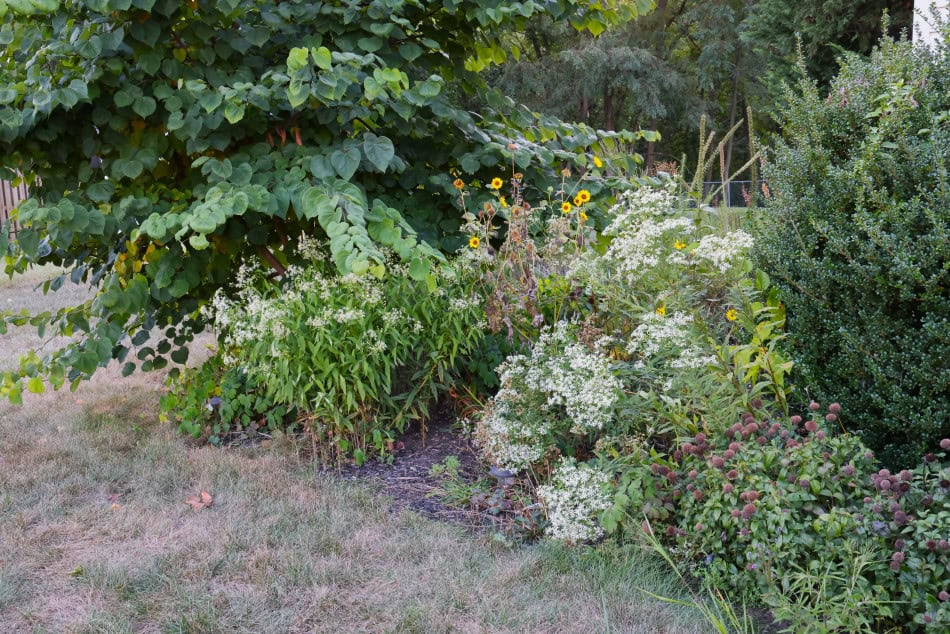
This plant is best suited for either wildflower areas with adequate moisture, or in flower beds provided you take care if it’s propensity to lean or flop. As I stated earlier, the Chelsea Chop is very effective at stopping the ‘arching’ of the stems. Just chop it in early to mid-July by half, and you will prevent it from leaning over.
Companion Plants
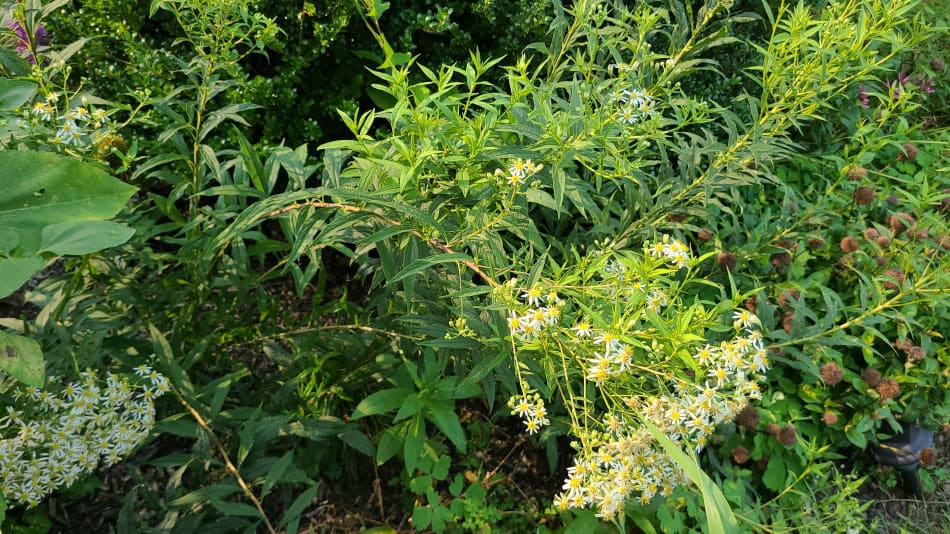
For companion plants, it will grow well with any species that likes a bit of moisture and sunlight. So, there are many candidates. Some examples would include Sneezeweed, Echinacea, Swamp Milkweed, Blue lobelia, and Cardinal Flower. Also, I shouldn’t leave out it’s cousin, New England Aster, which likes almost identical growing conditions!
Medicinal Uses
The Native Americans had two uses for this plant. An infusion of leaves was supposed to help with stomach aches. And the flowers were ‘smudged’ to ward off evil spirits[7].
Final Thoughts
Flat-Topped Aster is one of those natives that doesn’t get much attention. Heck, I bet many native plant gardeners don’t even know it exists. Partly this can be forgiven considering how many different native Asters there are, but also because while pretty, it isn’t a show-stopper on it’s own. That being said, this plant really does a lot for pollinators in terms of nectar and pollen as well as hosting so many species of caterpillar. That combined with it’s toughness and versatility should hopefully increase it’s popularity as native plant gardening gains in popularity.
Find more native plants here
References:
[1] – Doellingeria umbellata (Mill.) Nees, USDA NRCS.
[2] – Picton, Paul. The plant lover’s guide to asters. Portland, Oregon : Timber Press, 1999, pp99
[3] – Haney, Erin. “Doellingeria infirma (Michx.) Greene (Aster infirmus Michx.) Cornel-leaved flat-topped aster.”
[4] – – Federal Highway Division, Ecoregional Revegetation Application (ERA)
[5] – Bertin, Robert I., Daniel B. Connors, and Holly M. Kleinman. “Differential herbivory on disk and ray flowers of gynomonoecious asters and goldenrods (Asteraceae).” Biological Journal of the Linnean Society 101.3 (2010): 544-552.
[6] – Chmielewski, Jerry G., and Sonam Ruit. “Interrelationships Among Achene Weight, Orientation, and Germination in the Asters Doellingeria umbellata var. umbellata var. Symphyotrichum novae-angliae and S. puniceum (Asteraceae).” Bartonia (2002): 15-26.
Doellingeria umbellata, North American Ethnobotany Database.
Recent Posts
Green Milkweed is a herbaceous wildflower native to North America[1], and is a host plant for caterpillars of the Monarch Butterfly[2]. Scientifically known as Asclepias viridis, it grows up to...
Keystone Plants - What Are They, And Why Are They Important?
If you've been researching native plants, you may have come across the term "Keystone Plant" or "Keystone Species". Often spoken or reverence or casually noted for their importance. So, what exactly...