
If you’ve spent anytime researching old hand planes, you’ve undoubtedly come across some comments or forum posts extoling the virtues of Stanley Bedrock Hand Planes. And if you’ve searched out old tools on Ebay, you have also probably noticed the high premium Bedrock planes frequently fetch. So, in this article I will briefly discuss the history of Bedrock planes as well as give you a side by side comparison of them, noting the feature differences and what benefits those would provide.

All of the pictures in this article are either my own, or from public domain patents or catalogs. One thing you will notice is that my Bedrock is one of the earliest types in that the cheeks were still rounded and not ground flat. I still have a bit of restoration to do to it, but it is useable in it’s current condition.
What is a Stanley Bedrock Plane?
Leonard Bailey received his first patent for a plane in 1855, and he largely invented/innovated the designs of what most consider bench or hand planes. If you see any type of bench plane today, it largely resembles a Bench Plane invented by Leonard Bailey.
But, in 1895, a man named Justus Traut, who was working for Stanley & Co. at the time innovated a better method of securing the blade.
This involved increasing the bearing area between the iron and frog, and subsequently the frog and sole. It was more costly to make, but should reduce the chatter. Oh, and it also was easier to move the frog forward or aft by tightening of a screw at the rear base of the frog. And thus was built the Bedrock.
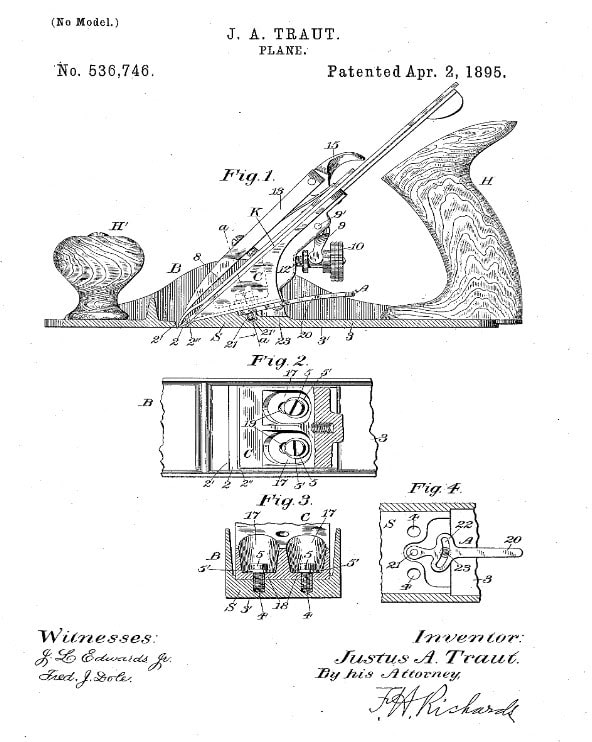
This was a wise move for Stanley, as it now allowed it to sell not only it’s top of the line standard bench planes, but could charge a premium price for a higher end model that would provide a more consistent cut with minimal chatter. It also allowed easier adjustment, and thus can command a higher price. So, now when somebody walks into a hardware store they have options based on their budget. And, like with anything, there are always those ‘guys’ who have to have the top-of-the-line stuff!
All modern ‘high end’ planes are largely copies of Stanley’s Bedrock planes. And this makes sense as discerning users passionate about hand tools are willing to pay top dollar for them. But even the old Bedrock planes command higher prices on Ebay and other sales sites. They are more rare, and they are better than standard bench planes.
Differences between a Bedrock and standard Stanley-Bailey Bench Plane
The primary differences between the standard Stanley Bench Plane and a Bedrock can be found in the sole and the frog. The frog is the name of the piece that holds the blade and is attached to the sole via two screws.
Differences in the sole
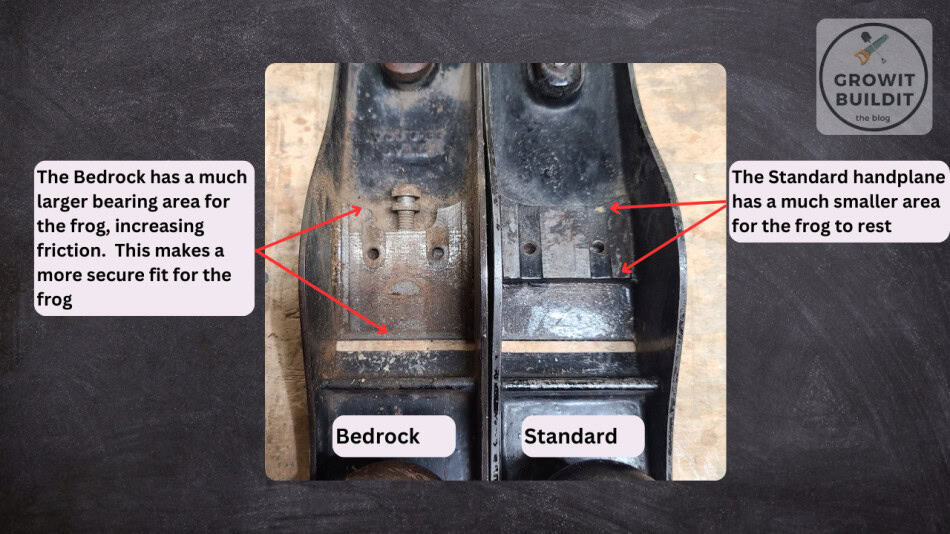
Like the above image shows, the top of the sole is machined flat on Bedrocks, all the way to the mouth. While on standard handplanes, there is a much smaller clamping area for the frog. The idea here is that you will have a more secure frog, and hence a more secure blade. This should reduce the amount of chatter you get on your workpiece.
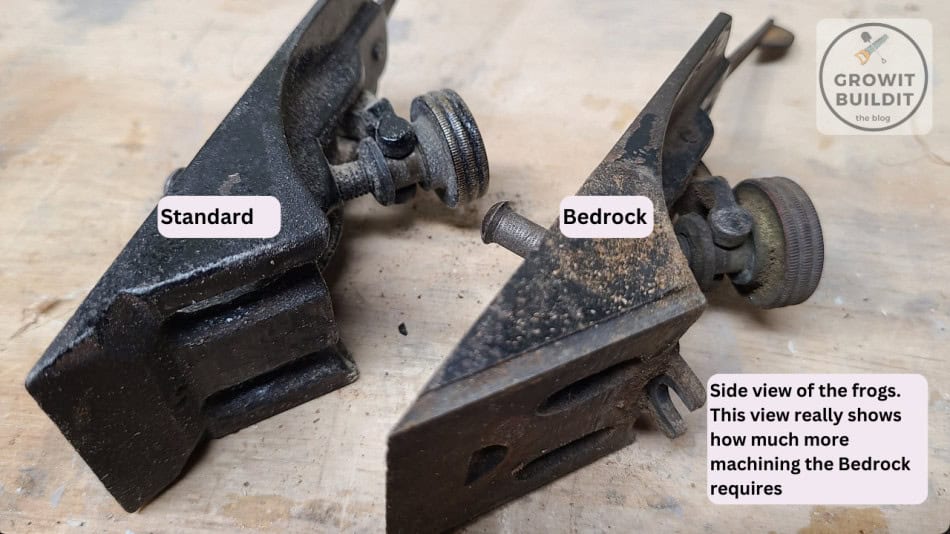
The side profile of the frogs illustrate the fit difference. The bedrock is more secure, and the rear adjustment screw is a really nice feature.

Additionally, the adjustment screw behind the frog makes it really easy to advance/retract the frog, while keeping the frog perfectly square. The regular Stanley bench planes require a bit of finesse to move the frog and keep it square.
How to identify a “Bedrock” plane
Check the numbering
There are two full-proof methods of identifying a Bedrock. First, while the standard bench planes made by Stanley are numbered 1 to 8, the Bedrock numbers are all the same, but you just add 600. So, a 14″ standard plane is a no.5, and a 14″ Bedrock is 605. The earlier models have the 600# in the front. The later models have the number in the back, and the front of the sole will be stamped “BEDROCK”.
Examine the frog and sole
Next, you just need to look at the frog and sole. If the frog is completely flat, and has the adjustment screw, then you have a bedrock. This is the key difference.
Look at the sides of the sole
The pictures I have been showing you are from my one and only Bedrock. And it is one of the earliest models. In later years, sometime in the 1920’s I believe they started trimming the sides of the sole. This is a quick way to visually differentiate the later Bedrocks from the standard bench planes.
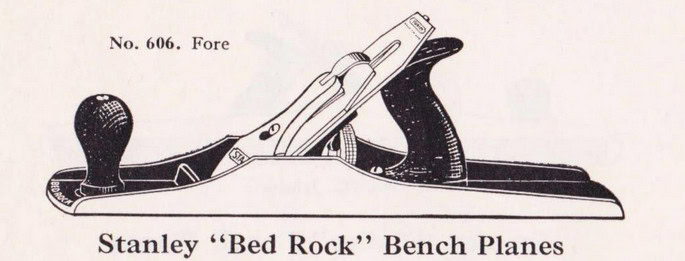
The above image is from Stanley’s 1941 catalog.
Find more DIY here!
Recent Posts
Green Milkweed is a herbaceous wildflower native to North America[1], and is a host plant for caterpillars of the Monarch Butterfly[2]. Scientifically known as Asclepias viridis, it grows up to...
Keystone Plants - What Are They, And Why Are They Important?
If you've been researching native plants, you may have come across the term "Keystone Plant" or "Keystone Species". Often spoken or reverence or casually noted for their importance. So, what exactly...