
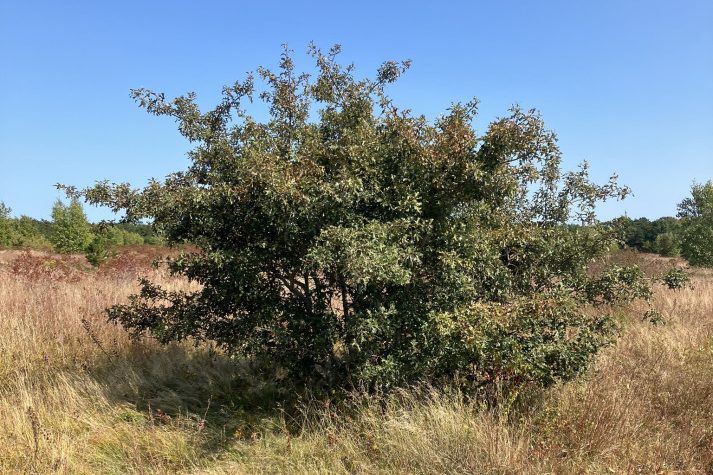
Bear Oak is a deciduous short-lived shrub native to Eastern North America[1]. Scientifically known as Quercus ilicifolia, it grows up to 25′ tall in full sun and well draining soil[2]. An important species for wildlife, it’s acorns feed numerous birds and animals[3], and it’s foliage hosts dozens of species of caterpillar as well as other insects that serve as food for baby birds[4][5].
Although not a famous species of Oak, Bear Oak is one of those ecological workhorses that has quietly evolved over millennia to support so many organisms. It’s importance cannot be overstated, as it is one of the primary colonizers after disturbance like logging or, more importantly, forest fires[2].
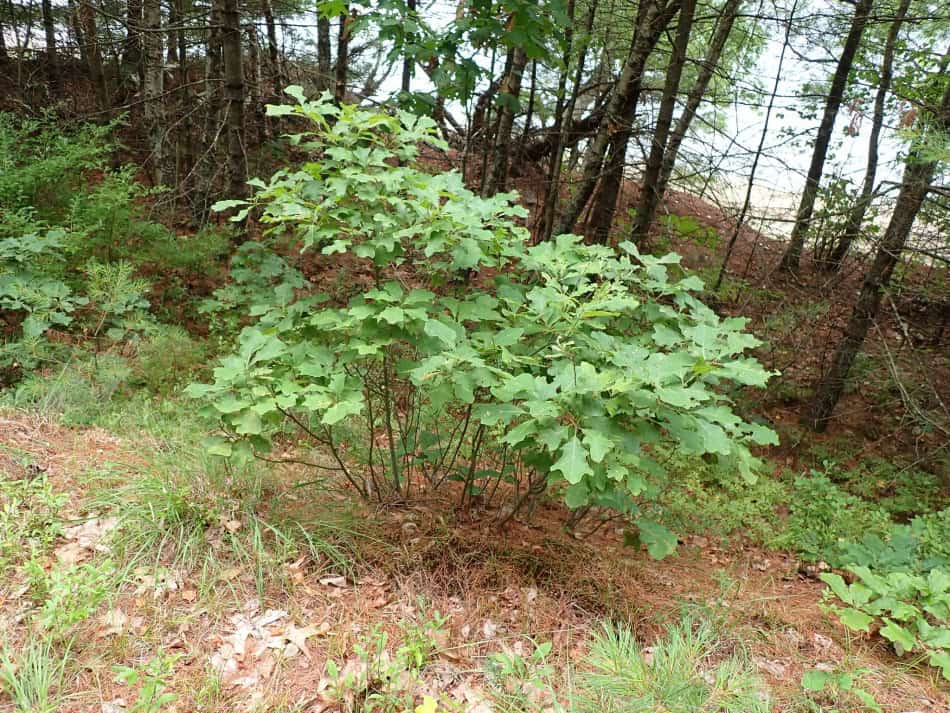
Bear Oak is not impressive to look at, unless you are into irregular branching or (most commonly) thickets. But it can resprout quickly after a fire. One study in Pennsylvania noted that resprouts after cutting continued for at least 12 years[3]. In this way it’s root system acts as a stabilizing force for the soil. But that is not all, as the cover it provides not only helps wildlife, but also prevents soil erosion (when combined by it’s taproot). Another non-obvious benefit of being able to resprout so much is that it can allow it to survive pressure from deer browsing.
Related ==> Looking for a smaller Oak tree that is definitely landscape friendly? Check out our guide for the best Oaks for suburban yards.
And we haven’t even gotten to the food aspect! Sure, most readers of this website are familiar with acorn’s importance as a food source. But unlike most other oaks, Bear Oak can begin producing acorns in as little as three years, with peak production from 5-9 years of age[2][3]. That, combined with it hosting numerous caterpillars and other insects show just how this small-statured shrub is actually an ecological juggernaut! But let’s have a closer look at this plant, as I’ll tell you all you need to know to understand the benefits, how to identify, and grow and care for Bear Oak.
Native Range
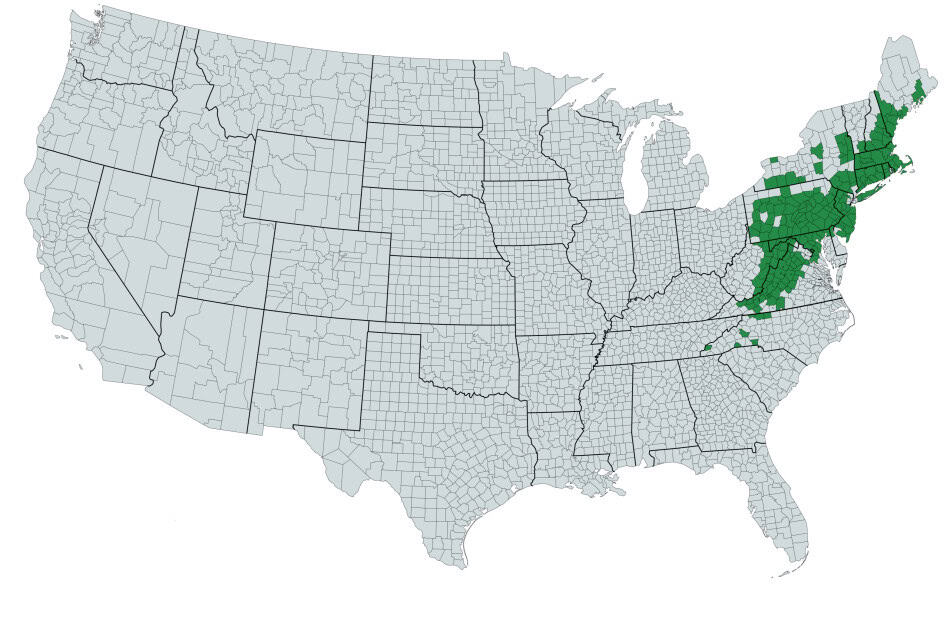
The primary native range of Bear Oak is Eastern North America, from Southern Virginia north to Maine & most of New England and upstate New York. Isolated pockets exist in Southern North Carolina and the Eastern Ontario rock barrens Northwest of Kingston, Canada.
Reference Table
| Scientific Name | Quercus ilicifolia |
| Common Name(s) | Bear Oak, Scrub Oak, Black Scrub Oak |
| Native Range, USDA Zone | Eastern North America, USDA Hardiness Zones 4-8 |
| Bloom Time | Spring |
| Bloom Duration, Color | 2-4 weeks, red/purple |
| Height | 10-25′ |
| Spacing / Spread | 10′ |
| Light Requirements | Full sun to part-sun |
| Soil Types | Well draining, shallow, rocky |
| Moisture | Dry to medium-moisture |
| Fauna Associations / Larval Hosts | Numerous animals/birds eat the acorns / Hosts 30 species of moth/butterfly |
Pros and cons
Pro
Making acorns when young
Bear Oak can begin producing acorns as young as three years old! This is far quicker than larger, more well known Oaks like Red Oak or Pin Oak who can take 15 years.
Short
Topping out at only 25′ tall (but often shorter at 10-15 feet), Bear Oak is one of the shorter Oak species. This gives it the possibility to be used in residential landscaping.
Wildlife
Oh where to begin…the acorns feed bear, deer, mice, squirrels, and birds….the leaves feed caterpillars and other insects, which are themselves food for birds! Really though, all Oaks are Keystone species in that they anchor the entire food web together. The more of these you have growing near you, the better the food supply for all native wildlife.
Drought tolerant
Evolving on shallow rocky slopes, Bear Oak thrives in well-draining conditions. It can grow from medium-moist to dry conditions.
Erosion control
The ability of Bear Oak to grow in shallow soils combined with it’s taproot make it good at erosion control. It not only provides cover, but the roots will help hold the soil.
Con
Short lived
Unfortunately this shrub is very short lived, only living 20-30 years. So, while there are other Oaks that regularly exceed 300 years (like White Oak), this one is small in stature and in lifespan. But, when you consider it grows in fire-prone areas (and resprouts readily from fire), the shorter lifespan makes a bit more sense. That, and that it readily colonizes disturbed areas that have just had a fire or been heavily logged.
Scraggly
Depending on your preferences, this feature may actually be a pro. But, the branching is quite irregular and non-uniform. So, if you are looking for a well-manicured tree….this ain’t it.
Identification and Characteristics
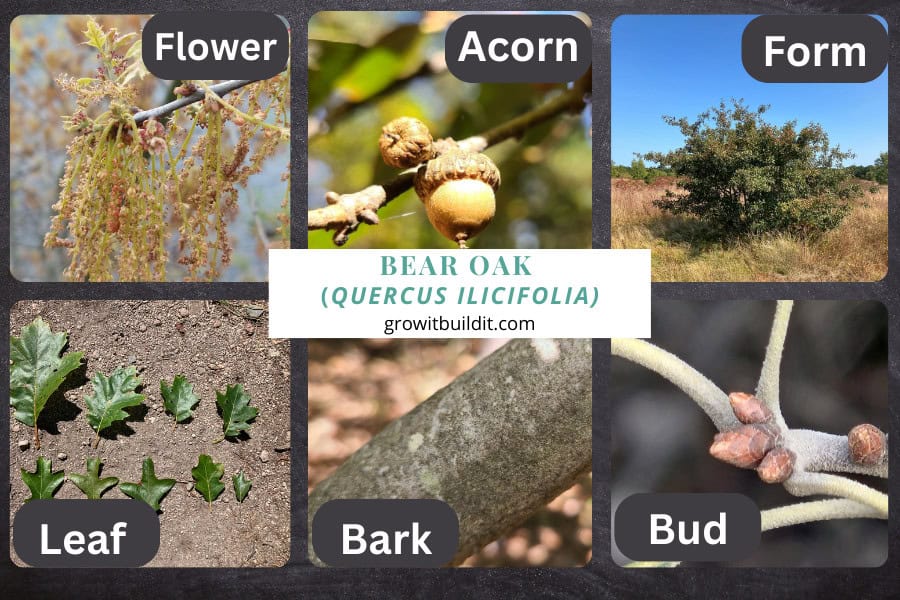
Trunk
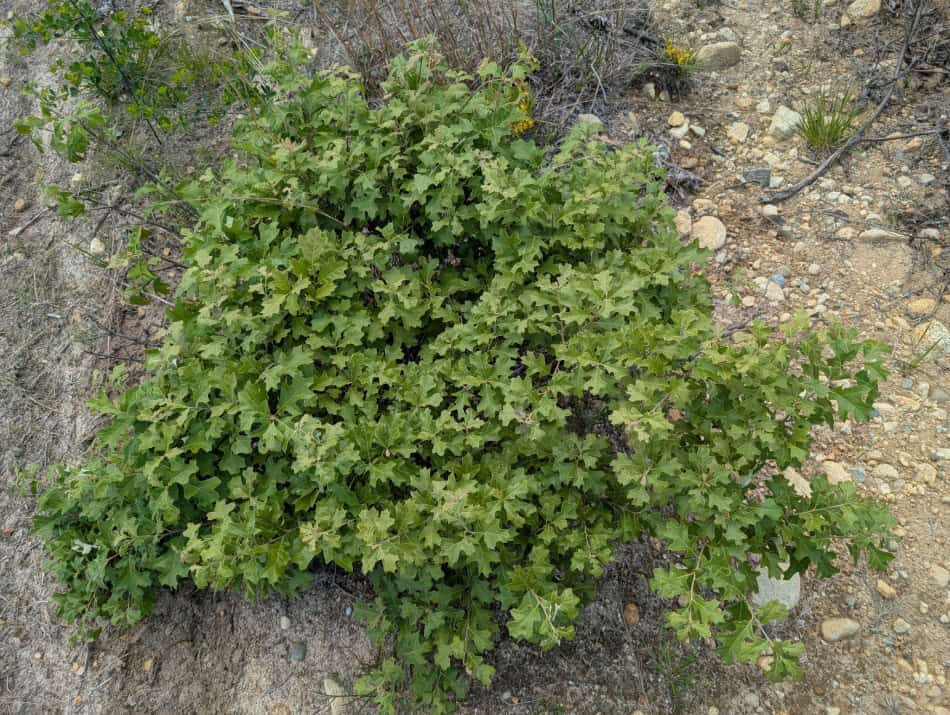
This is a thicket forming shrub or small tree. The branching will be irregular Overall height in the 10-15′ tall in partial shade, while in the open it can grow to 25′ tall.
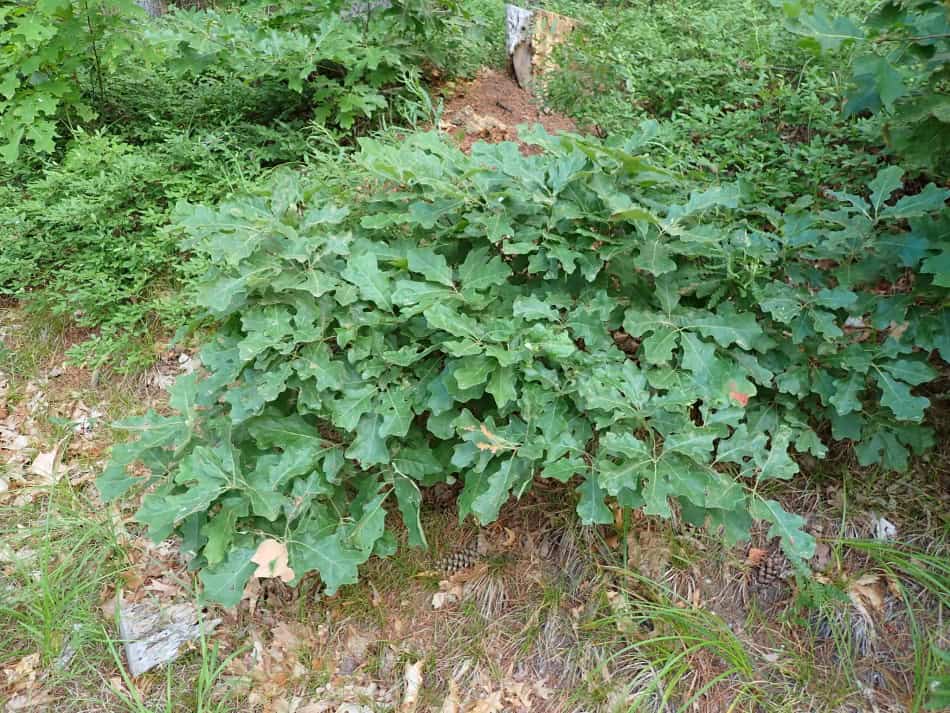
Bark
The bark is smooth and gray with some small white spots (lenticels).
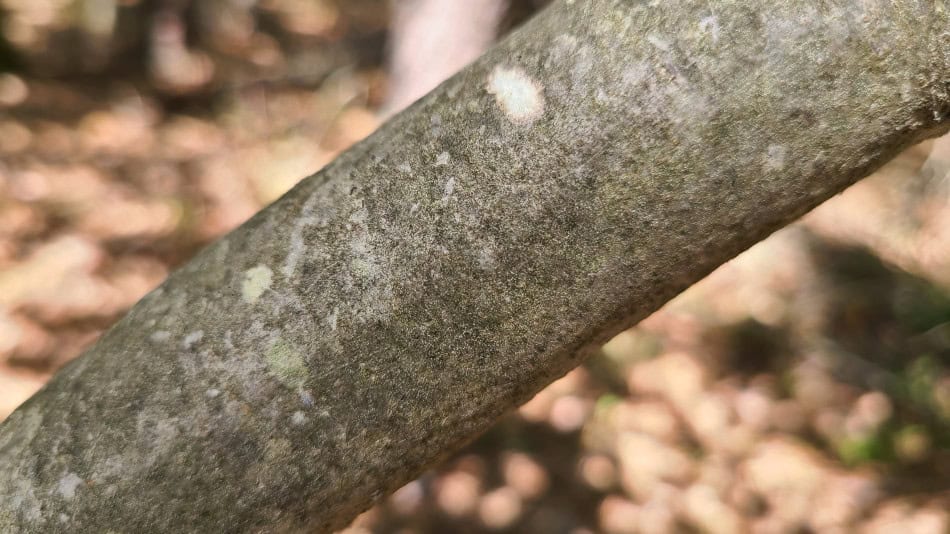
Leaf
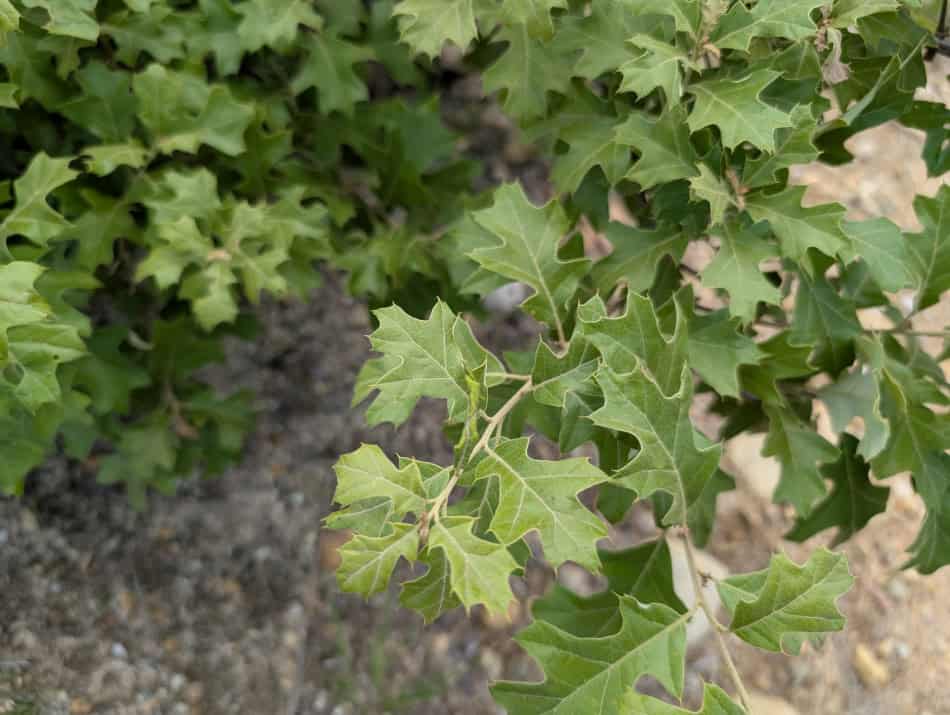
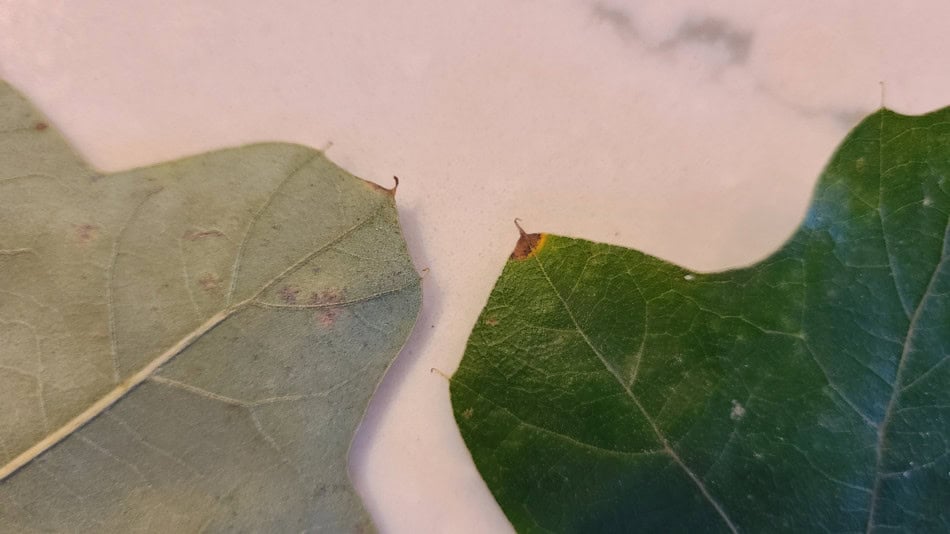
Leaves are alternate, up to 5″ long by roughly half as wide, obovate in shape, and 5-9 lobes that have bristles at the tip. The leaves are glossy dark-green on the upper side and pale on the underside, and fuzzy to the touch. In Autumn, leaves will turn to a orange-brown color.
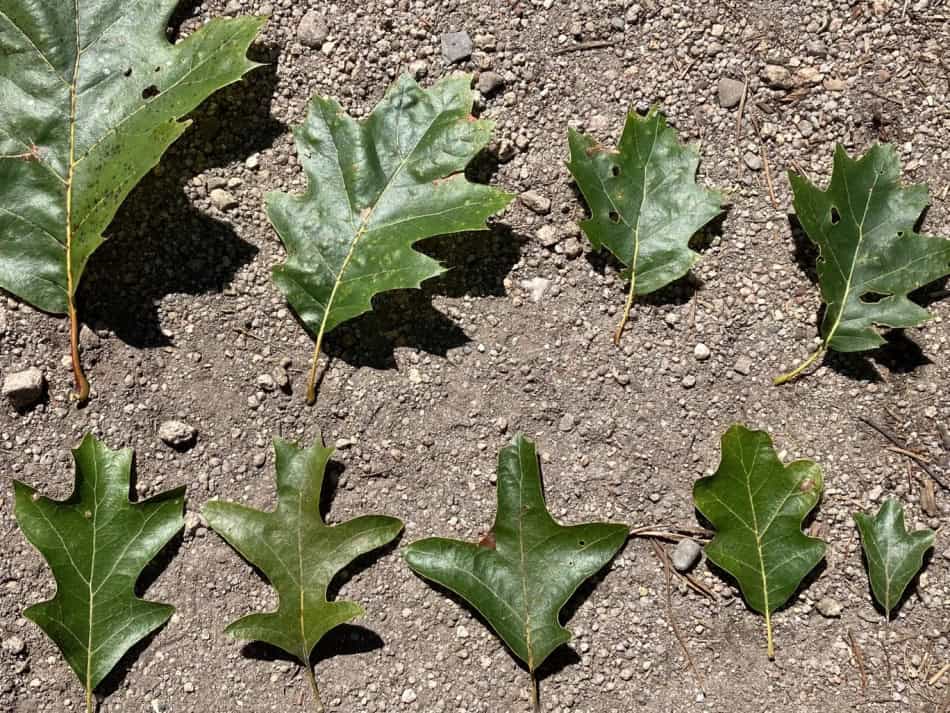
Flower
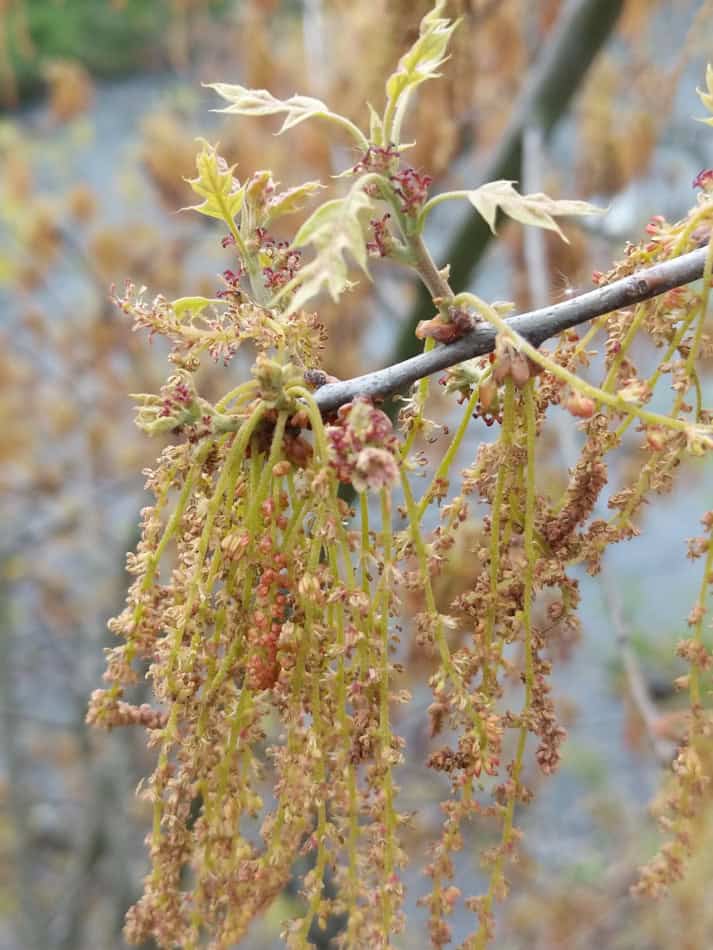
Flowers are 2-4″ purple to red/green catkins. They are pollinated by the wind.
Acorns
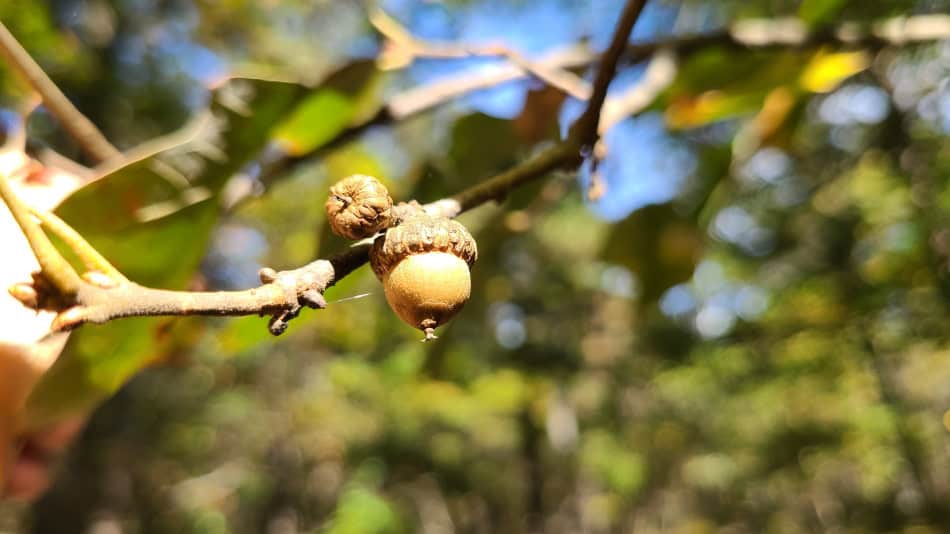
Acorns take two full seasons to mature. When they are ready, they mature in late summer to early Fall. These are smaller egg-shaped acorns, 3/8-1/2″ long, and the cap will cover about 1/2 of the nut.
Root
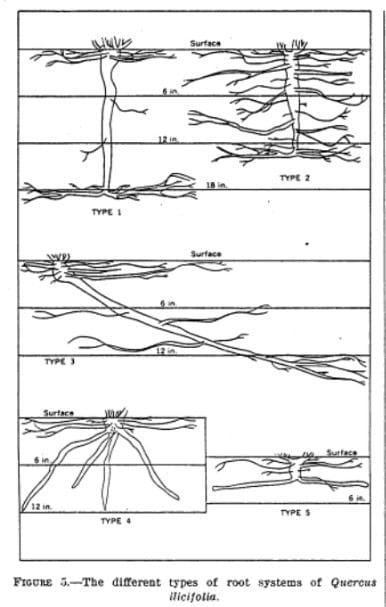
The root system is a very large taproot. In 1967 Bear Oak was excavated in New Jersey to study the root structure (Laycock, 1967). They found a “thickened, often irregular” taproot that ranged from 2-7″ thick. Different styles of taproot were found. One type was the initial portion of the taproot was straight down up to 36″, having most lateral roots near the surface. Others forked or grew at oblique angles, which would make sense given the rocky nature of Bear Oak’s natural habitat. Click on the image at right to see the sketches of the root system from their study[6].
One other interesting observation they made was that the root system will not grow into the water table. They noted this characteristic even when the water table was near. So, this lends further evidence that Bear Oak needs well draining soil, and probably cannot tolerate any flooding.
Growing Conditions
Sunlight Requirements
Pretty much every reference I’ve found stated that Bear Oak needs full sun to grow. However, I have personally observed numerous specimens 10-15′ tall along the Appalachian Trail in Pennsylvania, in what I would describe as part-sun (at best). In dense understory this would likely be shaded out.
Soil Requirements
This plant thrives on shallow rocky soils. Like the Eastern Red Cedar, it is shade intolerant and will be out-competed by taller species (Pine, Maple, Oak, Hickory). That being said, it’s soil must drain well.
Moisture Requirements
This shrub does best in dry to medium-moist areas provided the soil drains!
Maintenance
Pruning can occur in late winter, before insects are active. Should any branches break during the regular growing season, wrap them in shade cloth/twine to prevent insects from landing on open wounds.
Fertilizer
Do not fertilize Bear Oak. It does not need it, and will grow fine in poor soils.
How to Grow Bear Oak from Seed
Bear Oak, being in the Red Oak group needs a cold-moist stratification period to break dormancy. Studies have shown that six weeks will yield a germination rate of roughly 50% for viable acorns. But, if you collect acorns of Bear Oak, make sure that the acorns will be viable! Please inspect them and perform the float test. See my article on germinating acorns from seed for more detailed info.
Wildlife, Pests, and Diseases associated with Bear Oak
Wildlife
Bear Oak is an incredibly important species for wildlife. The acorns feed numerous mammals and birds including Bear, Deer, Fox, Mouse, squirrels[3][7][8]. When it comes to pollinators, some are actually noted for feeding on pollen (Bombus sp.). But more importantly, Bear Oak is known to host at least 30 species of moth[4].
Other insects
In addition to pollinators, over 40 other species of plant bug have been found on Bear Oak. These also serve as food for birds and their young[3].
Birds
Numerous birds feed on acorns from Bear Oak. This includes Blue Jays, Turkey, and several species of Woodpecker[8].
Deer and Rabbits
Deer will browse young stems from Bear Oak[7]. Rabbits often chew on the bark of young stems during the winter too. Protect your plants!
Disease
Bear Oak is subject to the various diseases and ailments that effect all oaks late in the season. The leaves will eventually look a bit rough, and may have various fungal or leaf spot. These are not a major concern though. The big thing to look out for is Oak Wilt.
Where you can buy Bear Oak
Bear Oak is not typically sold in nurseries, as it isn’t a typical ‘garden friendly’ plant. But it can be purchased at specialty nurseries that deal in Native Plants. You can find native plant nurseries near you on our interactive map.
Where to buy seeds
We have ordered a variety of native flower seeds from Everwilde Farms, which you can order right from Amazon through our link on our RECOMMENDED PRODUCTS PAGE. (We may earn a small commission when you purchase through our links, at no cost to you. This helps support our website.)

Uses of Bear Oak
Landscaping
Scrub Oak will often form a thicket if left to it’s own devices. However, it can grow into a smaller tree in the open, and with a bit of pruning help. Just note that it is not long-lived, and will only last 20-30 years. I plan to experiment on one over the next several years in my own yard, just to observe it’s growth habits.
Companion Plants
Scrub Oak needs sun, and well-draining soil. So, it would do well with any plant that tolerates similar conditions. Aromatic Aster, Blueberry, Black Raspberry, Mountain Mint, Hairy Beardtongue or Foxglove Beardtongue come to mind as excellent companion plants. For grasses, it would do well with Side Oats Grama or Little Bluestem.
Medicinal Uses
The Irioquois used it as a wash for ‘female troubles’ and as a ‘sugar medicine’. Although details are scant, it is most likely referring to the bark as the ingredient[9].
Final Thoughts
Although not one of the more popular Oak species, Bear Oak has certainly evolved to earn it’s place in our ecosystem. The amount of wildlife fed by this inconspicuous shrub is immense, and often hidden from what we would normally perceive. What is less obvious from causal nature observers is it’s importance in recolonizing burned or logged areas. The cover it provide not only helps birds/mammals, but protects the soil from erosion. Yes, good things come in small packages, and in this regard Scrub Oak certainly has shown it’s value.
Find more native plants here
References:
[1] – Quercus ilicifolia Wangenh. bear oak. USDA NRCS. Accessed 14DEC2025
[2] – Quercus ilicifolia. Fire Effects Information System (FEIS), US Forest Service. Accessed 14DEC2025.
[3] – BARRENS, PITCH PINE-SCRUB OAK. “PLANT BUGS OF QUERCUS ILICIFOLIA: MYRIADS OF MIRIDS (HETEROPTERA) IN.” JOURNAL OF THE NEW YORK ENTOMOLOGICAL SOCIETY 99: Accessed 14DEC2025
[germination] – Barden, L. S. “BEAR OAK (QUERCUS-ILICIFOLIA) IN NORTH-CAROLINA.” Castanea 50.2 (1985): 121-123.
[4] – – Federal Highway Division, Ecoregional Revegetation Application (ERA)
[5] – Catling, Paul M; Brownell, Vivian R. 1999. The flora and ecology of southern Ontario granite barrens. In: Anderson, Roger C.; Fralish, James S.; Baskin, Jerry M., eds. Savannas, barrens, and rock outcrop plant communities of North America. New York: Cambridge University Press: 392-405.
[6] – Laycock, William A. 1967. Distribution of roots and rhizomes in different soil types in the Pine Barrens of New Jersey. Geological Survey Professional Paper 563-C. Washington, DC: U.S. Department of the Interior, Geological Survey. 29 p.
[7] – CUIVIMING, JAMES A. “Prescribed burning on recreation areas in New Jersey: history, objectives, influence, and technique.” (1969).
[8] – DeGraaf, Richard M., and Mariko Yamasaki. New England wildlife: habitat, natural history, and distribution. Upne, 2001.
[9] – Quericus ilicifolia, North American Ethnobotany Database. Accessed 14DEC2025.
Recent Posts
Green Milkweed is a herbaceous wildflower native to North America[1], and is a host plant for caterpillars of the Monarch Butterfly[2]. Scientifically known as Asclepias viridis, it grows up to...
Keystone Plants - What Are They, And Why Are They Important?
If you've been researching native plants, you may have come across the term "Keystone Plant" or "Keystone Species". Often spoken or reverence or casually noted for their importance. So, what exactly...